
What documented Nasta'liq calligraphy looks like
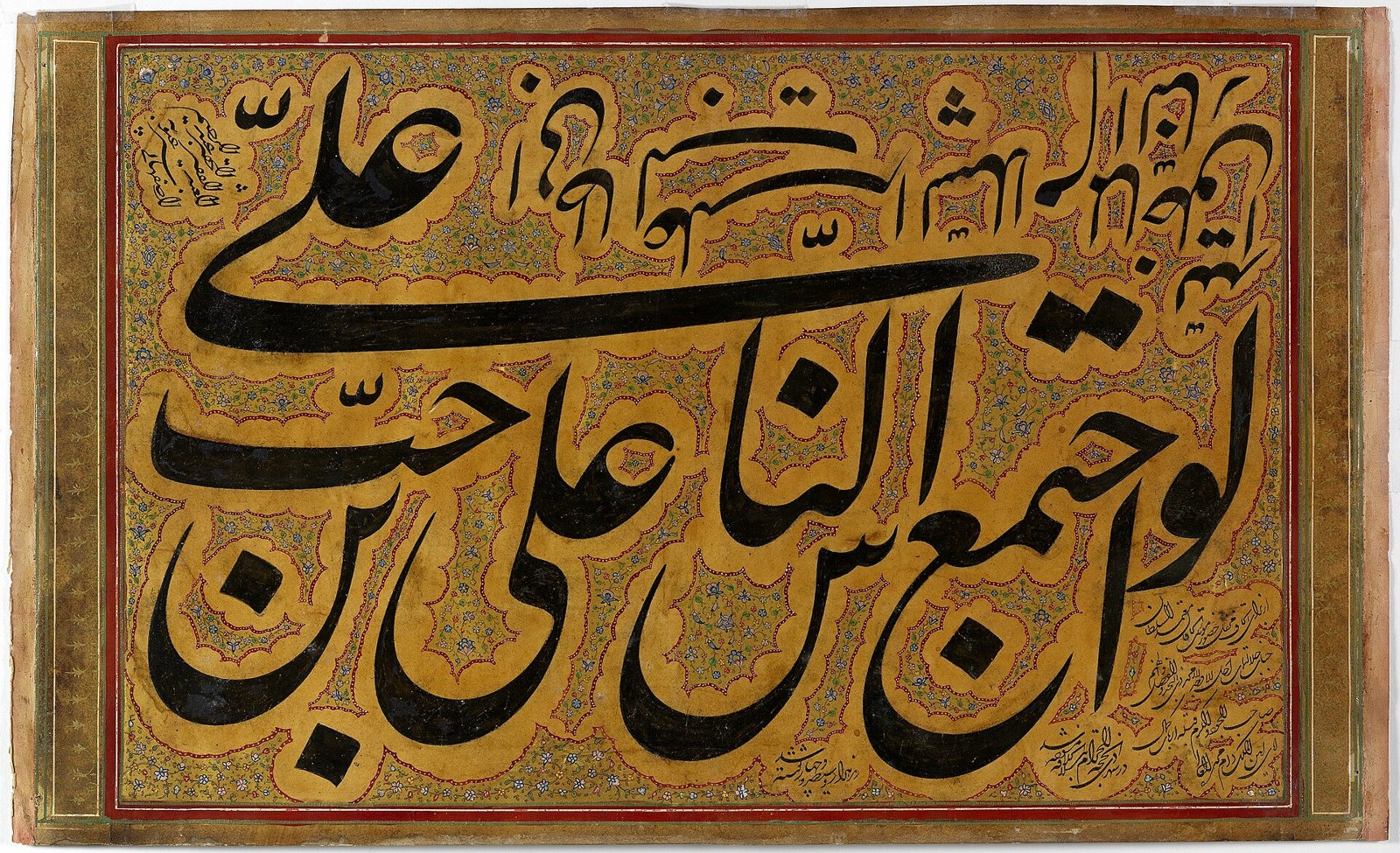
Reference photographs of documented Nasta'liq calligraphy pieces, credited to their sources. Compare construction, surface and wear with any piece you are offered — a resemblance is not proof of origin.
Nasta'liq calligraphy at a glance
| Persian name | نستعلیق |
| Category | Calligraphy · Script |
| Main techniques | tazhib-illumination |
| Typical materials | paper |
| Places of making | shiraz, isfahan, tabriz |
| Current vitality | Living tradition |
Understanding Nasta'liq calligraphy
What Nasta'liq calligraphy is and how it is made
Definition
Nasta'liq is written with a reed pen cut to a fine oblique nib. Its proportions are taught as fixed ratios expressed in nib-widths, so a letter is judged against a measurable standard rather than by impression.
History
Tradition credits the script's formalisation to Mir Ali Tabrizi in the late fourteenth century, an attribution repeated in many sources but not securely documented. It became the standard hand for Persian poetry and remains closely tied to literary manuscripts.
Tools and materials
Reed pens, a knife and cutting block, soot-based ink, burnished and often sized paper, and a silk-padded inkwell liner that regulates ink flow.
General background on the craft, not a statement about any individual object; dates and attributions summarise common positions in the literature and remain under review. Read the full Nasta'liq calligraphy entry.
Before you buy: what to inspect
- Original calligraphy shows the pen's ink pooling and slight unevenness in stroke; prints and digital outputs are flat and uniform.
- Look for the signature (ketabat) and date, and compare with the calligrapher's known works.
- Check the paper and any illuminated borders: are they original to the panel or added later?
Typical materials: paper.
Red flags: copies and 'Persian style' imports
- Prints or giclées sold as original calligraphy.
- Famous signatures on undocumented works.
- Old manuscript pages with modern printed text.
A genuine Nasta'liq calligraphy piece should come with a named place of making in Iran (often shiraz, isfahan, tabriz) and a clear statement that it is handmade.
Questions to ask the seller
- Is this an original work in ink?
- Who is the calligrapher, and is it signed?
- Is there documentation of exhibition or sale?
What affects the price
| Original versus print |
| Calligrapher |
| Size and complexity |
| Age and documentation |
Care and cleaning
- Frame behind UV-filtering glass.
- Keep out of direct sunlight and away from damp.
- Handle with clean, dry hands at the edges.
Storage
- Store flat in acid-free folders.
- Keep humidity stable.
Shipping
Ship flat between rigid boards, or rolled only if the maker agrees.
Disclaimer
This guide is educational. It cannot confirm that any particular object is genuine, old or valuable. For important purchases, ask an independent specialist. Read the full Nasta'liq calligraphy entry.