
What documented Persian lacquer painting looks like
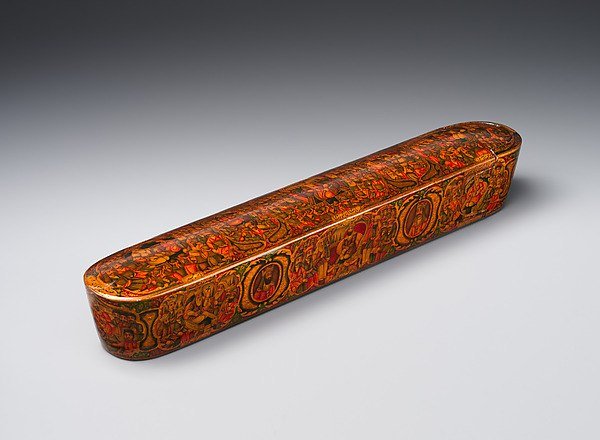
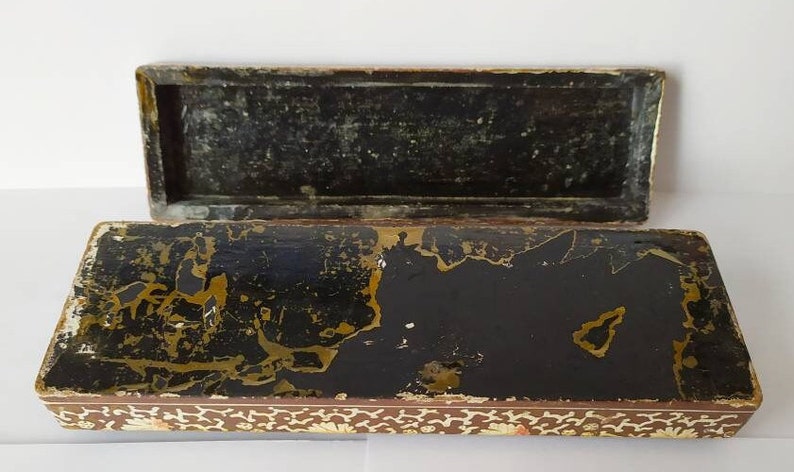
Reference photographs of documented Persian lacquer painting pieces, credited to their sources. Compare construction, surface and wear with any piece you are offered — a resemblance is not proof of origin.
Persian lacquer painting at a glance
| Persian name | لاکیکاری |
| Category | Painting · Decorative lacquer |
| Main techniques | painted-lacquer-finishing |
| Typical materials | paper, lacquer |
| Places of making | isfahan, shiraz |
| Current vitality | At risk |
Understanding Persian lacquer painting
What Persian lacquer painting is and how it is made
Definition
Persian lacquer painting decorates small objects, most often pen boxes, mirror backs, jewellery boxes and book covers, formed from papier-mâché or thin wood, with painted scenes or floral ornament and then protected by successive coats of clear varnish that give the surface its characteristic glossy depth.
The painting itself draws heavily on the conventions of Persian miniature painting, including fine figural and courtly scenes, alongside a strong tradition of gol-o-morgh, flower-and-bird compositions, particularly on mirror cases and smaller decorative objects.
History
Painted and lacquered small objects are documented in Iran from the Safavid period, when pen boxes and bookbindings were decorated with fine miniature painting under a protective varnish, connecting the craft closely to the book arts and to miniature painting workshops of the period. Production expanded in the Qajar period, when lacquered pen boxes, mirror cases and larger decorative panels became popular among a wider range of patrons, and painters developed distinct regional styles.
Through the twentieth century, lacquer painting continued as a specialist craft, with some workshops maintaining fine miniature-style painting on traditional forms while a broader market developed for simpler floral-decorated boxes aimed at general buyers, a divide that persists in the range of quality found in the craft today.
Materials
The object base is typically papier-mâché, built up from layered paper and glue over a mould and sanded smooth, though wood is also used for some forms. A ground layer, fine painting in gouache or similar media, and multiple coats of clear lacquer varnish complete the object, with polishing between coats to build up a smooth, glassy finish.
- Papier-mâché or wood base, shaped and sanded
- A prepared ground layer to take fine painted detail
- Gouache or comparable fine painting media for the design
- Multiple coats of clear varnish, polished between applications
General background on the craft, not a statement about any individual object; dates and attributions summarise common positions in the literature and remain under review. Read the full Persian lacquer painting entry.
Before you buy: what to inspect
- Persian lacquer painting is painted on papier-mâché or wood and sealed under layers of varnish; look for depth in the varnish and brushwork beneath it.
- Printed paper transfers under varnish show a dot pattern under magnification and no brush texture.
- Check corners, hinges and edges for cracks, lifting varnish and old repairs.
Typical materials: paper, lacquer.
Red flags: copies and 'Persian style' imports
- Printed transfers sold as hand-painted lacquer.
- Plastic or resin boxes sold as papier-mâché.
- Undocumented 'Qajar' attributions on new pieces.
A genuine Persian lacquer painting piece should come with a named place of making in Iran (often isfahan, shiraz) and a clear statement that it is handmade.
Questions to ask the seller
- What is the base: papier-mâché or wood?
- Was the decoration painted by hand?
- Who painted it, and is it signed?
What affects the price
| Fineness of painting |
| Age and attribution |
| Size |
| Condition of the varnish |
Care and cleaning
- Dust with a soft, dry cloth; never wet-clean or use solvents.
- Keep away from direct sun, heat and damp, which crack varnish.
Storage
- Store in a stable, moderate humidity; avoid attics and cellars.
Shipping
Pad all sides; papier-mâché and lacquer crack under pressure.
Illustrative examples in the archive
- Antique Persian Lacquered Qalamdan (Pen box) Handpainted with Flowers & Vines · Illustrative example · not for sale here
Disclaimer
This guide is educational. It cannot confirm that any particular object is genuine, old or valuable. For important purchases, ask an independent specialist. Read the full Persian lacquer painting entry.