
Carpets & rugs
Vintage Persian Rugs: Identification, Origins, and Buying Guide
Learn how to identify, evaluate, and care for genuine vintage Persian rugs. Understand mid-century Iranian weaving, natural patina, and how to avoid fakes.
Published 6 October 2026 · 12 min read
AI-written from our archive and public references; not expert reviewed. Prices, dates and attributions are indicative only — confirm with a specialist.
A vintage Persian rug is a hand-knotted carpet produced in Iran roughly between 30 and 99 years ago, representing a distinct era of mid-twentieth-century workshop, village, and nomadic craftsmanship. Unlike pristine modern production or fragile museum-era antiques, genuine vintage pieces offer softened wool, subdued color harmony through natural oxidation, and historical character that withstands everyday living. Navigating this market requires an eye for structural integrity, an understanding of regional dye shifts, and the knowledge to separate naturally aged carpets from chemically altered imitations.
The vintage category has surged in global popularity over recent decades, driven by interior designers and collectors who value individual expression over mass-manufactured uniformity. However, the term 'vintage' is frequently misused across online marketplaces, where modern power-loomed replicas, aggressively bleached discards, and imported knock-offs are routinely mislabeled. Exploring the origins, weave structures, and material behavior of genuine vintage Iranian rugs empowers you to make an informed, confident acquisition.
What defines a vintage Persian rug?
In the international carpet market, age classifications follow clear conventions. An antique carpet must be at least 100 years old, meaning any piece woven prior to the late 1920s qualifies as antique. A contemporary carpet has generally been woven within the last 20 to 30 years. Vintage rugs occupy the pivotal period between these milestones: pieces hand-tied predominantly from the 1930s through the late 1980s.
This chronological boundary matters because weaving conditions in Iran changed dramatically across the 20th century. During the interwar and mid-century periods, carpet production remained largely domestic and decentralized. Weavers relied heavily on hand-spun local wool rich in natural lanolin, paired with traditional vertical looms in cities or collapsible horizontal looms among pastoralist tribes. As international commerce expanded after the Second World War, Iranian weaving saw both an expansion of commercial city workshops and a steady continuation of tribal utilitarian weaving. To understand where these textiles fit into the broader tradition, explore our comprehensive guide to the [Persian carpet](/encyclopedia/persian-carpet).
| Category | Age Span (Approximate) | Yarn & Foundation | Typical Market Role |
|---|---|---|---|
| Antique | 100+ years (pre-1925) | Hand-spun wool, natural dyes dominant, cotton or wool foundation | High-end collector, auction houses, museum display, careful low-traffic use |
| Vintage | 30 to 99 years (c. 1925–1995) | Hand-spun or machine-spun wool, chrome and natural dyes, cotton foundation common | Daily residential use, functional decor, accessible historical collecting |
| Contemporary | Under 30 years (post-1995) | Machine-spun or hand-spun wool, modern synthetic dye formulas, varied foundations | Modern retail, bespoke interior commissions, new production |
| Artificial Vintage (Altered) | Often recent (1–20 years) | Chemically stripped modern rugs, sheared low, overdyed with industrial pigment | Fast-fashion home trends; brittle fibers with compromised longevity |
Mid-century Iranian weaving: Why vintage pieces look different
Mid-century vintage Persian carpets exhibit aesthetic and structural traits distinct from both 19th-century tribal weavings and 21st-century production. Between 1940 and 1975, economic expansion and modernization within Iran led to structural adjustments in carpet manufacturing. Urban carpet master workshops (known as *ostadan*) in cities like Isfahan, Nain, and Tabriz formalized design cartoons (*taqsheh*), yielding balanced symmetry and exceptionally crisp central medallions.
Concurrently, rural and nomadic communities preserved their ancestral, spontaneous weaving practices. The pastoral tribes of Fars, the Bakhtiari confederation, and the Kurds of northwest Iran continued creating textiles without paper cartoons, memorizing ancient geometric motifs passed maternally across generations. You can discover more about these spontaneous, vibrant styles in our overview of [nomadic weaving of Iran](/learn/nomadic-weaving-of-iran).
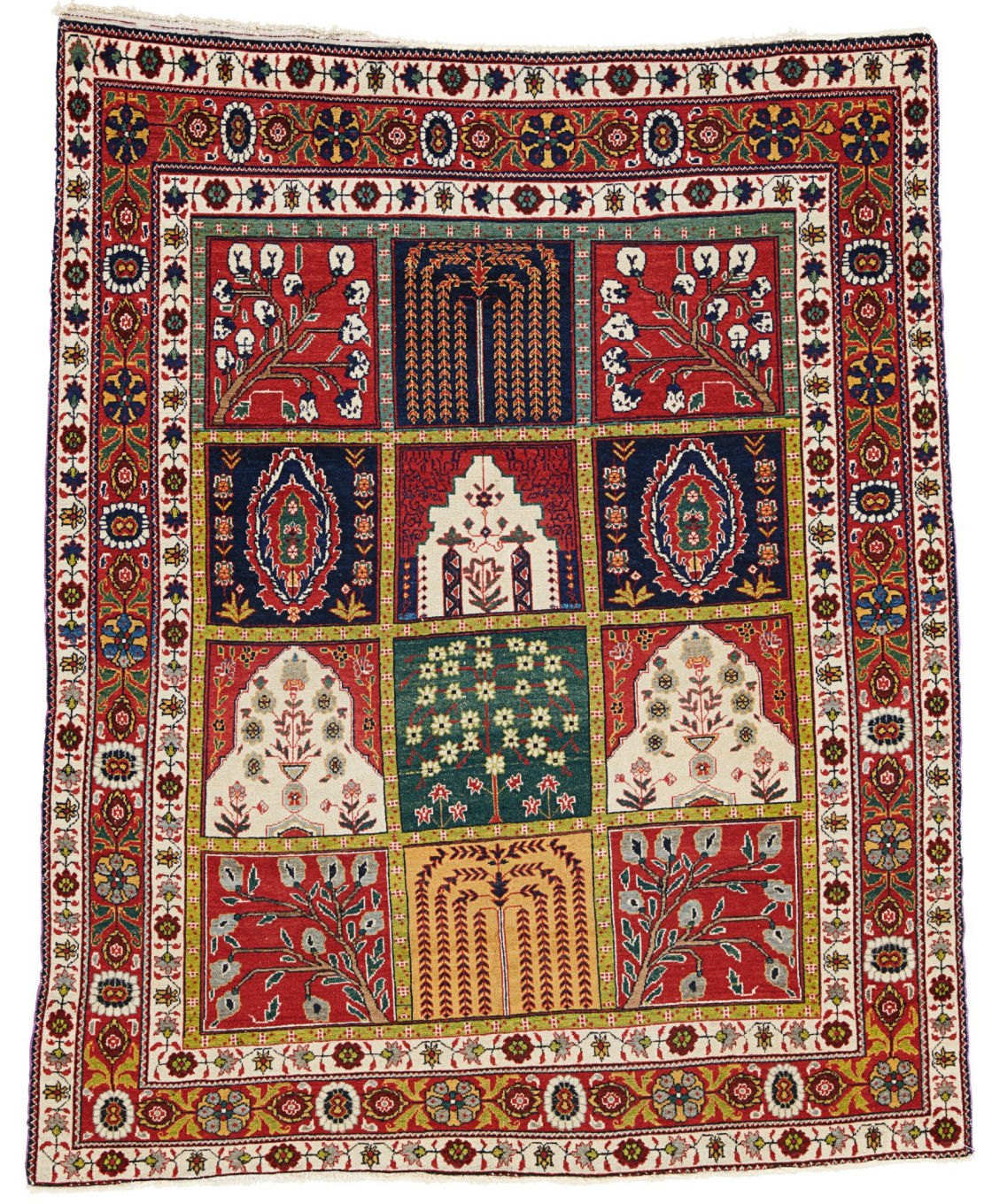
Dye technology also marks mid-century rugs. While 19th-century carpets relied almost universally on madder, indigo, weld, and walnut husks, mid-century weavers operated in a transitional dye landscape. By the 1940s, high-quality synthetic chrome dyes had established a firm presence alongside regional plant-based baths. These mid-century synthetic formulations yielded rich, lightfast hues that mellowed over decades without dissolving into the muddy grays sometimes seen in poorly dyed transitional wares.
Natural patina versus artificial chemical distressing
The defining hallmark of an authentic vintage Persian rug is patina. Patina is not damage or dirt; it is the physical transformation of sheep's wool under years of friction and light. As generations walk across a hand-knotted pile, wool fibers are microscopically burnished, releasing lanolin and smoothing out raw microscopic scales. The result is a tactile suppleness and a soft, low-angle sheen that new wool cannot replicate.
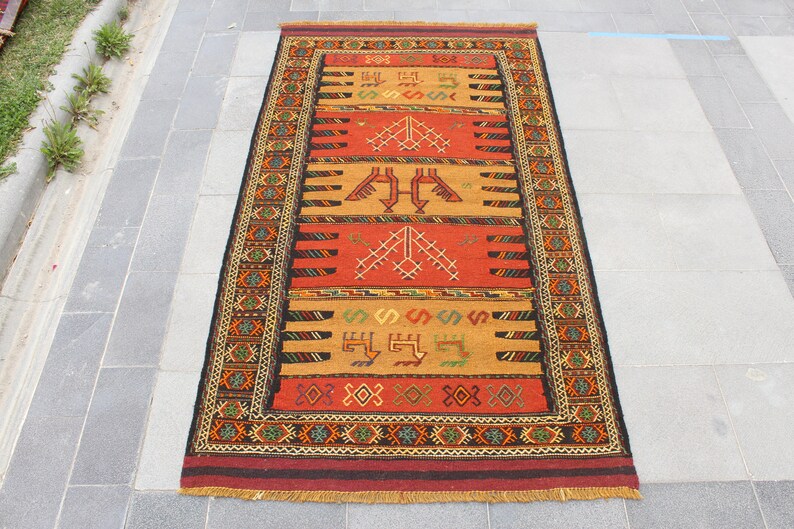
Moreover, genuine vintage pieces often exhibit *abrash*—horizontal banding caused by minor variations in yarn dye batches or seasonal water composition during hand-dyeing. Over decades of ambient light exposure, these distinct wool batches age at slightly varying rates, resulting in rhythmic, organic color transitions across fields of terracotta, indigo, or ivory.
To verify whether patina is genuine, inspect the base of the tufts. Part the pile down to the foundation warp and weft. In a naturally aged rug, the wool at the tip may be slightly softer or more mellow than the deeper wool near the knot core, but the transition is gentle. In an acid-washed or chemically stripped rug, the color shift looks bleached out across the surface while smelling faintly of sulfur or household pool chemicals.
Key regional styles to explore on the vintage market
When browsing vintage Persian rugs in the United States, you will encounter carpets originating from dozens of distinct weaving clusters. Each region developed its own unique structural formula, wool selection, and design repertoire during the mid-20th century.
Prominent regional vintage styles
- Heriz & Serapi (Northwest Iran): Renowned for their heavy geometric medallions, stepped corner spandrels, and astonishing resilience. Woven on thick cotton foundations with durable, mountain-pastured wool, vintage Heriz pieces are celebrated centerpieces in busy households.
- Kashan (Central Iran): Classic workshop weaving characterized by swirling floral arabesques, central teardrop medallions, and deep midnight-navy or crimson grounds. Mid-century Kashans often feature fine Kurk wool with dense knotting.
- Tabriz (Northwest Iran): Highly structured workshop carpets utilizing symmetric Turkish knots. Vintage Tabriz rugs display intricate Shah Abbas florals, hunting motifs, or medallion layouts, classified by knot-per-unit metrics (*raj*).
- Tribal Fars & Qashqai (Southwest Iran): Village and nomadic pieces utilizing lustrous wool foundations or mixed cotton-wool warps, decorated with stylized birds, rosettes, and stepped lozenges woven entirely from memory.
- Bakhtiari (Zagros Mountains): Celebrated for the iconic *khesti* or garden panel design, dividing the field into square or diamond compartments filled with weeping willows, cypresses, and birds.
Buyers drawn to geometric boldness and structural endurance often gravitate toward northwest Iran. Read our comprehensive analysis of [Heriz rugs](/learn/heriz-rugs-guide) to understand how their copper-rich water and resilient sheep fleece produce some of the most robust vintage rugs available. Conversely, those seeking curvilinear elegance usually prefer the floral density described in our guide to [Kashan rugs](/learn/kashan-rugs-guide).
| Region / Weave Group | Knot Type | Foundation Materials | Pile Thickness | Prominent Mid-Century Palette |
|---|---|---|---|---|
| Heriz | Symmetric (Turkish) | Thick cotton warp/weft | Medium to thick | Terracotta red, madder, indigo, sage, bone ivory |
| Kashan | Asymmetric (Persian) | Fine cotton | Medium-low, dense | Midnight blue, cochineal or madder crimson, beige |
| Tabriz | Symmetric (Turkish) | Cotton warp, cotton weft | Low to medium | Subdued terracotta, muted blues, pale golds, pastels |
| Qashqai / Shiraz | Asymmetric or Symmetric | Wool or cotton warp | Medium | Rust red, deep cobalt, mustard yellow, raw white |
| Bakhtiari | Symmetric (Turkish) | Heavy cotton | Medium to heavy | Forest green, brick red, burnt amber, deep navy |
Durability and wear resistance: Regional comparison
Not every vintage Persian rug handles heavy foot traffic in the same way. Dense village weaves on heavy cotton foundations can absorb decades of active family life, while finely sheared urban silk-foundation rugs are better suited to formal, low-impact rooms.
Illustrative qualitative assessment based on typical foundation weight, wool quality, and pile density of mid-century pieces.
How to inspect condition: Structural soundness versus acceptable wear
When assessing a vintage carpet that has witnessed 40 to 80 years of existence, one must differentiate between honorable signs of aging and irreversible structural decline. Minor, even reduction of pile height across the field is normal and often aesthetically pleasing. However, foundational structural failures require costly master restoration.
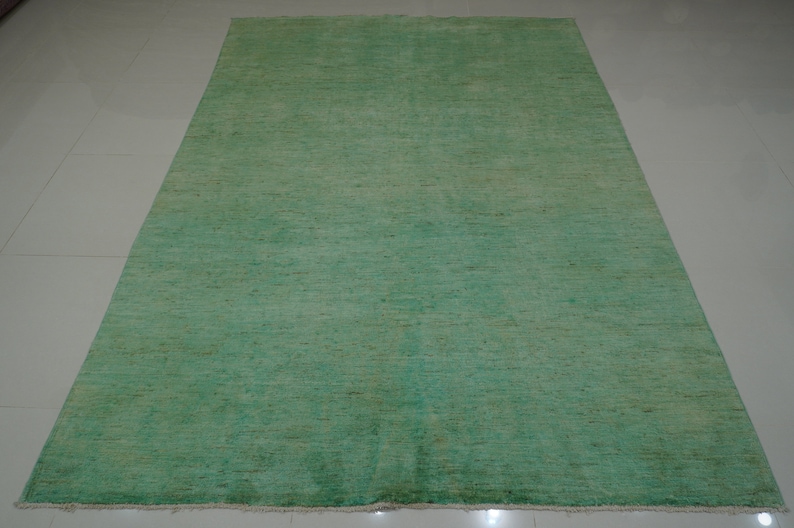
Begin by assessing dry rot. Dry rot occurs when a cotton foundation is subjected to moisture or humidity without proper airflow, allowing fungi to quietly break down the cellulosic core. To test for dry rot, take a small section of the carpet in your hands and bend it gently backward, listening closely. A healthy rug flexes silently with supple resilience. A rug with dry rot will emit a distinct crackling sound, or its warp threads may snap under moderate pressure.
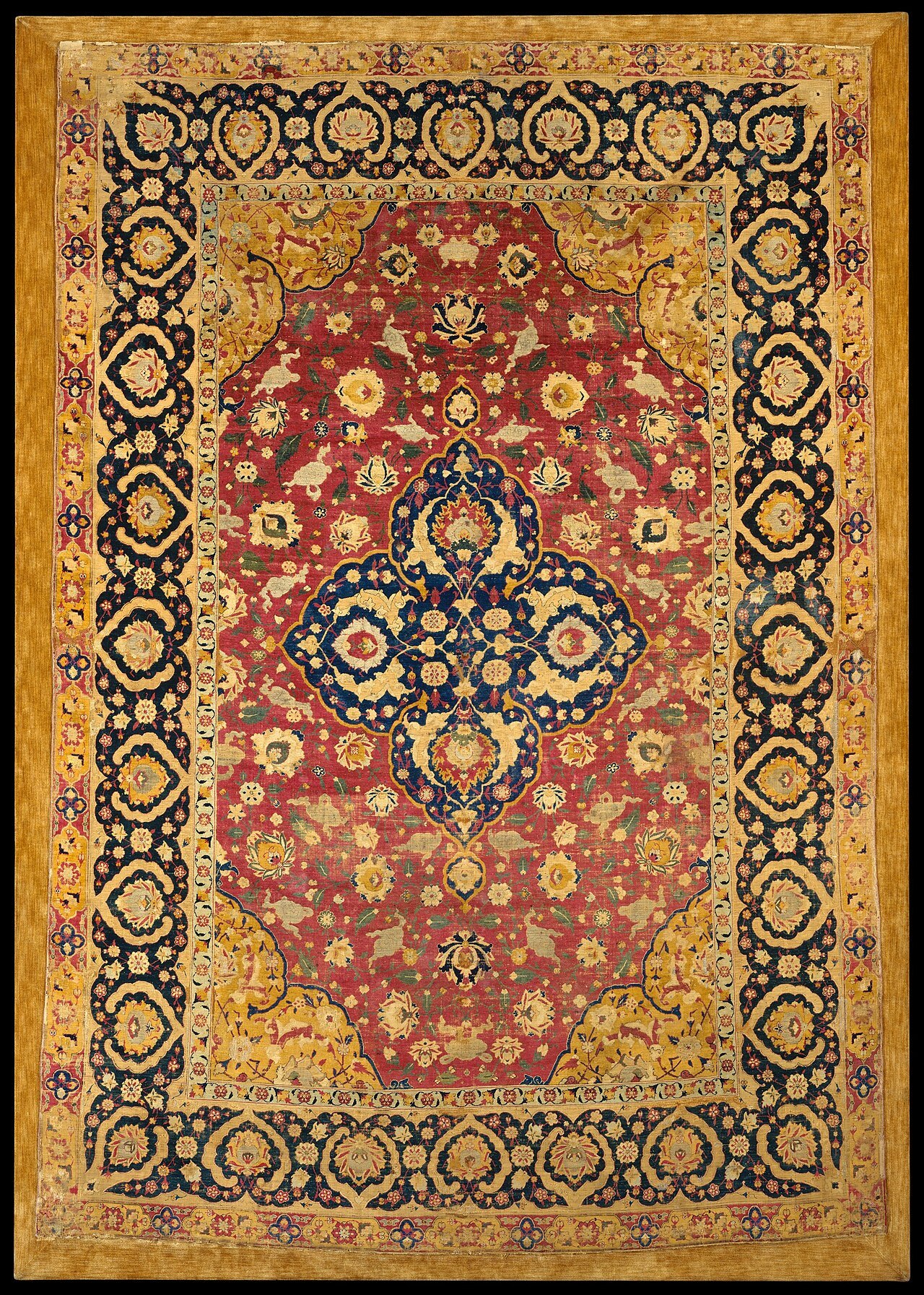
Next, inspect the side cords (selvedges) and end fringes. Mid-century Persian rugs were secured at the loom with flatwoven kilim ends and bound selvedges (*shirazi*). If the outer selvedge wraps have unravelled, adjacent knots may slip off their warps. Rewrapping selvedges is a straightforward, routine conservation task, but unraveling that eats into the primary guard borders signals significant repair costs.
Step-by-step checklist for inspecting a vintage Persian rug
Whether browsing at an estate sale, an antique gallery, or online, run through these diagnostic steps before committing to a purchase.
Hands-on diagnostic inspection
- 1
Flip the corner and examine the back
Examine the knot definition on the underside. In genuine hand-knotted rugs, the design pattern mirrors the front with remarkable clarity. If the underside is hidden by canvas or adhesive, walk away.
- 2
Check knot alignment for hand-variations
Observe the rows of knots. Machine-made imitations display clinical, computer-perfect grids. Hand-knotted vintage pieces reveal subtle, organic variations in knot spacing and tension.
- 3
Conduct the flexibility and crackle test
Bend the carpet along the warp (lengthwise) and weft (crosswise). Ensure the foundation gives without stiff cracking sounds or resistance, confirming the absence of dry rot.
- 4
Inspect the fringes at the root
Follow the fringe tassels directly into the body. Authentic fringes are the structural warps of the loom emerging through the pile. If fringes are machine-sewn on as separate trim, it is not a genuine Persian rug.
- 5
Check for color bleeding with a damp cloth
Dampen a clean white cotton cloth with warm water and press it against high-contrast transitions (like deep red against white). A quality vintage rug with stable dyes will yield virtually zero pigment transfer.
Spotting modern reproductions and machine-made fakes
The international marketplace contains countless rugs marketed as 'vintage Persian style', 'heritage oriental rugs', or 'Persian-inspired vintage'. These are almost invariably modern industrial products made in automated mills from synthetic petrochemical fibers such as polypropylene, nylon, or polyester.
An industrial machine-made rug weaves pre-dyed synthetic yarn onto plastic cross-grids in seconds. When you turn a machine-made carpet upside down, you will immediately notice that the design looks hazy, fuzzy, and muted compared to the face. Furthermore, because a machine cannot tie true knots around warps, manufacturers bind the edge with surging thread and sew fringe bands to the exterior after cutting the roll. Read our field guide on [how to identify handmade work](/identify) for step-by-step visual comparisons.
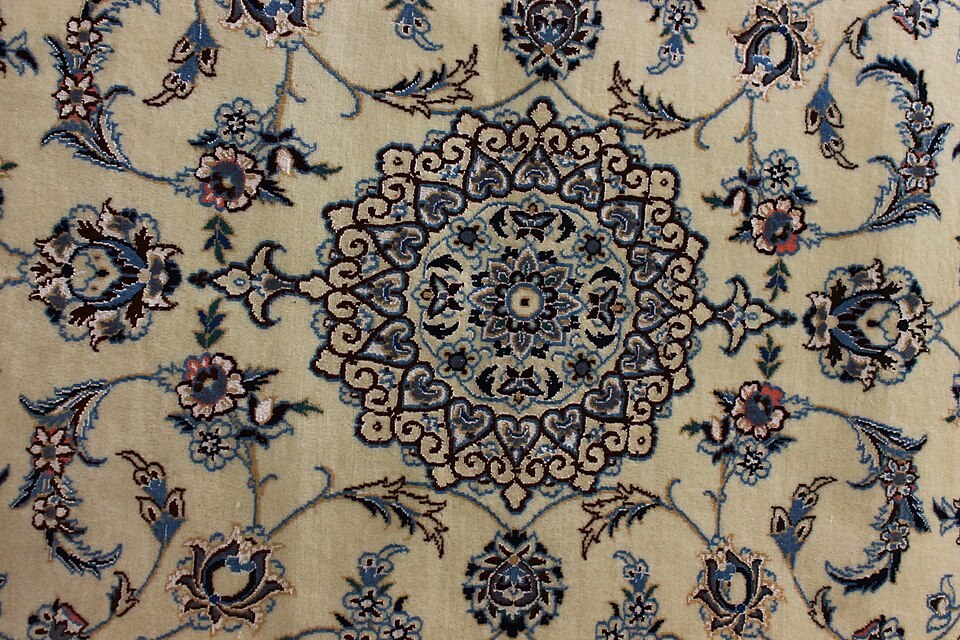
Another category to identify is the contemporary hand-knotted replica made in other countries. Workshops in India, Pakistan, Turkey, and China have long woven interpretations of classic Iranian patterns. While these hand-knotted pieces can be high quality, they should be priced and sold truthfully under their actual origin, not passed off as vintage Iranian heritage pieces. Differences in local sheep wool, spinning techniques, and palette will distinguish them to an educated observer.
Pricing realities: What should you expect to pay?
Vintage Persian rug values are shaped by origin, size, knot density, raw material quality, condition, and visual appeal. Because individual rugs are unique, prices vary considerably across retail galleries, secondary auction houses, and online importers.
As a broad indicative baseline in the US market, small vintage tribal rugs or runners (roughly 3x5 to 3x10 feet) typically trade between $400 and $1,500 depending on wool quality and provenance. Mid-size room rugs (6x9 to 8x10 feet) from recognized weaving towns like Heriz, Kashan, or Shiraz generally range from $1,200 to $4,500. Rare master workshop pieces (such as mid-century Tabriz or fine Isfahans) or oversized salon formats in exceptional original condition can command between $5,000 and $15,000 or more.
Be cautious of massive liquidation sales claiming 80% to 90% markdowns from inflated initial appraisals. Transparent dealers price their inventory based on verifiable condition, origin, and market demand rather than artificial discount games.
Everyday living: Caring for a vintage Iranian rug in your home
One of the greatest virtues of a genuine vintage Persian rug is its inherent durability. Having survived several decades of living, it is already proven. With simple, regular maintenance, it will serve comfortably for several decades more.
Essential maintenance guidelines
- Use a high-grade underlay (rug pad): Never place a vintage carpet directly on hardwood or tile without an appropriate dual-surface pad. A dense felt-and-rubber pad prevents slipping, absorbs impact friction, and protects the foundation warps from grinding against floor grit.
- Vacuum with suction only: Avoid aggressive rotating beater bars or power heads, which grab vintage fringe threads and pull at loose surface pile. Use a canister vacuum with a floor brush attachment, vacuuming in the direction of the pile nap.
- Rotate annually: Rotate the rug 180 degrees once every 12 to 24 months to distribute sunlight exposure and foot traffic pathways uniformly across the entire surface.
- Blot spills immediately: Wool's natural lanolin repels liquids for several minutes. Immediately blot spills with dry, unbleached cotton towels. Never scrub or apply commercial stain removers, which can strip lanolin or set synthetic stains.
- Professional washing: Entrust washing exclusively to specialist rug cleaners who hand-wash Persian carpets submerged in water pools using pH-neutral wool soap. Never send a vintage wool rug to a standard dry cleaner or steam-cleaning franchise.
Frequently asked questions
What is the difference between an antique and a vintage Persian rug?
By widely accepted trade definition, antique rugs are at least 100 years old, woven during or before the 1920s. Vintage rugs range from approximately 30 to 99 years old, encompassing the active mid-20th-century period through the 1980s. Vintage rugs offer aged patina and softer wool while remaining durable and accessible for daily living.
Are vintage Persian rugs suitable for high-traffic areas?
Yes. Mid-century village and workshop rugs woven with hand-spun mountain wool—such as Heriz, Bakhtiari, and Bijar pieces—feature thick cotton foundations and lanolin-rich piles that handle bustling hallways, dining spaces, and family living rooms far better than modern synthetic alternatives.
How can I tell if a vintage rug has been artificially distressed?
Artificially distressed rugs often show signs of chemical bleach baths: dry, brittle wool stripped of lanolin, a faded surface masking vivid knot roots underneath, sheared-down piles, and faint chemical odors. Natural vintage patina shows gradual light-induced softening, intact fiber elasticity, and clean, supple wool.
Can I use a vintage Persian rug over radiant heated floors?
Yes, provided the carpet has a sound foundation free of dry rot. Hand-knotted wool and cotton breathe naturally over radiant floor systems. Always use a heat-tolerant, breathable felt-and-rubber pad underneath to prevent excessive moisture loss that can make cotton warps brittle over time.
Why do some vintage Persian rugs smell musty, and can it be removed?
A musty smell usually indicates the rug was stored in a damp basement or poorly ventilated space, encouraging mild bacterial activity in the wool or cotton. Professional immersion washing with pH-neutral solutions and climate-controlled drying typically clears the odor. Avoid rugs where mold has degraded the structural foundation threads.
How often should a vintage Persian rug be washed?
For ordinary residential settings, professional hand-washing is recommended every 3 to 7 years. In high-traffic entryways or homes with pets, washing every 2 to 3 years prevents microscopic sand and grit from cutting into the inner knot foundation.
Explore further on CraftPersia
Sources and further reading
- Encyclopaedia Iranica — Encyclopaedia Iranica Foundation
- Heilbrunn Timeline of Art History — The Metropolitan Museum of Art
- Middle East collections — Victoria and Albert Museum
- The George Washington University Museum and The Textile Museum — GWU
- Etsy seller listings (product photos) — Etsy sellers
- Wikimedia Commons (images) — Wikimedia Foundation
General reference collections; they do not endorse this article.
Topics: vintage persian rugs · persian carpets · rug buying guide · wool carpets