
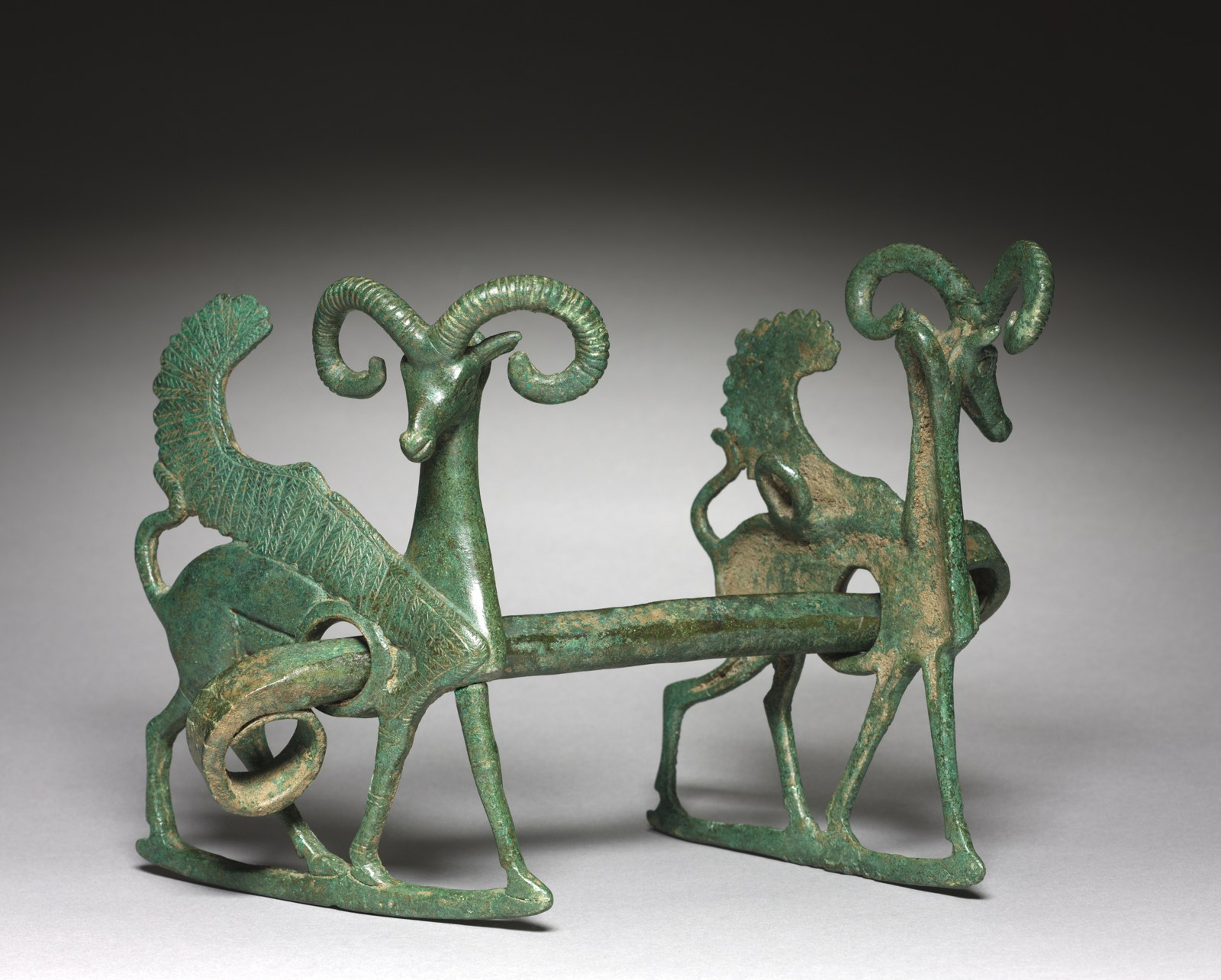
Horse Bit with Winged Ibex Cheekpieces, 1980.102; Iran, 800–600 BCE
800–600 BCE · CP-LIB-CMA-1980-102 · Cleveland Museum of Art · CC0 (museum open access; resized JPEG) · منبع عکس ↗
معنا
فرمی ساختهشده با سردشدن فلز مذاب در قالب، همراه با خطوطی که در عملی جداگانه روی سطح کنده شدهاند. این عبارت نوع دقیق قالب را تعیین نمیکند.
املا و تلفظ
- فارسی: فلز ریختهگری و کندهکاریشده
- آوانویسی: rikhtegari va kandekari
- کاربرد انگلیسی: Cast and incised metal
املا در میان فروشندگان، موزهها و مناطق متفاوت است.
بخشهای تکمیلی زیر هنوز به فارسی ترجمه نشدهاند و فعلاً به انگلیسی نمایش داده میشوند.
Forming and surface detail operate at different scales
Casting creates a form by solidifying metal in a mould; incision cuts lines into a surface. A cast object can receive incised finishing, so the two terms are complementary rather than contradictory. Cleveland uses both for the Luristan horse bit shown here. Preserve that catalogue wording before offering a more detailed manufacturing explanation.
Read the outline and three-dimensional structure separately from fine lines. Complex animal forms do not prove that every detail was made in the mould, while visible lines do not mean the entire shape was carved from solid stock. An object can combine several operations and contributors. Identifying the broad sequence does not identify a named maker or workshop.
Open spaces and mould systems need evidence
An openwork-looking form may have gaps produced during casting or through later cutting. The visible opening alone does not establish which process occurred. Similarly, “cast” does not by itself identify lost-wax, sand or another mould system. Use technical documentation before assigning a detailed process to an ancient object.
Compare the catalogue medium with structural photographs, conservation records and relevant analysis. Seams, cores and tool marks can be informative, but each feature needs interpretation. Repairs and corrosion can obscure or imitate original fabrication evidence. A single frontal image should not become a complete workshop reconstruction.
Patina, authenticity and safe examination
Green surface colour is not a reliable clock or origin test. Bronze can develop different corrosion products, and coatings or treatment affect appearance. Keep the description of visible colour separate from a claim that the patina is original, stable or ancient. An incised line can also be altered by later wear or cleaning.
Never scrape, probe an opening or use acid to examine a historical bronze. Seek a qualified condition assessment and keep lawful provenance alongside stylistic comparison. A contemporary cast copy cannot inherit the museum object’s age or Iranian origin. Actual maker and manufacture evidence must accompany a new object independently.
Compare the evidence
| Object or term | What to examine | Limit of the evidence |
|---|---|---|
| Cast form | Documented mould-based forming | Does not specify the mould method. |
| Incised line | Cut surface detail | Not proof that all ornament was cut. |
| Open space | Construction and treatment evidence | Can arise through different processes. |
Practical questions
- Is all ancient bronze lost-wax cast?
- No such conclusion follows from a brief medium field. Preserve its wording and seek object-specific technical evidence.
- Does green patina prove an ancient date?
- No. Colour cannot establish age, origin or the history of a surface.
Sources and further reading
- Cleveland Museum of Art: Horse Bit with Winged Ibex Cheekpieces (1980.102)
Object-specific catalogue; consulted 14 October 2026. Comparative terminology, not authentication of another object.
Editorial draft awaiting specialist review. References provide context, not verification of every statement, object attribution or current workshop access.
کاربرد در این صنایع دستی
سنت ایرانی تزئین ظروف مسی، برنجی و نقرهای با قلمهای ریز که با چکش کوبیده میشوند و فلز را به خط، زمینه و برجستگی میسازند.