
Definition
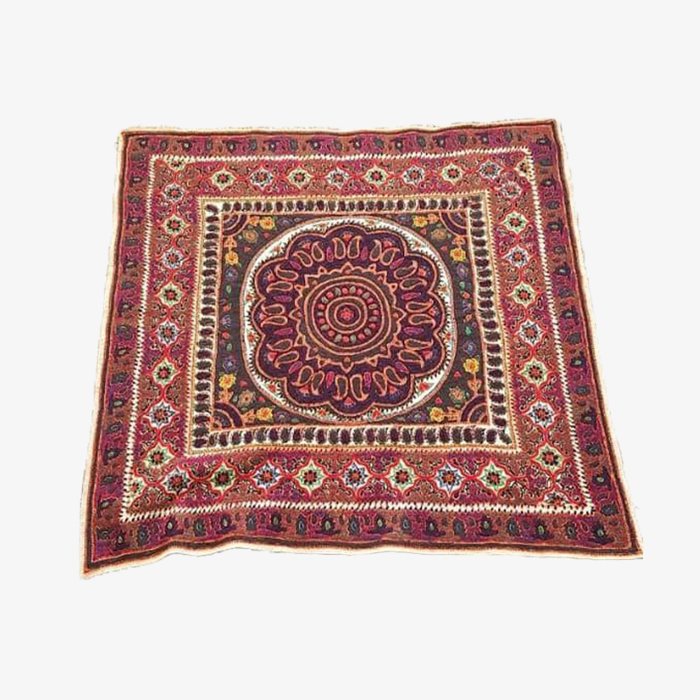
Pateh is a needle-embroidered textile particular to Kerman, worked with fine wool or silk thread over a plain woollen ground cloth, usually left in its natural cream or dyed to a solid colour. The embroidery covers the surface densely enough that little of the ground shows through in the finished field, producing a textured, almost pile-like surface distinct from open or sparse embroidery styles.
The craft is closely associated with Kerman's broader wool textile economy, drawing on the region's long-established supply of fine wool and dyeing expertise, and pateh pieces range from small purses and cushion covers to large tablecloths and wall hangings.
History
Kerman has been a centre of wool textile production for a long period, and pateh embroidery is documented as a distinct craft within that broader tradition by the Qajar period, produced largely by women working at home or in small workshops. Precise origin dates for the specific chain-stitch pateh technique as practised today are not firmly established in the published literature.
Twentieth-century demand, both domestic and through craft and tourist markets, sustained pateh production through the Pahlavi period, but heritage documentation in more recent decades has noted a shrinking number of embroiderers working at the finest, most time-intensive grades, as the labour required is not matched by commensurate prices in much of the market.
Materials
A plain-woven wool ground cloth, sometimes dyed, provides the base. Embroidery thread is traditionally wool or silk, worked in a restrained palette historically dominated by warm reds, oranges and golds against the ground colour.
- Woollen ground cloth, natural or dyed
- Wool or silk embroidery thread
- Traditional dyes for both ground and thread, with synthetic dyes common in later work
Technique
The embroiderer works freehand or from a lightly marked outline, filling in the design with dense chain stitch and satin stitch so that the pattern reads primarily through the raised, directional texture of the stitching rather than through sharp colour contrast, since the palette is often close in tone. Large pieces, such as full tablecloths, may take months of sustained work by a single embroiderer.
Because the design is largely carried by stitch direction and density rather than by strong colour separation, evenness of tension and stitch length across a large field is one of the more demanding aspects of the technique.
Motifs
Central medallions surrounded by dense floral and paisley-like boteh borders are common, echoing compositions also found in Kerman's carpets and shawls. Bird-and-blossom motifs and cypress-tree forms appear in some pieces, generally organised in symmetrical borders around a central field.
Collecting and identification
Examine the reverse of a piece: hand embroidery shows the stitching structure and thread tails on the back, while printed or machine-embroidered imitations show a flatter, more mechanical reverse or none of the expected texture at all. The density and evenness of stitch coverage across a large field is a reasonable indicator of skill level and time invested.
As with other regional textiles, claims about the age of a specific pateh piece should be weighed against the absence of firm documentation for much of the type's history, and treated as estimates rather than certainties.
Preservation
Wool and silk embroidery is vulnerable to insect damage; store pieces clean, dry and away from prolonged exposure to light that fades embroidery thread unevenly relative to the ground cloth. Avoid folding along embroidered lines repeatedly, since the raised stitching can crack or flatten permanently, and consult a textile conservator for cleaning rather than washing at home.
گالری
تصاویر نمونههایی معرف هستند، نه سندی برای رکوردهای نمونهٔ بازارچه. منبع و وضعیت مجوز آنها در بخش اعتبارهای عکاسی آمده است.
بازارچه
در حال حاضر هیچ شیئی از این صنعت فهرست نشده است.
- Construction
- Dense wool embroidery
- Object reading
- Structure, materials and condition before attribution
- Evidence status
- Educational summary under editorial review
Dense wool embroidery
Pateh is worked by stitching coloured yarn onto a fabric ground, often with large boteh-related or floral layouts. It is embroidery, not woven brocade: the motifs sit on top of a pre-existing cloth. Grounds and stitching materials differ by maker and period.
Inspect the reverse
The back reveals direction changes, knots, repairs and whether the coloured design is stitched or printed. Avoid assuming that a traditional-looking pattern dates an object.
- Surface stitches over a separate ground
- Distinct design fill and outline
- Condition of ground visible from reverse
Context, preservation and evidence
Workshops, households, museums and contemporary makers can use the same craft name in different ways. Record who made, sold and documented a piece before assigning a date or location. Condition and technique are observable; origin, attribution and value require further evidence.
These reading notes are educational, not an authenticity certificate or valuation. The associated source list is a starting point; many claims and translations still require specialist review.
Pateh embroidery (Kerman) در تصاویر
این تصاویر جنبهٔ نمایشی دارند و مربوط به شیء خاصی در فهرست نیستند. منابع در صفحهٔ منابع تصاویر آمده است.
| Type | How to distinguish it |
|---|---|
| Pateh | Surface embroidery on cloth |
| Termeh | Woven pattern integral to cloth |
| Sermeh-duzi | Metallic thread laid and couched on cloth |
اصطلاحات کلیدی
- Pateh پته
- Kerman-associated embroidery tradition.
منابع و مآخذ
- Book: Wulff, H. E. The Traditional Crafts of Persia. MIT Press, 1966.
- Institution: UNESCO, intangible cultural heritage documentation on Iranian craft practice.
در جایی که خاستگاه، تاریخ یا نمادشناسی محل مناقشه است، این مدخل روایتهای رقیب را بیان میکند نه اینکه میان آنها یکی را برگزیند. تحلیل سردبیری بهعنوان واقعیتِ مستند ارائه نمیشود.