
The two crafts in photographs
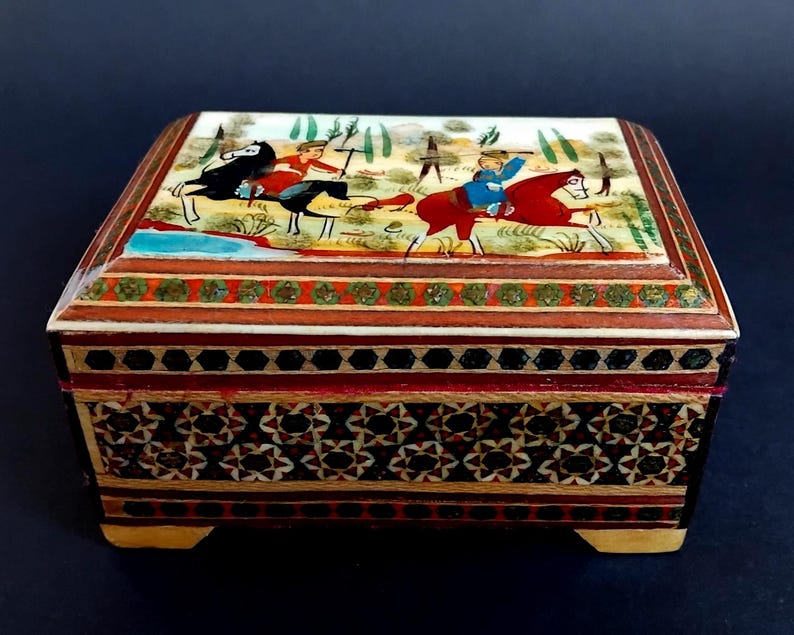
Khatamkari
Wood carving (Monabbat)
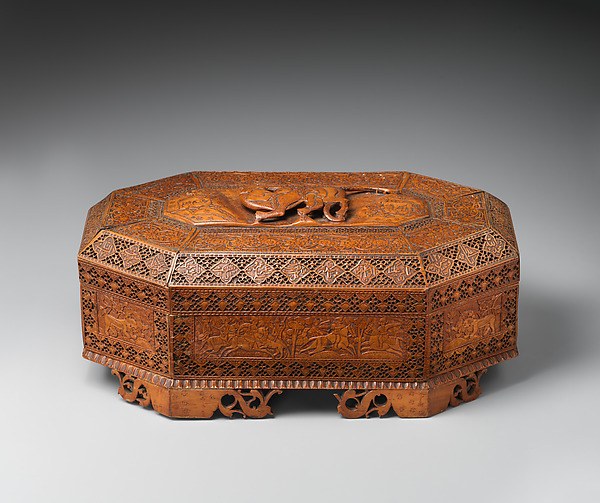
Photographs show documented examples of each craft for visual comparison; they do not prove what any other object is.
Side by side
| Khatamkari | Wood carving (Monabbat) | |
|---|---|---|
| Persian name | خاتمکاری | منبتکاری |
| Category | Woodwork · Inlay | Woodwork · Relief carving |
| Materials | Walnut wood, Camel bone, Brass | Walnut wood |
| Techniques | Wood inlay (khatam) | Wood relief carving |
| Regions | Isfahan, Shiraz | Isfahan, Shiraz, Kerman |
| Periods | Safavid, Qajar, Contemporary | Safavid, Qajar, Pahlavi, Contemporary |
| Motifs | Gereh (geometric knot), Eslimi arabesque | Eslimi arabesque, Gol-o-morgh |
| Current vitality | Endangered | At risk |
What they share
- Materials: Walnut wood
- Regions: Isfahan, Shiraz
- Motifs: Eslimi arabesque
- Periods: Safavid, Qajar, Contemporary
How to tell them apart
- The Khatamkari record lists Camel bone, Brass, which the Wood carving (Monabbat) record does not.
- Khatamkari typically involves Wood inlay (khatam).
- Wood carving (Monabbat) typically involves Wood relief carving.
- A material listed for only one craft is a question to ask, not an identification test.
- The stated place of making is a useful clue, but never proof on its own.
Background on each craft
About Khatamkari
Definition
Khatamkari is the assembly of a decorative surface from bundled rods rather than from cut shapes. Rods of contrasting material are filed to a triangular section, bound into a six-pointed star unit, glued into larger blocks, and then sliced across the grain into sheets thin enough to bend around a curved carcase.
Because the pattern is built into the block before slicing, every sheet cut from one block repeats the same figure. Fineness is measured by how many elements fall within a given area: the most demanding work packs several hundred rods into a single star repeat.
History
Inlaid geometric woodwork is documented in Iran from the Safavid period, when Isfahan and Shiraz workshops produced doors, Quran stands, boxes and instrument bodies for court and religious patrons. Earlier related traditions of geometric woodwork existed, but the direct line of descent for the bundled-rod method is not firmly established in the published record.
Production shifted toward smaller export objects in the Qajar period, and again in the twentieth century toward boxes, frames and cases sold to visitors. Several twentieth-century workshops in Isfahan maintained the finer standards; others adopted printed or transferred imitations that reproduce the appearance without the construction.
General background on the craft, not a statement about any individual object; dates and attributions summarise common positions in the literature and remain under review. Read the full Khatamkari entry.
About Wood carving (Monabbat)
Definition
Monabbat-kari is the carving of ornament directly into the surface of a solid wooden panel using chisels and gouges, removing material to leave a raised or sunken pattern in a single piece of wood, rather than assembling the design from separately cut or inlaid pieces as in khatam or marquetry.
The technique is applied to doors, mirror frames, furniture panels, Quran stands and architectural elements such as pillars and ceiling panels, and ranges from shallow low-relief surface decoration to deep, boldly undercut high relief with strongly three-dimensional floral and arabesque forms.
History
Relief-carved wooden doors, panels and architectural elements are documented in Iran across several historical periods, with notable surviving and well-studied examples from the Safavid period onward in religious and domestic architecture in cities such as Isfahan and Shiraz. Earlier carved woodwork existed but is less completely preserved, since wood survives poorly compared with stone or ceramic, which limits how far back a continuous technical lineage can be traced with confidence.
Carved wood furniture and decorative panels remained a significant craft through the Qajar and Pahlavi periods, associated particularly with workshops in Isfahan, Shiraz and Kerman producing both architectural commissions and freestanding furniture, mirror frames and boxes for domestic use and sale.
General background on the craft, not a statement about any individual object; dates and attributions summarise common positions in the literature and remain under review. Read the full Wood carving (Monabbat) entry.
Read more
Disclaimer
This comparison is educational and built from entries still under review. It cannot confirm what a particular object is.