
What documented Moarraq tile mosaic looks like
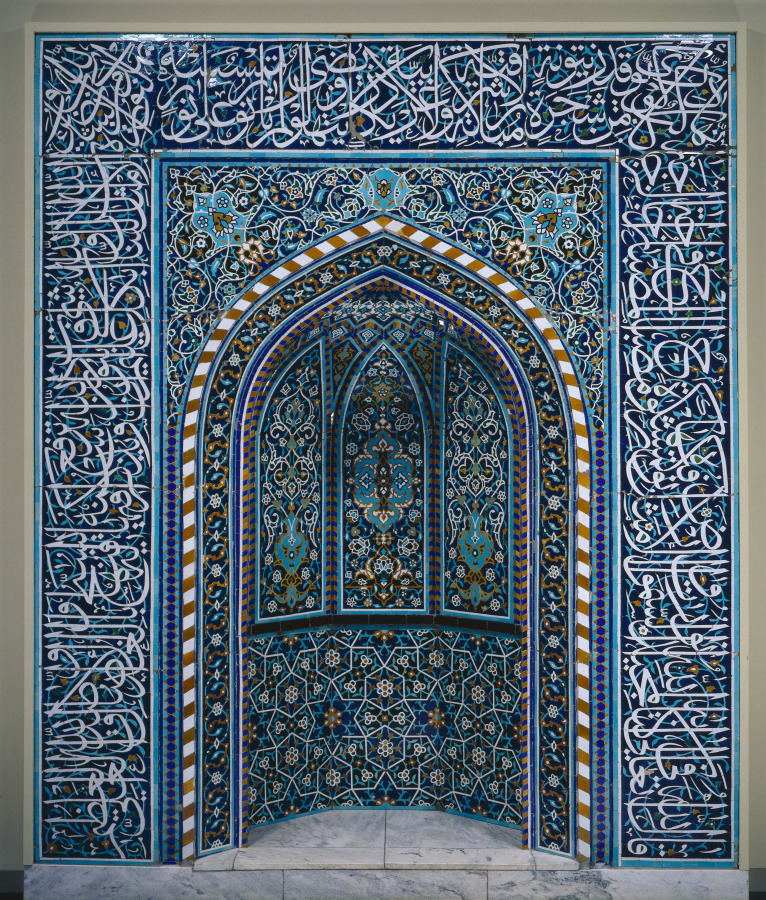
Reference photographs of documented Moarraq tile mosaic pieces, credited to their sources. Compare construction, surface and wear with any piece you are offered — a resemblance is not proof of origin.
Moarraq tile mosaic at a glance
| Persian name | کاشی معرق |
| Category | Ceramics · Architectural tilework |
| Main techniques | cut-tile-mosaic |
| Typical materials | clay |
| Places of making | isfahan, tabriz, kashan, yazd |
| Current vitality | Living tradition |
Understanding Moarraq tile mosaic
What Moarraq tile mosaic is and how it is made
Definition
Moarraq, meaning inlaid or veined, refers to tile mosaic assembled from small monochrome pieces rather than from tiles that are individually painted with a multicolour design. Each colour is fired separately as a plain glazed tile, then cut by hand into the precise shapes required by a full-scale drawing.
The cut pieces are laid face down on the drawing, glaze side against the paper, and mortar is poured over the reverse to bind them into a panel, which is then lifted, cleaned and set into the wall or dome as a finished section. The technique allows sharper colour separation and more intricate curvilinear detail than painted tile, at considerably greater labour cost.
History
Cut-tile mosaic revetment is documented on major Iranian monuments from the Ilkhanid and especially the Timurid period, when it was used extensively on shrines, mosques and madrasas in centres such as Yazd, Isfahan and Samarqand-linked workshops. The technique reached a widely recognised peak of refinement under the Safavids, notably on the great domes and portals of Isfahan.
From the later Safavid period onward, the faster and cheaper method of painting a design directly onto a single tile before glazing, known as haft rang or seven-colour tilework, was increasingly used alongside mosaic for large surfaces where cost and speed mattered, while moarraq was retained for the most prestigious commissions and for restoration of earlier monuments.
Materials
The tile body is a fired earthenware or stonepaste (fritware) biscuit, glazed in a single colour and fired before cutting. Cobalt blue, turquoise, white, black, ochre and manganese purple are the traditional palette, chosen for glazes that fire reliably and hold their tone under the mosaic's small unit sizes.
- Stonepaste (fritware) or earthenware tile biscuit
- Single-colour alkaline or lead glazes fired before cutting
- Lime or gypsum-based mortar for setting the assembled panel
- A full-scale cartoon transferred to guide the cutting of each colour
General background on the craft, not a statement about any individual object; dates and attributions summarise common positions in the literature and remain under review. Read the full Moarraq tile mosaic entry.
Before you buy: what to inspect
- Most architectural craft is seen in place; portable panels and tiles are the exception.
- Look for hand-cut edges and slight variation between pieces.
- Check tiles and panels for chips, cracks and old mortar or plaster on the back.
Typical materials: clay.
Red flags: copies and 'Persian style' imports
- Tiles or panels claimed to come from historic buildings (removal may be illegal).
- Printed or decal-decorated tiles sold as hand-painted or hand-cut work.
A genuine Moarraq tile mosaic piece should come with a named place of making in Iran (often isfahan, tabriz, kashan, yazd) and a clear statement that it is handmade.
Questions to ask the seller
- Where does this piece come from?
- Is it newly made or salvaged?
- Can it legally be exported?
What affects the price
| Hand-cutting or hand-painting |
| Size |
| Workshop |
| Age and documented provenance |
Care and cleaning
- Dust gently; avoid acidic cleaners on glaze and plaster.
- Mount securely on a solid wall.
Storage
- Store flat and padded.
Shipping
Heavy and fragile — use crates and insurance.
Disclaimer
This guide is educational. It cannot confirm that any particular object is genuine, old or valuable. For important purchases, ask an independent specialist. Read the full Moarraq tile mosaic entry.