
Definition
Sermeh-duzi is a couched metal-thread embroidery technique, historically worked with fine wire or wire-wound thread laid on the surface of the cloth and stitched down with a separate finer thread rather than passed through the ground fabric itself, since drawn metal wire is too rigid and abrasive to sew directly. The result is a raised, reflective surface pattern suited to heavier fabrics such as velvet.
The technique belongs to a broader family of gold-thread and metal-thread embroidery practised across the historic Persianate and Ottoman world, and Iranian sermeh-duzi shares methods and some motifs with related traditions while developing its own regional conventions in workshops such as those of Isfahan and Rasht.
History
Metal-thread embroidery for court and ceremonial dress is documented in Iran through the Safavid and Qajar periods, used on garments, horse trappings, cushion covers and religious textiles for patrons who could afford the costly gold and silver wire. The craft's prestige was closely tied to the cost of its materials as much as to the skill required.
Demand for elaborate metal-thread embroidered garments declined with changes in dress and court patronage through the twentieth century, and production narrowed toward ceremonial, religious and specialty commissions rather than everyday courtly use, a shift documented in general surveys of Iranian textile crafts.
Materials
Fine wire, traditionally of gold or silver, or more commonly a base-metal wire washed or plated to resemble precious metal, is wound around a silk core to make workable metal thread. The ground cloth is usually velvet or another dense weave capable of supporting the weight and stiffness of couched metal work.
- Wire-wrapped metal thread, historically gold or silver, more often brass-based in later work
- Silk core thread beneath the metal wrapping
- Velvet or heavy woven ground cloth
- Fine couching thread to secure the metal thread to the surface
Technique
The design is first drawn or transferred onto the ground cloth, then the metal thread is laid along the design lines and secured at intervals with small stitches of a finer thread passed over it and into the cloth, a method called couching that avoids drawing the stiff metal thread itself through the fabric. Dense areas may be padded beneath the metal thread to raise the surface further.
Working an even, continuous line of couched metal thread around curves and fine details requires close control of thread tension, since kinks or looseness in the metal thread are visible and difficult to correct once secured.
Motifs
Arabesque scrollwork, palmette borders and floral sprays dominate, often organised as borders and corner ornaments on garments or as central medallions on furnishing textiles, echoing motifs shared with other Persian decorative arts of the same periods.
Collecting and identification
Genuine couched metal-thread work shows the thread laid on the surface in continuous couched lines rather than stitched through the fabric in a running or satin stitch; the reverse of the cloth typically shows only the fine couching stitches, not the metal thread itself. Tarnishing patterns on older gold- or silver-washed thread can help indicate age but are not conclusive on their own.
Because base-metal substitutes for gold and silver wire have long been used even in historical pieces, claims that a specific piece uses precious-metal thread should be treated with caution absent testing or strong documentation.
Preservation
Metal thread tarnishes and can corrode the surrounding fibres if exposed to humidity, so stable, moderate humidity and avoidance of direct handling with bare skin (which transfers oils that accelerate tarnish) are important. Store flat or on a padded roller rather than folded, since folding stresses the rigid metal thread and can cause it to crack or detach.
Gallery
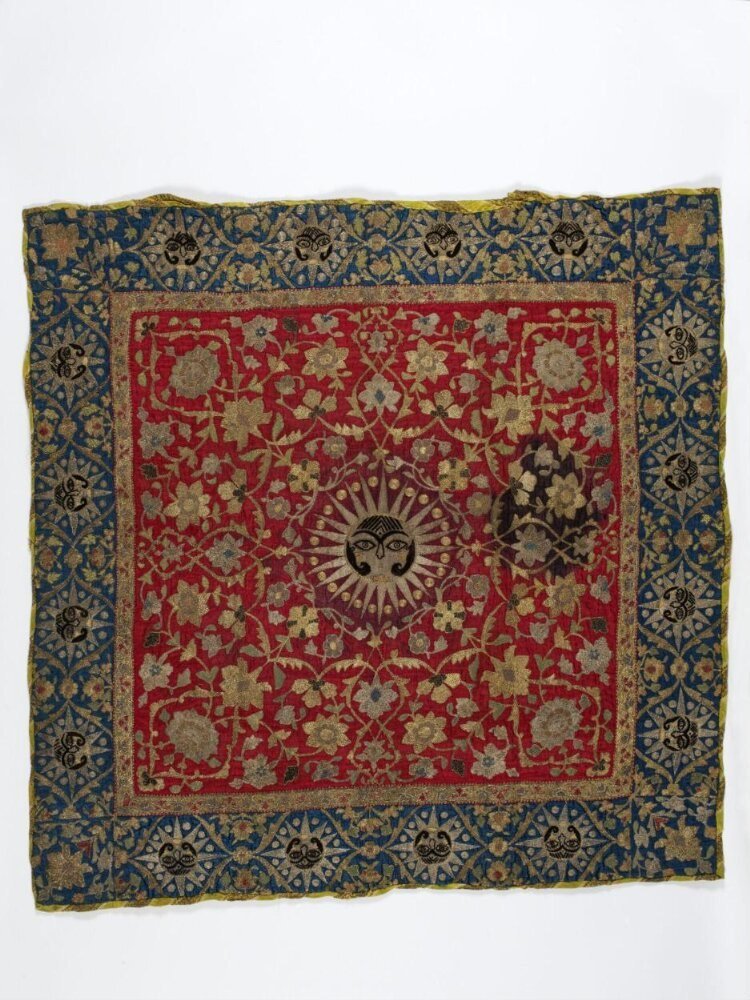
Images are representative examples, not evidence for the sample marketplace records. Their sources and permission status are listed in the photography credits.
Marketplace
No objects of this craft are currently listed.
- Construction
- Couching reflective thread
- Object reading
- Structure, materials and condition before attribution
- Evidence status
- Educational summary under editorial review
Couching reflective thread
Metallic threads or strips are laid along a marked design and attached with small holding stitches. The metal may be wrapped around a textile core or formed in other ways. Metallic appearance alone does not establish composition or period.
Handle carefully
Photograph both sides without bending the cloth. Check for detached threads, exposed cores and corrosion products before any cleaning; rubbing or polishing can destroy the stitching.
- Raised metal-thread passages
- Small anchoring stitches
- Possible tarnish or vulnerable textile core
Context, preservation and evidence
Workshops, households, museums and contemporary makers can use the same craft name in different ways. Record who made, sold and documented a piece before assigning a date or location. Condition and technique are observable; origin, attribution and value require further evidence.
These reading notes are educational, not an authenticity certificate or valuation. The associated source list is a starting point; many claims and translations still require specialist review.
Technique: what to look for
Metal strip or wrapped thread is laid on a textile and held by small couching stitches. Inspect the relationship between raised metal and its ground; damaged wrapped threads can expose a fibre core.
Historical and regional context
The label applies to varied decorative practices. Bright metallic appearance does not establish metal composition or age; modern substitutes can serve legitimate contemporary work.
Collecting and documentation
Ask whether the metal is solid, wrapped or simulated and photograph tarnish, detached stitches and backing. Keep heavy embellishments supported flat, without polishing them on the cloth.
These checks are non-destructive educational prompts, not an authentication, attribution or appraisal. Keep a record of which claims were observed and which came from a seller.
Sermeh-duzi in photographs
Representative photographs, not of any specific catalogued object. Sources on the credits page.
| Type | How to distinguish it |
|---|---|
| Sermeh-duzi | Couched metal-thread surface decoration |
| Pateh | Predominantly coloured wool embroidery |
| Termeh | Woven patterned textile |
| Observed process | Often confused with | What to examine |
|---|---|---|
| Couched metal thread | Metallic printed motif | Raised thread and holding stitches differ from a surface print; decorative foil may also be attached. |
Timeline
- Design
Mark and secure a suitable cloth ground.
- Couching
Lay metal thread and hold it with small stitches.
- Care
Support weight and document repairs without abrasive cleaning.
Key terms
- Sermeh سرمه
- Metal thread or strip used in embroidery; workshop usages vary.
References and further reading
- [1] Wulff, H. E. The Traditional Crafts of Persia. MIT Press, 1966.Background reference; individual statements and attributions still require editorial verification.
These sources provide context, not authentication or provenance for an individual object. Editorial interpretations remain under review.
Sources & references
- Book: Wulff, H. E. The Traditional Crafts of Persia. MIT Press, 1966.
- Museum catalogue: Victoria and Albert Museum, Middle East collection records, embroidered textiles.
Where origins, dates or symbolism are contested, this entry states the competing readings rather than choosing between them. Editorial analysis is not presented as documented fact.