
Definition
Firuzeh-kubi covers a metal object's surface with small, irregularly shaped chips of turquoise set closely together and fixed with adhesive, producing a continuous mosaic-like blue-green field rather than a design of separate set stones as in conventional gem-set jewellery.
The technique is strongly associated with Mashhad, reflecting the city's historical role as a centre for turquoise from nearby Neyshabur mines, and is applied to a range of objects including bowls, vases, boxes and items of jewellery.
History
Neyshabur, near Mashhad, has long been a documented source of fine turquoise, and the stone has been used in Iranian jewellery and decorative arts across several periods; the specific mosaic inlay technique of firuzeh-kubi as practised today is most clearly documented as a Mashhad craft specialty from the Qajar period onward. Earlier turquoise-set metalwork existed in related but not necessarily identical forms, and the precise history of the mosaic-chip method itself is less thoroughly documented than the stone's general history.
The craft has continued into the contemporary period as a specialty of Mashhad workshops, closely tied to the continued, though fluctuating, availability of turquoise from regional mines, and remains a recognisable regional decorative art rather than a widespread national practice.
Materials
Turquoise, historically sourced from the Neyshabur mines near Mashhad, supplies the small chips that cover the object's surface; stone quality and colour vary from mine and lot to lot, and lower grades or reconstituted and imitation turquoise are also present in the market. The base object is typically brass or copper, sometimes silver-plated, chosen for its workability and as a stable ground for the adhesive-set stone.
- Small chips of natural turquoise, cut or broken to shape
- Brass or copper base object, sometimes plated
- Adhesive suited to setting stone chips on metal
- Occasionally reconstituted or imitation turquoise in lower-grade work
Technique
Turquoise is broken or cut into small, irregular chips, sorted roughly by size and colour, and set piece by piece into adhesive applied to the metal object's surface, packed closely enough that little to no base metal remains visible in the finished field. The surface is then ground and polished level so the stone chips present a smooth, even covering despite their irregular individual shapes.
Because the stones are set rather than carved or engraved into the metal, the technique depends heavily on the skill and patience of fitting many small, non-uniform pieces closely together, and on adhesive that will hold securely under handling and, in the case of vessels, occasional contact with liquids.
Motifs
Design is generally about coverage and colour rather than pictorial imagery: fields of turquoise are applied to the whole visible surface of an object, sometimes combined with engraved or inlaid metal bands, borders or reserved sections in the base metal, rather than forming a pictorial or figural composition in the stone itself.
Collecting and identification
Natural turquoise varies in colour and can include matrix veining; a suspiciously uniform, flawless blue across an entire piece can indicate reconstituted or dyed imitation material rather than natural stone, and buyers uncertain of stone quality should ask for the seller's basis for identifying it as natural.
Because chips are adhesive-set rather than mechanically locked as in some other stone-setting methods, older or poorly made pieces are prone to losing individual chips; missing or replaced chips of a different shade are common and are a condition issue rather than necessarily a sign of poor original workmanship.
Preservation
Turquoise is a relatively soft and porous stone that can be damaged by contact with oils, perfumes, household chemicals and prolonged sun exposure, all of which can dull or discolour it; clean gently with a dry or barely damp soft cloth only, avoiding any solvent or ultrasonic cleaning.
Because the setting adhesive can weaken over time or with heat exposure, avoid storing or displaying firuzeh-kubi objects near direct heat sources, and have any loose or missing chips reset by a specialist familiar with the technique rather than with a generic household adhesive.
Gallery
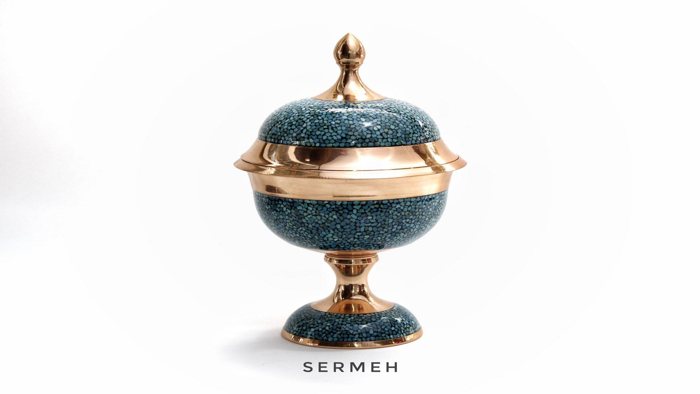
Images are representative examples, not evidence for the sample marketplace records. Their sources and permission status are listed in the photography credits.
Marketplace
No objects of this craft are currently listed.
- Construction
- Fragments of blue-green stone in metal
- Object reading
- Structure, materials and condition before attribution
- Evidence status
- Educational summary under editorial review
Fragments of blue-green stone in metal
Firuzeh-kubi sets many small turquoise fragments close together on a shaped metal support, often copper. Stone colour or a seller statement alone cannot establish a mine or geographic origin.
Examine without testing
Note gaps, lifted fragments, setting material and metal form. Keep porous stone away from oils, acids and polishing compounds.
- Many closely fitted small stone fragments
- Visible metal support at margins
- Variable colour within the inlay
Context, preservation and evidence
Workshops, households, museums and contemporary makers can use the same craft name in different ways. Record who made, sold and documented a piece before assigning a date or location. Condition and technique are observable; origin, attribution and value require further evidence.
These reading notes are educational, not an authenticity certificate or valuation. The associated source list is a starting point; many claims and translations still require specialist review.
Technique: what to look for
Small turquoise-coloured fragments are fitted closely onto a shaped metal support using a setting material. Gaps, dislodged pieces and the material below them determine how a piece should be handled.
Historical and regional context
Colour cannot prove that a stone is turquoise or establish a mine of origin. Isfahan is a centre of decorative metalwork but not proof of a specific object's production site.
References: [2]
Collecting and documentation
Request detailed views of stone, base metal, gaps and re-set areas; ask for mineral identification if it matters to price. Avoid acids, oils and polishing compounds on porous stones.
These checks are non-destructive educational prompts, not an authentication, attribution or appraisal. Keep a record of which claims were observed and which came from a seller.
Turquoise inlay (Firuzeh-kubi) in photographs
Representative photographs, not of any specific catalogued object. Sources on the credits page.
| Type | How to distinguish it |
|---|---|
| Firuzeh-kubi | Turquoise fragments fitted into metal |
| Minakari | Glassy fired enamel on metal |
| Malileh | Openwork formed with metal wire |
| Observed process | Often confused with | What to examine |
|---|---|---|
| Fragment-set stone surface | Painted blue-green decoration | Fitted pieces have physical boundaries; colour alone cannot identify the mineral. |
Timeline
- Form
Prepare and shape the metal support.
- Set
Fit and fix fragments in the surface.
- Maintain
Record loose pieces and repairs without home cleaning.
Key terms
- Firuzeh فیروزه
- Turquoise; visual appearance does not prove origin.
References and further reading
- [1] Wulff, H. E. The Traditional Crafts of Persia. MIT Press, 1966.Background reference; individual statements and attributions still require editorial verification.
- [2] UNESCO Creative Cities Network, Isfahan: Crafts and Folk Art. ↗
These sources provide context, not authentication or provenance for an individual object. Editorial interpretations remain under review.
Sources & references
- Book: Wulff, H. E. The Traditional Crafts of Persia. MIT Press, 1966.
- Journal article: Encyclopaedia Iranica, entry on turquoise (firuza) and its use in Iranian decorative arts.
Where origins, dates or symbolism are contested, this entry states the competing readings rather than choosing between them. Editorial analysis is not presented as documented fact.