
Definition
Abr-o-bad, literally cloud-and-wind, describes the Persian tradition of marbling paper by floating prepared pigments on the surface of a viscous bath, usually thickened with a mucilage such as gum tragacanth, and shaping them into patterns before laying a sheet of paper onto the surface to lift off a mirrored impression of the floating colour.
The technique belongs to a wider family of marbling practices found across the Islamic world and into Europe, sharing core methods with the Turkish ebru tradition, and the exact lines of historical transmission between regional variants are not fully settled in the scholarly literature.
History
Marbled paper is documented in Persian manuscript production from the Safavid period, used for borders, album pages, bookbindings and decorative surrounds to calligraphy and miniature painting, often in combination with illumination (tazhib) on the same page. Its use continued into the Qajar period as part of the broader decorative apparatus of the book arts.
Interest in Persian and related marbling traditions declined with the broader contraction of manuscript arts as print culture spread, but the technique has seen renewed practice and teaching in more recent decades as part of a wider revival of traditional book arts, alongside related Turkish ebru practice with which it shares considerable technical overlap.
Materials
A mucilaginous bath, traditionally thickened with gum tragacanth or a similar plant gum, carries the floating pigments. Pigments are historically mineral or plant-based, prepared with a wetting agent, usually a small amount of ox gall, so they spread and float rather than sink or clump.
- A size bath thickened with gum tragacanth or comparable mucilage
- Mineral or plant-based pigments prepared with a wetting agent
- Fine brushes, styluses or combs for working the floating colour
- Absorbent handmade paper suited to lifting the marbled surface
Technique
Pigment is dropped or flicked onto the size bath, where it spreads into rings or fine networks depending on its preparation, and the artist then manipulates the floating colour with a stylus, comb or brush to draw it into the desired pattern of veins, waves or combed lines. Timing matters, since the bath's surface changes as it is worked and as pigments interact.
A sheet of paper is laid gently onto the prepared surface and lifted after a brief contact, transferring the pattern in mirror image; the paper is then rinsed and dried. No two sheets are identical, since the floating pattern cannot be repeated exactly, which is part of the technique's appeal for individual decorative sheets and album pages.
Motifs
Patterns are non-figural, built from the physical behaviour of pigment on the bath: fine veining, combed wave patterns, and cloud-like or feathered fields, sometimes further worked into more structured comb patterns resembling stylised vegetal or wave forms.
Collecting and identification
Historic marbled sheets are usually encountered bound into or associated with manuscripts and albums rather than as freestanding collectibles, and detached sheets should be checked for consistency of paper, pigment ageing and any tool or printing marks that would indicate a modern reproduction rather than a hand-marbled historic sheet.
Modern hand-marbled paper, made in the same tradition today, is a legitimate and actively practiced craft in its own right and should not be assumed to be either historic or a forgery; sellers should be asked directly whether a piece is contemporary or claimed to be historic, and any historic attribution should come with supporting documentation.
Preservation
Marbled paper, like other historic paper, is sensitive to light, humidity and acidity; store away from direct light and in acid-free enclosures, and avoid adhesive tapes or mounts that will stain or embrittle the sheet over time.
Pigment layers can be sensitive to moisture even after drying; avoid direct water contact or aggressive cleaning, and refer any staining, flaking pigment or structural paper damage to a paper conservator.
Gallery
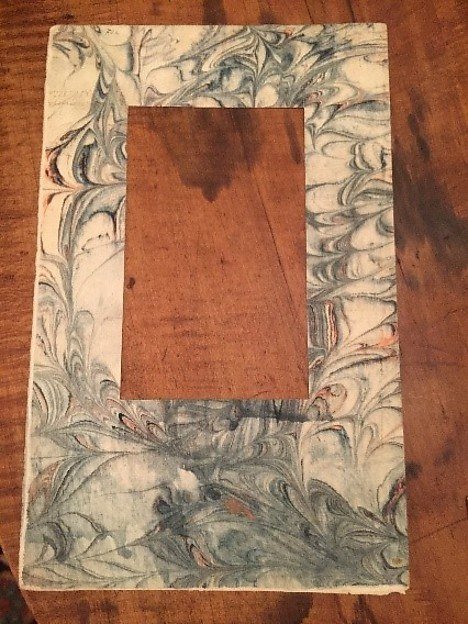
Images are representative examples, not evidence for the sample marketplace records. Their sources and permission status are listed in the photography credits.
Marketplace
No objects of this craft are currently listed.
- Construction
- Colour moved on a liquid surface
- Object reading
- Structure, materials and condition before attribution
- Evidence status
- Educational summary under editorial review
Colour moved on a liquid surface
In paper marbling, pigments or inks spread on a liquid bath. The maker draws or combs them, then lays a sheet on the surface to capture a one-off pattern. Later uses include book endpapers and calligraphy mounts.
Look at the sheet, not the name
Surface pattern is transferred, not painted line by line. Some printed papers imitate marbling, so inspect paper fibres and image repeats without rubbing the surface.
- Flowing non-identical colour paths
- Pattern transferred to one face of paper
- Possible bookbinding or album use
Context, preservation and evidence
Workshops, households, museums and contemporary makers can use the same craft name in different ways. Record who made, sold and documented a piece before assigning a date or location. Condition and technique are observable; origin, attribution and value require further evidence.
These reading notes are educational, not an authenticity certificate or valuation. The associated source list is a starting point; many claims and translations still require specialist review.
Technique: what to look for
Colours are floated and manipulated on a liquid surface before a sheet picks up their pattern. Bath composition and paper preparation change the result; one print is not a reliable workshop signature.
Historical and regional context
Marbled sheets can be independent works or parts of bindings and albums. A loose sheet may have lost the context needed for dating or attribution.
Collecting and documentation
Ask for both sides, sheet dimensions, binding traces and any inscriptions; compare the exact pattern for mechanical repetition. Avoid moistening or flattening the paper yourself.
These checks are non-destructive educational prompts, not an authentication, attribution or appraisal. Keep a record of which claims were observed and which came from a seller.
Paper marbling (Abr-o-bad) in photographs
Representative photographs, not of any specific catalogued object. Sources on the credits page.
| Type | How to distinguish it |
|---|---|
| Abr-o-bad | Pattern transferred from floating colours |
| Tazhib | Painted gold and pigment ornament |
| Printed endpaper | Mechanical repetition of a motif |
| Observed process | Often confused with | What to examine |
|---|---|---|
| Transferred marbling | Printed imitation | Flowing variation may distinguish hand transfer from a repeated mechanical image, but requires cautious examination. |
Timeline
- Bath
Prepare colour and a suitable liquid surface.
- Transfer
Move floating colours and lift the pattern onto paper.
- Reuse
Record any later mounting, trimming or incorporation into a book.
Key terms
- Abr-o-bad ابر و باد
- Literally cloud and wind; marbled-paper pattern.
References and further reading
- [1] Encyclopaedia Iranica, entry on bookbinding and the arts of the book in Iran.Background reference; individual statements and attributions still require editorial verification.
These sources provide context, not authentication or provenance for an individual object. Editorial interpretations remain under review.
Sources & references
- Journal article: Encyclopaedia Iranica, entry on bookbinding and the arts of the book in Iran.
- Museum catalogue: Victoria and Albert Museum, Middle East collection records, manuscripts and marbled paper.
Where origins, dates or symbolism are contested, this entry states the competing readings rather than choosing between them. Editorial analysis is not presented as documented fact.