
What documented Needlework embroidery (Suzan-duzi) looks like
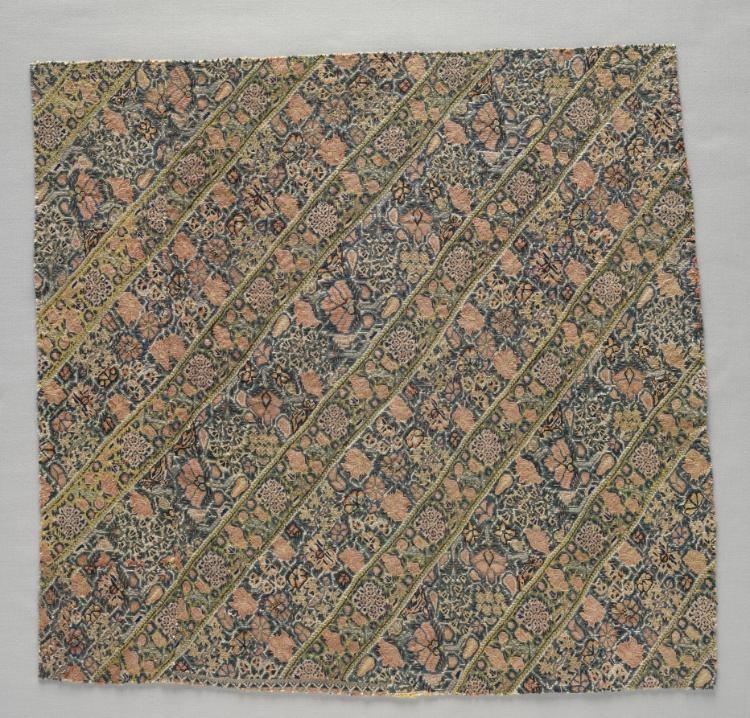
Reference photographs of documented Needlework embroidery (Suzan-duzi) pieces, credited to their sources. Compare construction, surface and wear with any piece you are offered — a resemblance is not proof of origin.
Needlework embroidery (Suzan-duzi) at a glance
| Persian name | سوزندوزی |
| Category | Textiles · Surface embroidery |
| Main techniques | surface-embroidery |
| Typical materials | cotton, silk |
| Places of making | sistan-baluchestan, isfahan, kerman |
| Current vitality | At risk |
Understanding Needlework embroidery (Suzan-duzi)
What Needlework embroidery (Suzan-duzi) is and how it is made
History
Embroidered covers and garment panels survive from the Safavid period onward. Balochi needlework and Kerman pateh are often discussed as distinct but related regional traditions.
Technique
Embroiderers count threads of the ground or follow a drawn design, working densely packed stitches that may cover the ground entirely; regional schools differ in stitch vocabulary and colour.
Collecting and identification
Stitch type, density, ground fabric and dye palette help comparison; museum attributions to regions are often approximate.
This guidance is educational only and is not an authentication or valuation service.
General background on the craft, not a statement about any individual object; dates and attributions summarise common positions in the literature and remain under review. Read the full Needlework embroidery (Suzan-duzi) entry.
Before you buy: what to inspect
- Turn the piece over: hand embroidery shows knots, thread joins and slightly uneven stitch lengths on the back.
- Machine embroidery has perfectly repeated stitches and often a paper or fabric stabiliser left on the back.
- Look at the ground cloth: is it hand-woven, and does the stitching follow the weave?
Typical materials: cotton, silk.
Red flags: copies and 'Persian style' imports
- Machine-embroidered pieces sold as hand needlework.
- Central Asian suzani or other embroideries sold as Iranian without a named maker or place.
A genuine Needlework embroidery (Suzan-duzi) piece should come with a named place of making in Iran (often sistan-baluchestan, isfahan, kerman) and a clear statement that it is handmade.
Questions to ask the seller
- Who embroidered it, and where?
- Which stitches and threads were used?
- Is the ground cloth hand-woven?
What affects the price
| Stitch density |
| Size |
| Design complexity |
| Maker |
Care and cleaning
- Do not iron directly on the embroidery; press from the back through a cloth if needed.
- Display away from direct sunlight, which fades silk and wool threads.
- Have older or metal-thread pieces cleaned by a textile conservator, not a general dry cleaner.
Storage
- Roll with the pile facing inward, never fold.
- Wrap in breathable cotton, not plastic.
- Protect against moths with regular airing and inspection.
Shipping
Rolled textiles travel well; ask for tube or rolled packing and tracked delivery.
Disclaimer
This guide is educational. It cannot confirm that any particular object is genuine, old or valuable. For important purchases, ask an independent specialist. Read the full Needlework embroidery (Suzan-duzi) entry.