
What documented Namad felt looks like
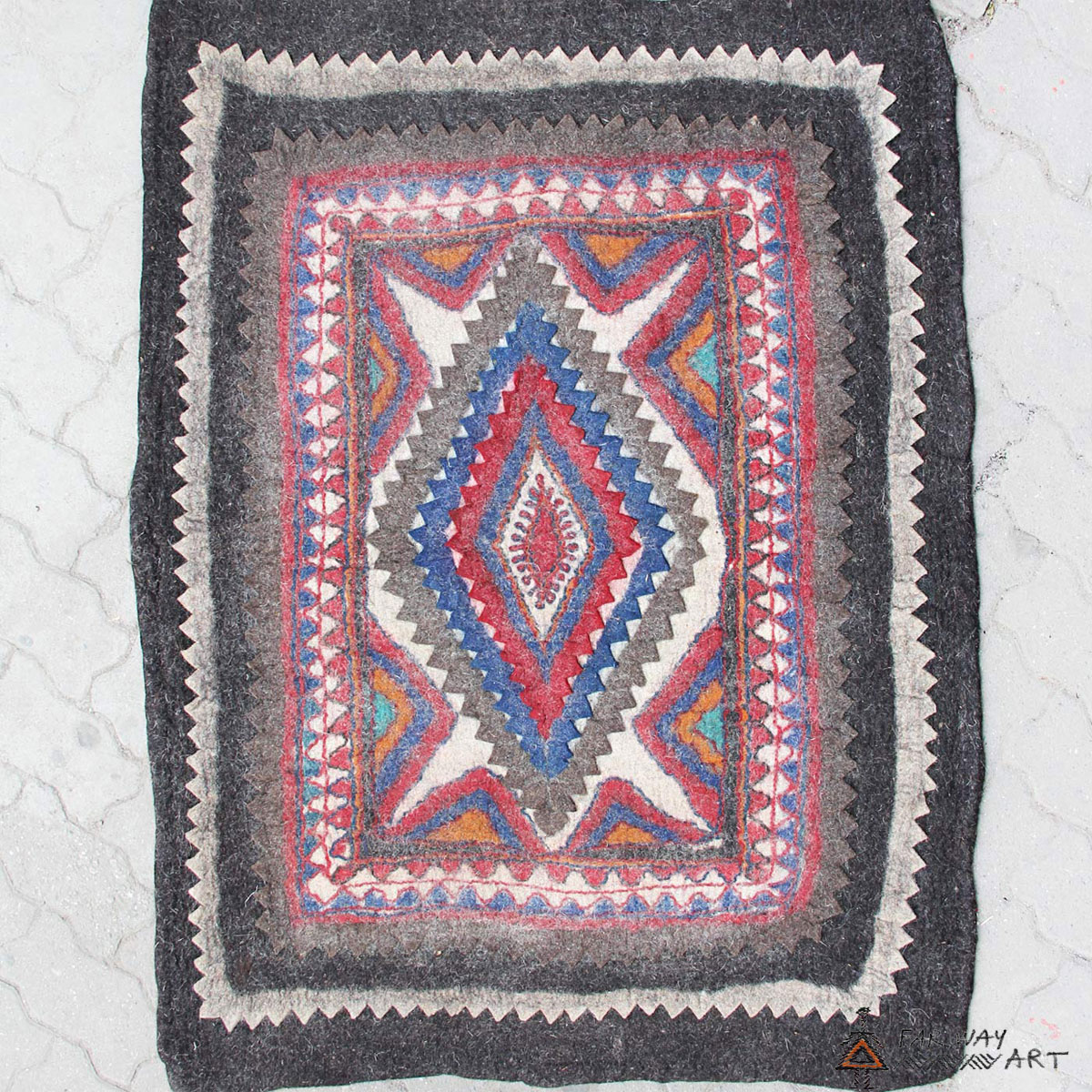
Reference photographs of documented Namad felt pieces, credited to their sources. Compare construction, surface and wear with any piece you are offered — a resemblance is not proof of origin.
Namad felt at a glance
| Persian name | نمد |
| Category | Textiles · Felted wool |
| Main techniques | wet-felting |
| Typical materials | wool |
| Places of making | isfahan, yazd, kerman |
| Current vitality | At risk |
Understanding Namad felt
What Namad felt is and how it is made
Definition
Namad is felted wool cloth, made not by weaving thread but by working loose wool fibres with water, soap and pressure until their scaled surfaces lock together into a solid, dense mat. The technique requires no loom, and namad-makers have historically worked with simple tools: a reed or bamboo mat, a source of hot water, and physical effort applied by hand, foot or roller.
Namad has served a wide range of everyday functions in Iran, including floor coverings, shepherd's cloaks that shed water and insulate against cold, saddle pads, and protective wrapping material, reflecting felt's practical qualities of warmth, water resistance and durability rather than decorative refinement alone.
History
Felting is among the oldest textile technologies in the wider Central Asian and Iranian region, associated historically with nomadic and pastoral groups for whom sheep's wool was abundant and weaving equipment less practical to transport. Documented Iranian namad-making centres, including workshops in Isfahan and other cities, produced both plain utilitarian felt and, in some cases, decorated felt with applied or pressed-in pattern.
Through the twentieth century, manufactured textiles and synthetic materials displaced much everyday use of felt for cloaks and floor covering, and craft surveys and heritage documentation describe a shrinking number of practitioners maintaining traditional hand-felting methods, with some production continuing for ceremonial, decorative or specialty markets.
Materials
Raw sheep's wool is the primary material, chosen and sorted for fibre quality since coarser and finer wool felt differently. Soap or another wetting agent and hot water are needed to open the fibre's scales and encourage matting; natural dyes are sometimes applied to the wool before felting for coloured or patterned namad.
- Raw sheep's wool, sorted by grade
- Hot water and soap to encourage fibre matting
- Natural dyes for coloured felt in some regional traditions
General background on the craft, not a statement about any individual object; dates and attributions summarise common positions in the literature and remain under review. Read the full Namad felt entry.
Before you buy: what to inspect
- Felt has no warp or weft: check that the design is felted into the surface rather than glued or stitched on.
- Press the felt: well-fulled namad is dense and firm, with an even thickness and no thin patches.
- Look at the edges for cracking and at the surface for moth damage.
Typical materials: wool.
Red flags: copies and 'Persian style' imports
- Needle-punched industrial felt with printed designs sold as hand-felted namad.
- Synthetic fibre sold as wool felt.
A genuine Namad felt piece should come with a named place of making in Iran (often isfahan, yazd, kerman) and a clear statement that it is handmade.
Questions to ask the seller
- Was it felted by hand, and where?
- Is it pure wool?
- Has it been mothproofed?
What affects the price
| Density and thickness |
| Design complexity |
| Size |
| Maker |
Care and cleaning
- Do not wash or soak felt; brush gently and air it regularly.
- Inspect often for moths, which favour wool felt.
Storage
- Roll loosely rather than folding, wrapped in breathable cotton.
Shipping
Rolled textiles travel well; ask for tube or rolled packing and tracked delivery.
Disclaimer
This guide is educational. It cannot confirm that any particular object is genuine, old or valuable. For important purchases, ask an independent specialist. Read the full Namad felt entry.