
Guides
Iranian Gifts That Fit Real Life: Thoughtful Handmade Picks
Find handmade Iranian gifts for hosts, weddings, colleagues and family, with practical advice on choosing useful crafts and avoiding machine-made copies.
Published 30 September 2026 · 9 min read
AI-written from our archive and public references; not expert reviewed. Prices, dates and attributions are indicative only — confirm with a specialist.
The best Iranian gifts are genuine handmade objects that fit the recipient’s everyday life: a khatam box for someone who likes an orderly desk, a qalamkar cloth for a frequent host, or a minakari plate for someone who enjoys displaying art. Rather than choosing the most elaborate piece, match the craft to their space, taste and care habits. This guide focuses on gifts people can comfortably live with—not objects that create an obligation to display, maintain or understand them.
What will make an Iranian gift welcome rather than burdensome?
Start with the recipient’s routines. Do they set a dining table, keep small mementos, collect drawings or prefer clear surfaces? A craft can be exceptional yet unsuitable: a large wall plate needs display space, a rug changes a room, and a delicate textile may worry someone who has young children or pets.
Think of the gift as a small agreement about ownership. You are offering beauty and usefulness; the recipient should not inherit unexpected cleaning, installation or repair tasks. When you cannot ask directly, choose something compact, non-personalized and easy to put away. For a substantial gift, inviting the recipient to choose between two handmade options is often more thoughtful than preserving the surprise.
Three questions before browsing
- Where could this object comfortably live without rearranging the recipient’s home?
- Does it support something they already do, rather than a habit you hope they will acquire?
- Can you explain its materials, handmade process and basic care in a short gift note?
Which handmade Iranian gifts suit different recipients?
| Recipient or habit | Handmade gift to consider | Check before choosing |
|---|---|---|
| An organized colleague | A small khatam lidded box | Usable interior dimensions, lid fit and workplace gift rules |
| A host who enjoys setting a table | A hand-block-printed qalamkar cloth | Finished size, washing guidance and suitability for regular use |
| Someone who collects decorative objects | A hand-painted minakari plate | Display space, secure mounting and enamel condition |
| A textile enthusiast | A hand-embroidered pateh panel from Kerman | Embroidery method, fibre details and mounting needs |
| A lover of drawing or lettering | An original work on paper by an Iranian artist | Original versus print, wording, attribution and framing |
| A couple furnishing a home | A handwoven Iranian kilim chosen together | Dimensions, colours, placement and willingness to maintain it |
These are starting points, not rankings of cultural importance. Smaller does not necessarily mean simpler to make, and a useful gift need not be plain. Let the recipient’s preferences narrow the field before comparing workmanship; otherwise, dazzling decoration can distract you from an awkward size or an object with no obvious place to go.
Why does a khatam box work well for a desk or bedside?
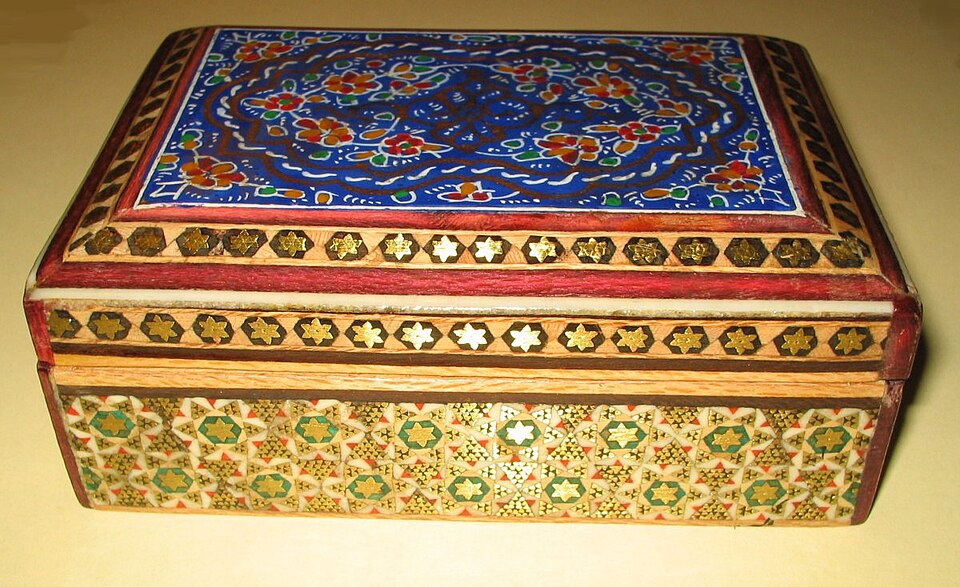
Khatamkari creates geometric surfaces from tiny assembled elements, commonly including wood, metal and bone. A handmade Iranian box can offer an approachable introduction to the craft because it has an immediate purpose: holding cufflinks, keepsakes or small stationery. Shiraz and Isfahan are important centres associated with khatam, but a city name on a listing is not evidence of where a particular box was made.
For gifting, usability matters alongside the patterned surface. Request the internal dimensions, a photograph of the open box and information about hinges or lining. A visually generous box may have a surprisingly small cavity. For jewellery, check for a smooth, suitable interior; do not assume a decorative box provides tarnish protection or conservation-grade storage.
Which textiles suit hosts and shared homes?
A qalamkar cloth can be a good gift for someone who enjoys changing a table setting without accumulating rigid decorative objects. The relevant handmade process is printing the fabric with carved blocks by hand; the base fabric need not itself be handwoven. Ask the seller to describe both the fabric and printing method so that “handmade” has a clear meaning.
For frequent use, choose dimensions that fit the table rather than buying by a photograph alone. Obtain washing and colourfastness guidance, especially if the cloth will sit beside pale upholstery. Do not infer natural dyes from muted colours or assume that a hand-printed cloth can tolerate hot washing. A recipient who prefers easy-care linens may be happier with a small occasional-use cloth than a full table covering.
Hand-embroidered pateh, associated with Kerman, suits a textile lover who appreciates detailed needlework. It is a different proposition from a casual tablecloth: ask how the seller intends the piece to be used and whether it needs backing or professional mounting. With termeh, be particularly precise about production. The name alone does not establish handweaving, so select only pieces whose handmade contribution is clearly explained.
When is minakari a better gift than something functional?
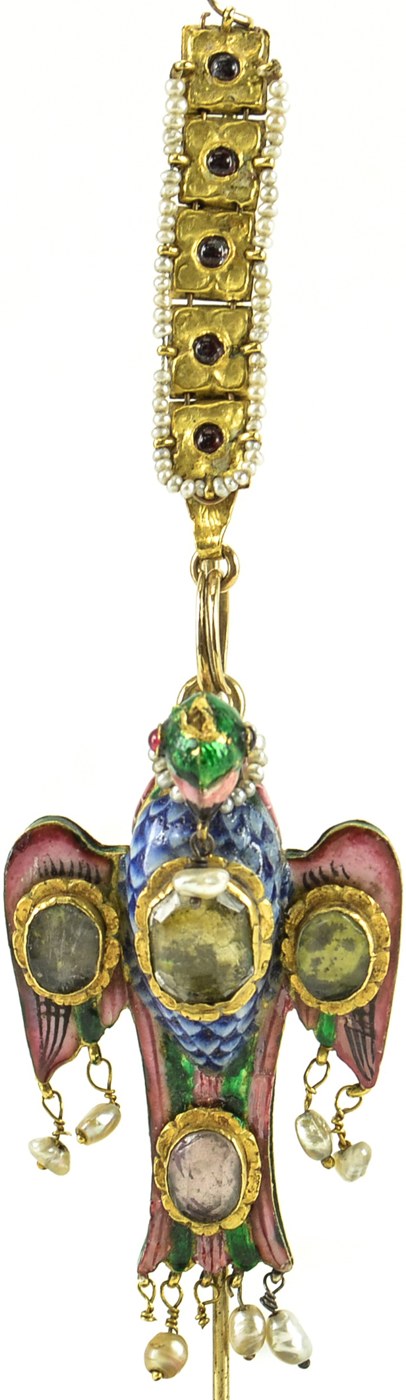
Hand-painted minakari enamel, often associated with Isfahan and commonly made on copper, suits someone who actively enjoys decorative display. A small plate can provide visual impact without taking over a room. It is less suitable when the recipient avoids ornaments, has no secure display location or would naturally mistake it for everyday serving ware.
Ask whether a stand or hanging arrangement is included and how it supports the piece without damaging the enamel. Check the rim and reverse for chips, repairs or exposed areas that the main listing image may hide. If a blue-and-white palette is not their taste, do not select it simply because it feels recognizably Iranian; handmade qalam-zani engraved metalwork may better suit someone who prefers metallic surfaces.
What suits someone who prefers art to household objects?
An original small painting, drawing or handwritten calligraphic work by an Iranian artist can be a personal gift without occupying a shelf. Choose it for the recipient’s taste rather than treating any traditional-looking image as interchangeable. Contemporary Iranian artists also make original work that draws on craft traditions without reproducing historical compositions.
For calligraphy, obtain the exact text, a reliable translation and the attribution if it quotes a poem. A beautiful inscription may carry religious, romantic or mournful content that changes its suitability. Attributions of widely circulated verses can be uncertain; if the seller cannot support one, do not repeat a famous poet’s name as established fact.
Confirm whether the work is original, a reproduction or a hand-coloured print. A signature alone does not resolve that question. Framing is also part of the gift’s practical cost and footprint: agree on it for significant purchases, or give the work with a clear offer to arrange appropriate framing after the recipient has seen it.
How should the occasion change your choice?
For a host, keep the gift easy to receive during a busy gathering. A neatly packed cloth usually demands less immediate attention than a fragile object requiring assembly. For a colleague, modest scale and usefulness are safer than intimate symbolism; check workplace restrictions before buying. For weddings and housewarmings, a shared choice can prevent colours, dimensions or display preferences becoming a problem.
At Nowruz, handmade Iranian work can be a thoughtful seasonal gift, but not every craft object has a defined role on the haft-sin table. Avoid presenting a general decorative item as a required traditional element. Likewise, Iranian recipients do not all share the same tastes or relationship to heritage: ask whether they would enjoy a traditional pattern, a contemporary handmade piece or something for everyday use.
How much work will the recipient inherit?
Consider the whole handover: carrying the object home, unpacking it, finding a place for it and maintaining it. The following comparison is a planning prompt, not a measure of artistic quality or durability. A framed miniature may be effortless for an established collector but inconvenient for someone renting a room with restrictions on wall fixings.
Qualitative editorial scale, not measured data: 1 means little setup and 10 means substantial planning. Assumes a finished small box, an occasional-use cloth and a rug requiring placement.
If luggage or delivery space is limited, a flexible textile may be easier to pack than ceramics or enamel. A hard box still needs protection against crushing and abrasion. For international gifts, check current destination rules, material restrictions, payment options and the carrier’s acceptance before purchase; rules affecting Iranian-origin goods can change and depend on jurisdiction.
What should you ask before paying?
For this gift guide, the threshold is genuine handmade Iranian work—not a machine-made object with Persian-looking decoration. Ask about the particular piece rather than accepting broad shop descriptions. Handmade production can involve tools, bought-in materials and several specialists; the useful question is which stages were performed by hand, by whom where known, and in which location.
| Listing claim | Ask instead | What remains insufficient |
|---|---|---|
| “Persian-style” | Where was this particular piece manufactured? | Pattern, product name or seller address alone |
| “Handmade khatam” | Is the decoration assembled inlay? Can I see close-ups and edges? | A printed geometric surface or one distant photograph |
| “Hand-painted enamel” | Which decoration is painted by hand, and can I see this exact piece? | Generic workshop footage unrelated to the item |
| “Traditional textile” | Is it handwoven, hand-block-printed or hand-embroidered? | The word “traditional” without process details |
| “Original miniature” | Is this entirely original painted work rather than a reproduction? | A signature or certificate with no clear supporting description |
A short purchase check
- 1
Request object-specific evidence
Ask for front, back, edge and detail photographs, along with dimensions and a written material description. For a box, include the interior; for textiles, request the reverse.
- 2
Clarify origin and process
Record the maker or workshop when known and the stated place of manufacture. If attribution is uncertain, retain that uncertainty rather than turning it into a gift-card fact.
- 3
Check condition and practical terms
Ask about repairs, defects, dispatch timing, protective packing and returns. A gift deadline is not a reason to overlook missing information.
- 4
Step away from unsupported claims
If the seller cannot distinguish inlay from printing or handweaving from machine weaving, choose another handmade piece with clearer information.
Small irregularities can support an understanding of process, but they are not proof by themselves. Skilled handwork can be exceptionally regular, while factory products can imitate unevenness. Likewise, a low price does not prove machine manufacture, and an expensive presentation box does not establish origin or craftsmanship.
How do you present the gift without overexplaining it?
Keep the introduction warm and specific: explain why you chose it for this person, then add a few factual lines about the craft. Separate confirmed purchase details from the seller’s uncertain attribution. Include a simple use restriction where relevant—such as “decorative only”—and keep the receipt, full correspondence and return information separately.

Include a small object note
- Craft name and a plain-English description of the handmade process.
- Maker or workshop, if known, and the stated place of manufacture.
- Materials disclosed by the seller, including animal-derived components.
- One or two essential care or use instructions supplied for the piece.
- A friendly reminder that you can help with framing, display or an exchange.
The strongest Iranian gifts combine a craft worth supporting with a recipient who will enjoy owning it. When two pieces appeal equally, choose the one with clearer production information, a better everyday fit and fewer unanswered questions. Thoughtfulness is not measured by size or ornament; it is shown by how comfortably the gift becomes part of someone’s life.
Frequently asked questions
What is a good Iranian gift for someone who knows little about Iran?
A small handmade khatam box or hand-block-printed qalamkar cloth is approachable because its purpose is easy to understand. Choose colours and dimensions that suit the recipient rather than trying to represent an entire culture. Add a short explanation of the process and the maker or place of manufacture when known.
What Iranian gifts are suitable for a wedding?
For a wedding, choose something both partners want: a handmade textile, an original artwork or a handwoven Iranian kilim selected together. Larger pieces affect shared space and are best discussed in advance. If you want a surprise, keep it compact and arrange an exchange option rather than committing the couple to a major decorative object.
Are minakari plates safe to serve food on?
Do not assume so. A handmade enamel plate may be intended only for display, and its appearance does not establish suitability for food contact. Ask for documentation relevant to its materials and intended use. If that information is unavailable, give it as a decorative object and make that limitation clear to the recipient.
How can I tell whether an Iranian gift is actually handmade?
Ask for the exact process, manufacturing location, material details and close photographs of the specific object. Useful evidence differs by craft: khatam should involve assembled inlay rather than printed decoration, while qalamkar should be hand-block-printed. Neither slight imperfections nor a signature proves handmade manufacture. Avoid sellers who cannot explain what their handmade claim means.
Can I buy handmade Iranian gifts outside Iran?
Yes, specialist retailers and diaspora businesses may carry handmade Iranian work, but a seller’s location or identity does not establish the origin of every item. Ask where the particular piece was made and how it was produced. Also check applicable trade restrictions, returns and material disclosures before ordering, especially when the seller will ship internationally.
What should I avoid when choosing Iranian gifts?
Avoid printed imitations sold as inlay, reproductions presented as original paintings and machine-made goods marketed only as Persian-style. Also avoid practical mismatches: oversized decor, untranslated inscriptions, animal-derived materials unsuitable for the recipient, or serving ware without relevant safety information. An impressive gift is not necessarily a considerate one if it creates unwanted work.
Explore further on CraftPersia
Sources and further reading
- Encyclopaedia Iranica — Encyclopaedia Iranica Foundation
- Heilbrunn Timeline of Art History — The Metropolitan Museum of Art
- Intangible Cultural Heritage — Iran — UNESCO
- Wikimedia Commons (images) — Wikimedia Foundation
General reference collections; they do not endorse this article.
Topics: iranian gifts · handmade crafts · thoughtful giving · gift etiquette · buying advice