
Collector guide · 6 min
Identifying khatam from printed imitation
Editorial team · updated 2026-07-30
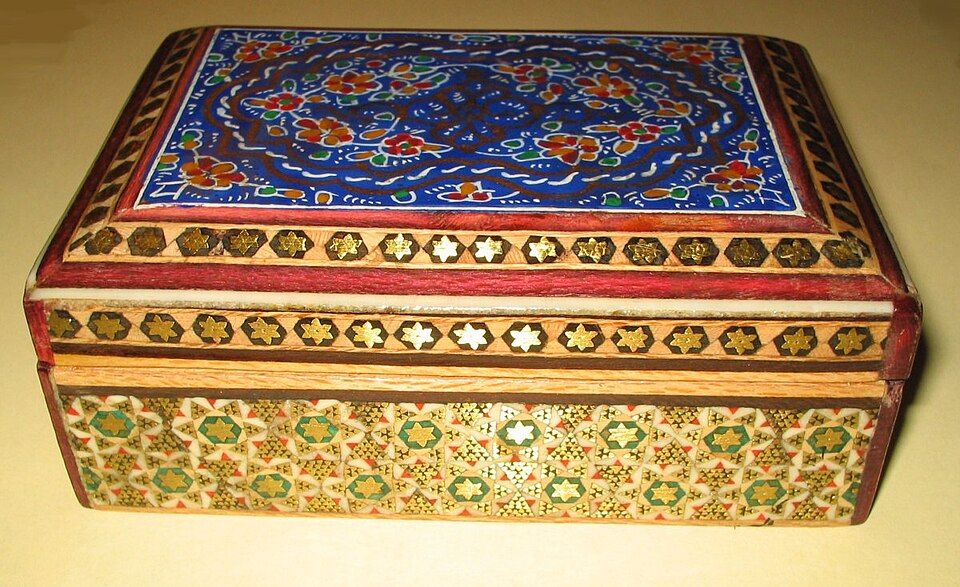
2006-05 · Fabienkhan (Wikimedia Commons) · Public domain (per Wikimedia Commons) · Photo source ↗
- Type
- Collector guide
- Reading
- 6 min
- Chapters
- 8
- Photos
- 1
Three checks that separate constructed inlay from a surface film printed to resemble it.
Look at the edges
Constructed khatam is a sheet with thickness: at an edge or an inner corner, the rod ends show in section and the pattern continues through the material. A printed film stops at the surface and usually meets the edge in a clean line.
Use magnification
Under a loupe, bone elements show fine porosity and slight colour variation. Plastic substitutes are uniform. Brass wire reads as metal, with a different reflectance from a printed yellow line.
Read the repeat
Sheets cut from one block repeat exactly, but adjoining sheets are hand-laid, so joins show small alignment shifts. A print repeats with mechanical regularity across the whole surface, joins included.
- Genuine method
- Bundled triangular rods of wood, bone, brass, cut into slices
- Typical centre
- Shiraz and Isfahan
How real khatam is built
Khatam makers glue thin triangular rods — wood, bone or camel bone, brass, sometimes silver — into bundles that show a star or rosette in section. The bundle is pressed, dried and sliced into thin sheets, which are laid on a wooden carcass and finished with lacquer or varnish. A single small box can contain thousands of individual pieces.
What to look for
Under a loupe, genuine khatam shows tiny geometric cells with slight irregularity and true material differences: wood grain, the porous texture of bone, the metallic glint of brass. Printed laminates and resin moulds show perfect repetition and no grain.
- Grain and texture differ from cell to cell
- Brass elements catch light as metal
- Edges and corners show the slices meeting
- Plastic imitations feel light and warm
Red flags
Very low prices, identical perfect repeats across a large surface, a pattern that stops at edges without strips, and descriptions such as 'khatam style' or 'inspired by' indicate imitation. Ask sellers for workshop location and close-up images of corners.
Technique and evidence
A khatam pattern begins with a bundle of differently coloured rods; slices of the bundle become a veneer. A film, print or transfer can imitate the star pattern. Examine intact and damaged edges under safe magnification, without scraping or removing finish.
Collecting and next steps
Ask for inside, underside and edge views, a materials list and maker or workshop records. Visible texture may help distinguish methods but cannot by itself verify age, bone species or geographic origin.
The steps here are educational; identification, conservation and valuation of an individual object require appropriate independent expertise.
| Check | Khatam | Printed laminate | Resin moulding |
|---|---|---|---|
| Magnified surface | Separate cells of different materials | Ink dots | Uniform glossy cast |
| Metal | Real brass rods | Printed gold | Painted |
| Repetition | Slight variation | Perfect | Perfect |
| Corners | Edge strips visible | Wrapped film | Rounded mould seam |
| Subject | What differs | What to do |
|---|---|---|
| Rod-built veneer | Physical elements continue into a cross-section | Inspect existing exposed edge, not a new scratch |
| Printed film | Pattern only on surface | Look at clean edge and repeated image |
| Unknown coating | May conceal either construction | Request maker documentation |
Timeline
- Preparation
Sort rods by material and section.
- Assembly
Bind, slice and lay the repeating pattern.
- Review
Document structure and uncertainty without destructive tests.
References and further reading
- [1] Encyclopaedia Iranica — 'Ḵātam-kāri' ↗
- [2] H. E. Wulff, The Traditional Crafts of Persia, MIT Press, 1966.Background on historical craft practice; not an authenticity test.
These sources provide context, not authentication or provenance for an individual object. Editorial interpretations remain under review.