
Definition
Jajim is a lightweight warp-faced flatweave, distinguished from kilim by its typically narrower loom width and the resulting practice of weaving in strips that are later joined edge to edge to make a full-sized cover. The narrow-loom method suited weavers who moved seasonally and could not maintain a wide fixed loom.
The finished cloth is thinner and more supple than a kilim, and its structure — bands of colour running the length of the warp, often patterned with small supplementary-weft figures — gives jajim a characteristically striped appearance even where additional motifs are worked in.
History
Jajim weaving is documented among village and pastoral communities in northwestern and central Iran, particularly associated with Azerbaijani-speaking weaving groups, though the craft has historically been practised more widely under regional names. Its household function — bedding, storage wraps, and covers — meant it was rarely made for outside trade until relatively recently.
As synthetic blankets and manufactured textiles became widely available through the twentieth century, everyday demand for handwoven jajim declined sharply in many villages, and the skill is now reported by craft researchers and heritage bodies to survive mainly among older weavers in a smaller number of communities.
Materials
Wool is the traditional fibre, sometimes combined with cotton for lighter or more affordable pieces. Because the warp carries most of the visual weight in jajim's warp-faced structure, warp yarns are spun and set with particular care for evenness of colour and tension.
- Handspun or commercially spun wool for warp bands
- Cotton sometimes used for warp or as a supplementary weft
- Vegetable and, later, synthetic dyes depending on period
Technique
Strips are woven individually on a narrow ground or frame loom, often no wider than the weaver's reach, with the warp threads dominating the visible surface so the weft is mostly hidden except where supplementary-weft patterning is introduced for small geometric motifs. Strips are then whip-stitched or otherwise sewn together along their long edges to build up the finished width.
Because each strip is woven separately, matching colour bands and tension across strips requires care; mismatched strips are a common sign of a piece assembled from unrelated weavings rather than made as a set.
Motifs
Decoration is generally restrained compared to pile carpets, favouring narrow bands of small geometric figures — diamonds, hooks, and stepped forms — introduced by supplementary weft against the striped ground. The overall effect relies as much on the rhythm of colour stripes as on figurative motifs.
Collecting and identification
Look for the seams joining individual strips; their regularity and the alignment of stripes across seams indicate careful assembly. Because jajim was made for household use, older pieces often show patching, mending and uneven wear that reflect genuine use rather than damage to be treated as defects.
As with other regional flatweaves, specific tribal attributions circulating in the market should be treated cautiously unless supported by documented provenance.
Preservation
Jajim's lighter, looser structure makes it more vulnerable to stretching if hung unsupported for long periods, so flat storage or full-width support is preferable to hanging by a single edge. Standard textile care applies: avoid prolonged sun exposure, keep dry, and consult a textile conservator before attempting to repair worn seams or fringes.
گالری
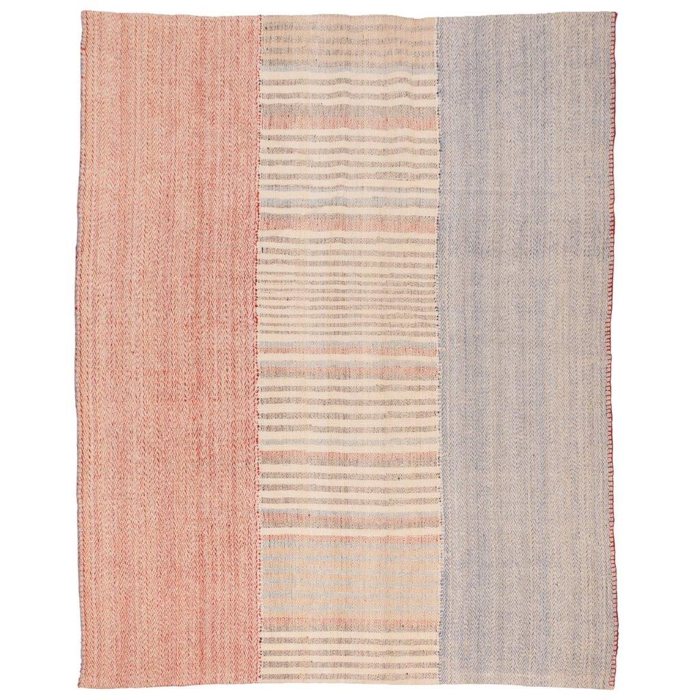
تصاویر نمونههایی معرف هستند، نه سندی برای رکوردهای نمونهٔ بازارچه. منبع و وضعیت مجوز آنها در بخش اعتبارهای عکاسی آمده است.
بازارچه
در حال حاضر هیچ شیئی از این صنعت فهرست نشده است.
- Construction
- Narrow-strip construction
- Object reading
- Structure, materials and condition before attribution
- Evidence status
- Educational summary under editorial review
Narrow-strip construction
Many jajims are woven as long narrow panels on a portable loom, then stitched together at the selvedges. The long coloured warp bands make the visible stripes; this distinguishes its usual construction from the weft-faced fields of many kilims.
Read the joins
Look for lengthwise seams joining strips and for patterned bands that run along the warp. Not all narrow striped textiles are jajim, and construction matters more than a vendor title.
- Narrow woven strips, often sewn together
- Lengthwise warp stripes
- Small supplementary-weft details on some pieces
Context, preservation and evidence
Workshops, households, museums and contemporary makers can use the same craft name in different ways. Record who made, sold and documented a piece before assigning a date or location. Condition and technique are observable; origin, attribution and value require further evidence.
These reading notes are educational, not an authenticity certificate or valuation. The associated source list is a starting point; many claims and translations still require specialist review.
Jajim در تصاویر
این تصاویر جنبهٔ نمایشی دارند و مربوط به شیء خاصی در فهرست نیستند. منابع در صفحهٔ منابع تصاویر آمده است.
| Type | How to distinguish it |
|---|---|
| Jajim | Warp-dominant narrow strips joined lengthwise |
| Kilim | Often weft-faced, sometimes slit-tapestry construction |
| Zilu | Cotton flatweave with a distinct reversible structure |
اصطلاحات کلیدی
- Jajim جاجیم
- Narrow, typically warp-faced woven cloth.
منابع و مآخذ
- Book: Housego, J. Tribal Rugs: An Introduction to the Weaving of the Tribes of Iran. Scorpion Publications, 1978.
- Institution: UNESCO, intangible cultural heritage documentation on Iranian craft practice.
در جایی که خاستگاه، تاریخ یا نمادشناسی محل مناقشه است، این مدخل روایتهای رقیب را بیان میکند نه اینکه میان آنها یکی را برگزیند. تحلیل سردبیری بهعنوان واقعیتِ مستند ارائه نمیشود.