
Exhibition
The Nomad Loom
دارِ عشایرGabbeh weaving in the Fars highlands
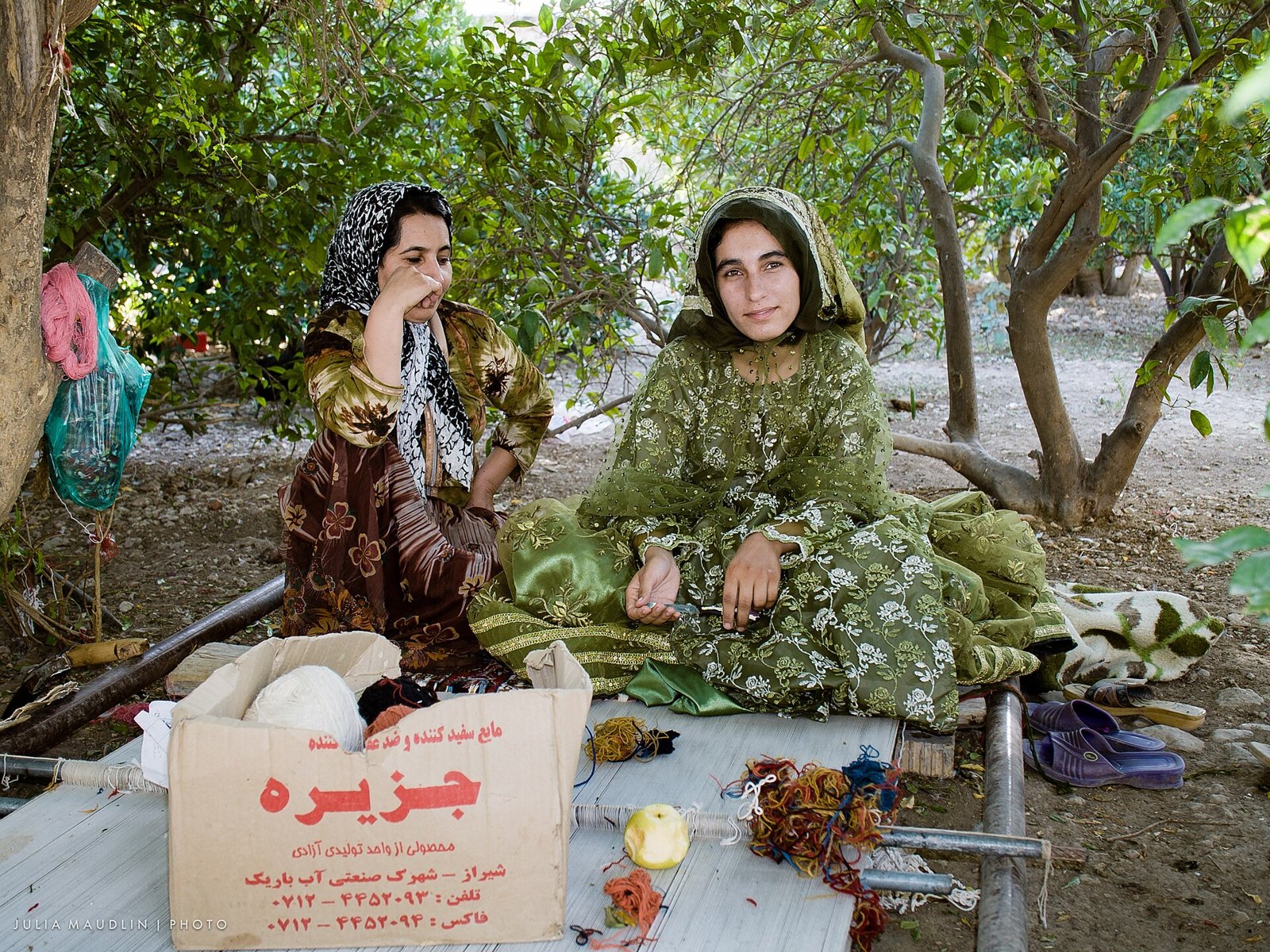
Qashqai weavers near Firuzabad, as documented by the source. Working-context photograph; the source does not identify the textile as gabbeh.
Date unverified · Julia Maudlin from Lake Oswego, Oregon, USA · CC BY 2.0 · Photo source ↗
Curatorial narrative
A gabbeh carries no cartoon. The design is held by the weaver, and the thick, long pile was made for the household — bedding and floor coverings in pastoral camps — long before it was made for export.
Late twentieth-century demand brought gabbeh to international markets, supporting weavers while also introducing workshop-made versions. The distinction matters, and the archive's entries keep it visible.
Room 1 · The camp
Gabbeh were woven by Qashqai, Luri and other pastoral weavers in Fars on horizontal ground looms that could be taken apart when the camp moved. Thick pile made them warm bedding and floor covers.
Room 2 · The weaver's design
There is usually no cartoon. Weavers place simple shapes, such as animals, figures, rectangles or a tree, freely in a large open field. Changes in wool batch create abrash, shifting bands of colour that are normal in handspun, hand-dyed wool.
Room 3 · Export and imitation
From the 1980s, gabbeh became popular abroad. Workshops in Iran and other countries began producing more regular versions. ‘Gabbeh-style’ rugs from outside Iran fall outside this archive's scope.
What to look for
- Long, dense wool pile and several weft passes between knot rows
- Abrash: natural colour shifts across the field
- Freely drawn, not perfectly symmetrical, motifs
- Seller information that names the country and the weaving community
Visitor questions
- Is every gabbeh tribal?
- No. Many modern gabbeh are woven in workshops, and some are made outside Iran. Ask for origin and maker information.
- Is abrash a defect?
- Usually not. Gentle colour shifts come from different dye batches. Harsh stripes or bleeding colour are a different matter.
Household textile, not only motif
Read a gabbeh through format, pile and ends as well as animals and geometric shapes. Household use may leave repairs absent from showroom images. Contemporary workshop rugs need their own accounts.
Do not infer community or migration history from open design. Seller accounts remain attributed. Iranian hand manufacture and historical nomadic use are different claims; one does not establish the other.
Colour variation has several causes
Abrash describes colour variation often associated with yarn or dye batches. Fading, treatment and reweaving can also alter appearance. Variation does not prove natural dyes or handspun wool.
Separate colour change from pile loss and repair in condition records. Use neutral light and both faces. Do not burn fibres or wet-rub a rug to test a seller's statement.
A loom picture and its limits
The documented photograph shows Qashqai weaving near Firuzabad. It supports working-context discussion but does not identify the textile as gabbeh. Preserve that limit instead of changing its caption to match the title.
Maker photography needs consent and accurate attribution. One scene cannot stand for all pastoral communities. Compare process context with source-listed textile descriptions while retaining their different provenance.
Compare the evidence
| Object or term | What to examine | Limit of the evidence |
|---|---|---|
| Gabbeh | Pile and production account | Simple motifs do not prove nomadic use. |
| Loom scene | Exact caption and place | Does not establish gabbeh structure. |
| Abrash | Colour and condition | Not a natural-dye certificate. |
Sources and further reading
- Encyclopaedia Iranica · Carpets
Weaving history and vocabulary; not validation of pictured seller claims.
- Canadian Conservation Institute · Caring for cultural heritage
Preventive care context; individual objects have not been assessed for treatment.
Editorial draft awaiting specialist review. References provide context, not verification of every statement, object attribution or current workshop access.
This exhibition is an editorial arrangement of archive material. Objects shown are sample marketplace records, and photographs are representative examples — not images of a physical collection.
More exhibitions
Other curated readings of the archive.