
Exhibition
The Drawn Carpet
فرشِ نقشهکشیدهCartoons, knot counts and the workshop weavers of Tabriz
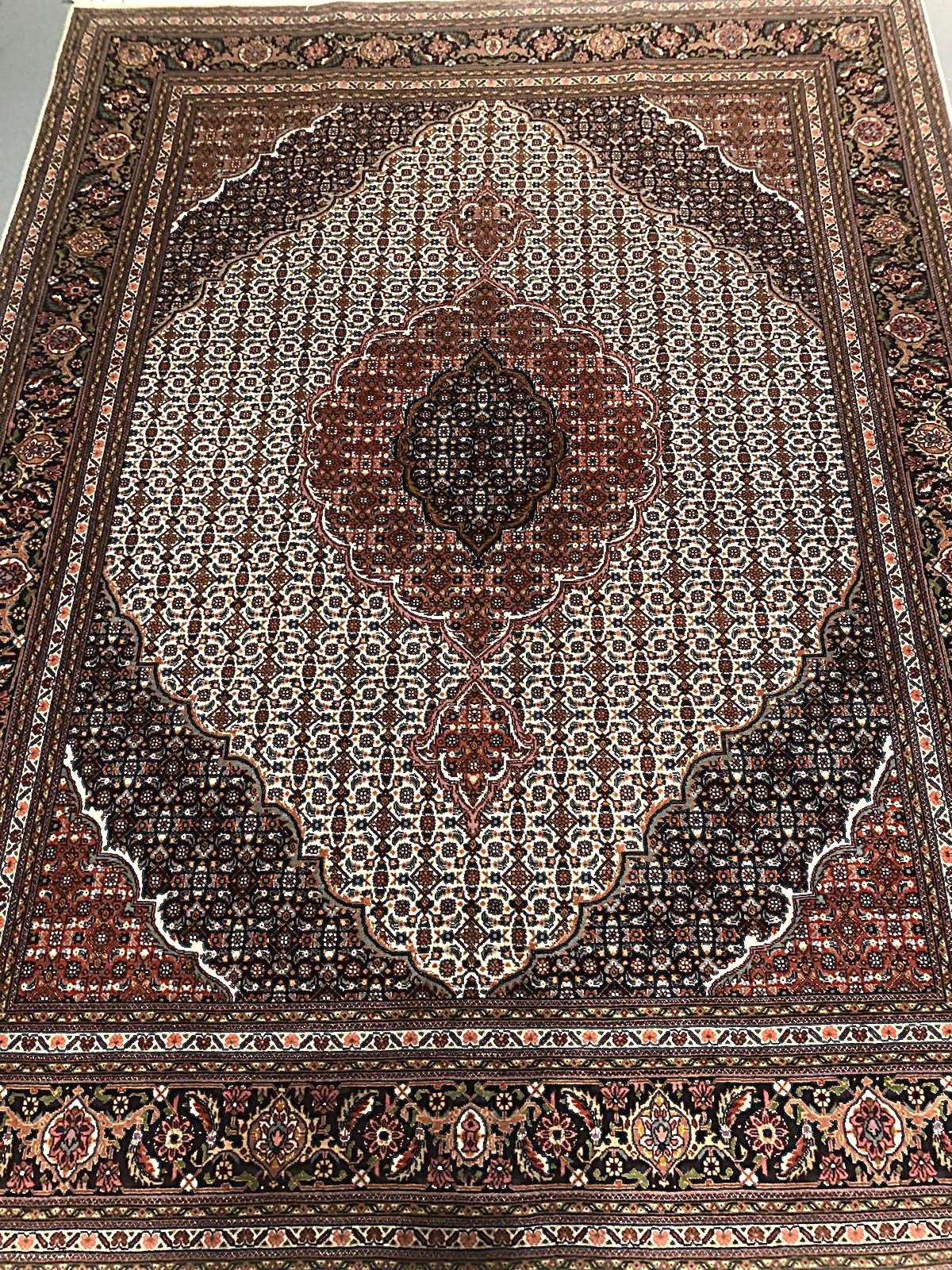
Source-listed Tabriz-design carpet: attributed comparison, not independently confirmed origin. Image reuse permission is unreviewed.
Listing image, 2025 · Arabesque Rugs (photographer not stated) · Permission status not reviewed · Photo source ↗
Curatorial narrative
In a workshop carpet the design exists twice: once on the squared paper of the cartoon, and once in wool. The weaver translates the drawing knot by knot, and the fineness of the result is read in the density of those knots.
Tabriz organised this translation on a commercial scale in the nineteenth century, and its workshops still set the reference for designed, drawn-carpet weaving in Iran.
Room 1 · The cartoon
A designer draws the carpet on squared paper, where each square stands for one knot and its colour. For a symmetrical design, often only a quarter or half of the carpet is drawn and the weaver mirrors it.
Room 2 · The loom
Tabriz weavers commonly use a hook knife (qollab) and the symmetric knot. Knot density is often given in raj, a local count of knots across about 7 cm. A higher count allows finer drawing, but it does not by itself make a carpet better made.
Room 3 · The market
From the late nineteenth century, Tabriz merchants organised workshops for European and American buyers. This shaped room-size formats, medallion and pictorial designs, and the city's reputation as a centre of designed carpets.
What to look for
- Reverse construction, foundation and knot rows; clarity alone does not identify hand knotting
- Warp ends and any replaced fringe; later fringe can also occur on a handwoven rug
- Small irregularities in the outline of the border
- Matching quality in the field and in the corners
Visitor questions
- Does a high raj prove a carpet is from Tabriz?
- No. Knot count shows fineness, not place. Origin depends on structure, materials, design and documentation together.
- Is ‘Tabriz design’ the same as a Tabriz carpet?
- No. Tabriz designs are woven elsewhere, including outside Iran, and by machine. Ask where and how the rug was made.
Drawing translated into yarn
A cartoon organises colours and knot positions, but yarn, foundation and weaving affect the result. Compare field, corners and medallion transitions. Symmetry alone cannot establish mechanised production.
Regular drawing occurs in handwork; asymmetry may reflect tension, design, wear or repairs. Neither is a universal handmade test. Process evidence and reverse examination offer a stronger description.
Knot count is not a judgement
Raj needs a defined length, direction and convention. Density can permit fine drawing while materials, finishing and condition remain separate. Do not turn a dealer figure into a universal score.
State whether counted or estimated. Repairs and different horizontal and vertical densities affect samples. Knot type does not prove Tabriz: multiple knot structures occur in Iranian weaving.
Workshop and actual object
Tabriz can describe production, market or design. A new Iranian workshop rug can be genuine without antique age or a historical master's name. A similar design woven abroad remains outside the archive's origin rule.
Keep maker statements, dimensions without fringe, both-face views and repairs together. Museum references are not valuations. Replaced fringe needs investigation rather than automatically disqualifying hand weaving.
Compare the evidence
| Object or term | What to examine | Limit of the evidence |
|---|---|---|
| Cartoon | Documented colour grid | Regularity does not prove machine work. |
| Structure | Foundation and knot rows | Density is not locality. |
| Trade label | Maker and place evidence | Design can circulate internationally. |
Sources and further reading
- Encyclopaedia Iranica · Carpets
Weaving history and vocabulary; not validation of pictured seller claims.
- Canadian Conservation Institute · Caring for cultural heritage
Preventive care context; individual objects have not been assessed for treatment.
Editorial draft awaiting specialist review. References provide context, not verification of every statement, object attribution or current workshop access.
This exhibition is an editorial arrangement of archive material. Objects shown are sample marketplace records, and photographs are representative examples — not images of a physical collection.
More exhibitions
Other curated readings of the archive.