
Exhibition
Stars in Wood
ستارهها در چوبKhatam inlay and the geometry of the bundled rod
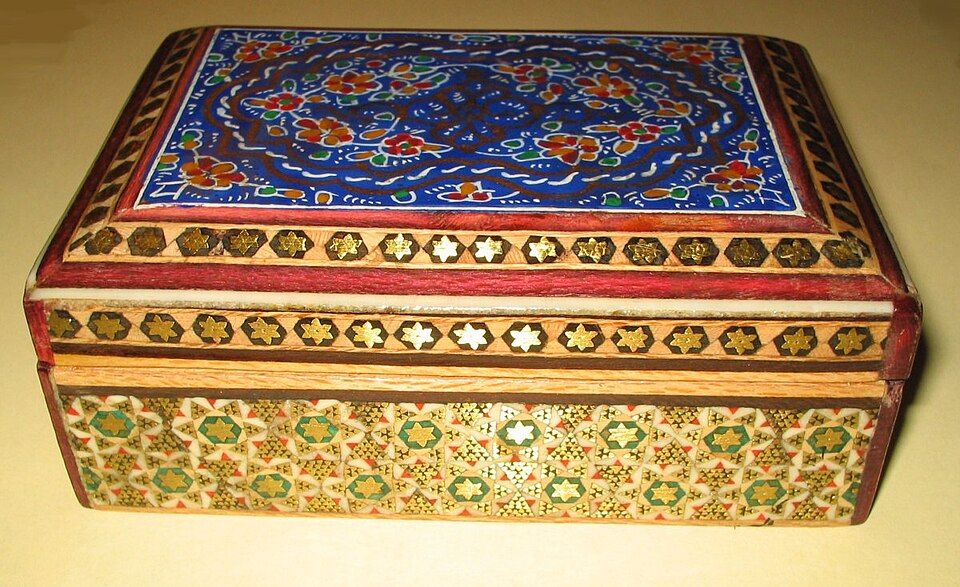
Documented khatam box: compare small repeating units and border assembly. Not a verified inventory record.
2006-05 · Fabienkhan (Wikimedia Commons) · Public domain (per Wikimedia Commons) · Photo source ↗
Curatorial narrative
Khatamkari begins not on the object's surface but inside a bundle: rods of wood, bone and metal glued into a prism whose cross-section is the design. Each slice off the bundle repeats that star, and the surface is assembled from hundreds of such slices.
This small exhibition gathers the archive's inlay material — the encyclopedia entry, the workshop record and the sample marketplace object — to show how one geometric decision repeats across doors, boxes and frames.
Room 1 · The bundle
The small design is established by arranging prepared rods of wood, bone or substitutes and metal into patterned bundles. Their cross-sections form repeating units such as stars. Bundles are fitted and glued, then sliced across the pattern; preparation and arrangement vary between workshops. The material combination needs a maker statement rather than identification from colour alone.
Room 2 · The slice
Thin slices are cut across the bundle and glued edge to edge on the object's base. Each slice holds the same small pattern. The quality of the work shows in tight joins, an even layout and clean borders, not in how many colours are used.
Room 3 · Object and place
Isfahan and Shiraz are the best-known centres. Boxes, frames and backgammon sets are common today. Doors, pulpits and furniture panels from earlier periods show the same method at architectural scale. Dating and attributing older pieces needs expert examination.
What to look for
- Small pattern units that repeat exactly across the surface
- Tiny joints between pieces, visible under a magnifier
- Bone or metal pieces that sit level with the wood
- A slight unevenness that a printed film or decal would not show
Visitor questions
- Is a printed ‘khatam-style’ box the same thing?
- No. Printed or laminated surfaces copy the look but contain no inlaid pieces. Under magnification they show dots of printing ink or a smooth plastic film.
- Why do some pieces crack?
- Wood, bone and metal react differently to changes in humidity. Keep pieces away from radiators and direct sun, and dust them gently with a dry cloth.
A box beyond its decorative skin
Begin with carcass, lid, hinge, base and veneer. Rod-bundle cross-sections make small stars; larger borders fit them around corners and openings. A face view may conceal loose edges and replacement parts. Ornament and sound assembly are distinct qualities.
Compare adjacent faces and where pattern stops. Gaps can reflect workmanship, stress or repair. A filled gap is not automatically original. The source photograph documents its own box, not every visually similar object.
Repetition and substitutes
Khatam, wood marquetry and printed geometric ornament can share stars. Examine small repeated units and their relation to the larger field. Obtain maker process evidence rather than taking geometric similarity as proof.
Materials need statements independent of colour. Bone, substitutes, timber and metal may be difficult to identify photographically. Avoid scratch and solvent tests and ask about coatings and replacements before discussing age.
Looking without damage
Wood, metal and adhesives react differently to environmental change. Broad support and protection from direct heat are more useful than polishing to a presumed original shine. Loose inlay requires advice rather than home gluing.
This is an editorial exhibition, not stock for inspection or sale. Source and sample comparisons retain their own qualifiers. They teach observation without certifying maker, age or country.
Compare the evidence
| Object or term | What to examine | Limit of the evidence |
|---|---|---|
| Veneer | Repeated units and borders | Pattern is not process evidence alone. |
| Carcass | Corners and lid assembly | Ornament does not prove strength. |
| Finish | Condition and repairs | Gloss cannot identify age. |
Sources and further reading
- Canadian Conservation Institute · Caring for cultural heritage
Preventive care context; individual objects have not been assessed for treatment.
Editorial draft awaiting specialist review. References provide context, not verification of every statement, object attribution or current workshop access.
This exhibition is an editorial arrangement of archive material. Objects shown are sample marketplace records, and photographs are representative examples — not images of a physical collection.
More exhibitions
Other curated readings of the archive.