
Exhibition
Seven Colours on Clay
هفت رنگ روی سفالHaft-rang tile painting from mosque wall to studio panel
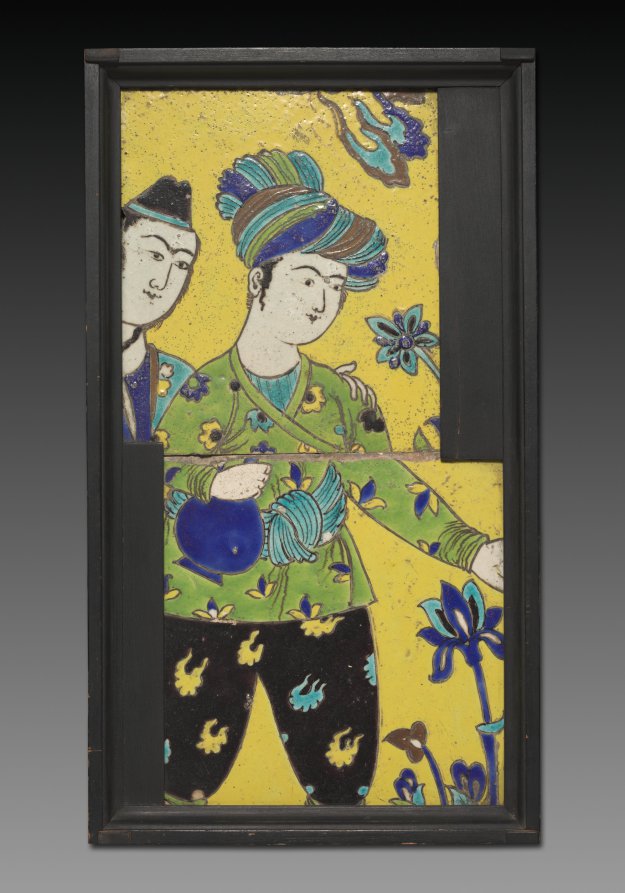
Wall tile, Iran, 1600s, Cleveland Museum of Art accession 1915.648. Historical subject, not a modern workshop-process photograph.
Wall tile with a man carrying a wine bottle, Iran, 1600s, acc. 1915.648 · Cleveland Museum of Art · CC0 (museum open access) · Photo source ↗
Curatorial narrative
Haft-rang — seven colours — names a technique, not a fixed palette: several glaze colours painted on one tile and fired together, where mosaic would have cut them apart. The method covered Safavid and Qajar buildings with figurative and floral imagery at a speed mosaic could not match.
The same technique survives in studio panels today. The photographs in this archive's tile entries show that living workshop practice rather than museum objects.
Room 1 · One tile, many colours
In haft-rang work, a painter applies several coloured glazes side by side on one square tile, and all are fired together. Lines of a greasy resist, often called cuerda seca in other traditions, can keep the colours from running into each other.
Room 2 · The wall
Many tiles together form one large picture: gardens, vases, birds or figures. Compared with cut-tile mosaic, the method was faster and cheaper for covering large walls, which helps explain its spread in Safavid Isfahan and later Qajar buildings.
Room 3 · The studio today
Workshops in Isfahan and other cities still paint panels by hand. Modern panels may use industrial tile bodies or commercial glazes; this does not make them inauthentic, but sellers should describe materials honestly.
What to look for
- Brush marks and slight differences between repeated motifs
- Colour edges that meet without the joints seen in mosaic
- Hand-drawn outlines rather than printed dots under magnification
- Tile edges that line up so the picture continues across joints
Visitor questions
- How is haft-rang different from moarraq?
- Moarraq is assembled from separately cut pieces, each a single colour. Haft-rang paints several colours on one tile.
- Are printed decal tiles haft-rang?
- No. Decal or digitally printed tiles copy the look. Hand-painted work shows brushwork and small variations.
Tile and panel together
The panel comprises physical tiles; colour areas within each describe another organisation. Follow the design across tile edges without confusing panel joints and cut-mosaic boundaries. One scene can span several tiles.
The displayed historical tile has its own catalogue date and medium. It is not a process photo of all firing stages. Contemporary hand painting may use commercial bodies or glazes; describe manufacture instead of inferring it from palette.
Not an exact seven-colour recipe
Haft-rang is conventional terminology. Counting colours is not a test, especially with loss or repair. Outlines inform looking but cannot establish original formulation or firing sequence.
Compare body, glaze and documented process across periods. Print and hand painting can share designs. A black outline or figurative scene cannot independently assign Safavid or Qajar age.
Architectural fragments and responsibility
Loose tiles may lose their architectural history. Provenance and documented collection matter. This archive does not encourage buying undocumented fragments or hide replacements behind broad building dates.
Support ceramics instead of lifting chipped corners. Do not wash old mortar or salts away as an amateur treatment. The exhibition compares catalogue subjects and techniques, not an authenticated wall reconstruction.
Compare the evidence
| Object or term | What to examine | Limit of the evidence |
|---|---|---|
| Polychrome tile | Colours in one body | Seven is not a literal test. |
| Mosaic | Fitted coloured pieces | Panel grout is not proof. |
| Replacement | Date and installation | Matching pattern is not matching age. |
Sources and further reading
- Canadian Conservation Institute · Caring for cultural heritage
Preventive care context; individual objects have not been assessed for treatment.
Editorial draft awaiting specialist review. References provide context, not verification of every statement, object attribution or current workshop access.
This exhibition is an editorial arrangement of archive material. Objects shown are sample marketplace records, and photographs are representative examples — not images of a physical collection.
More exhibitions
Other curated readings of the archive.