Definition
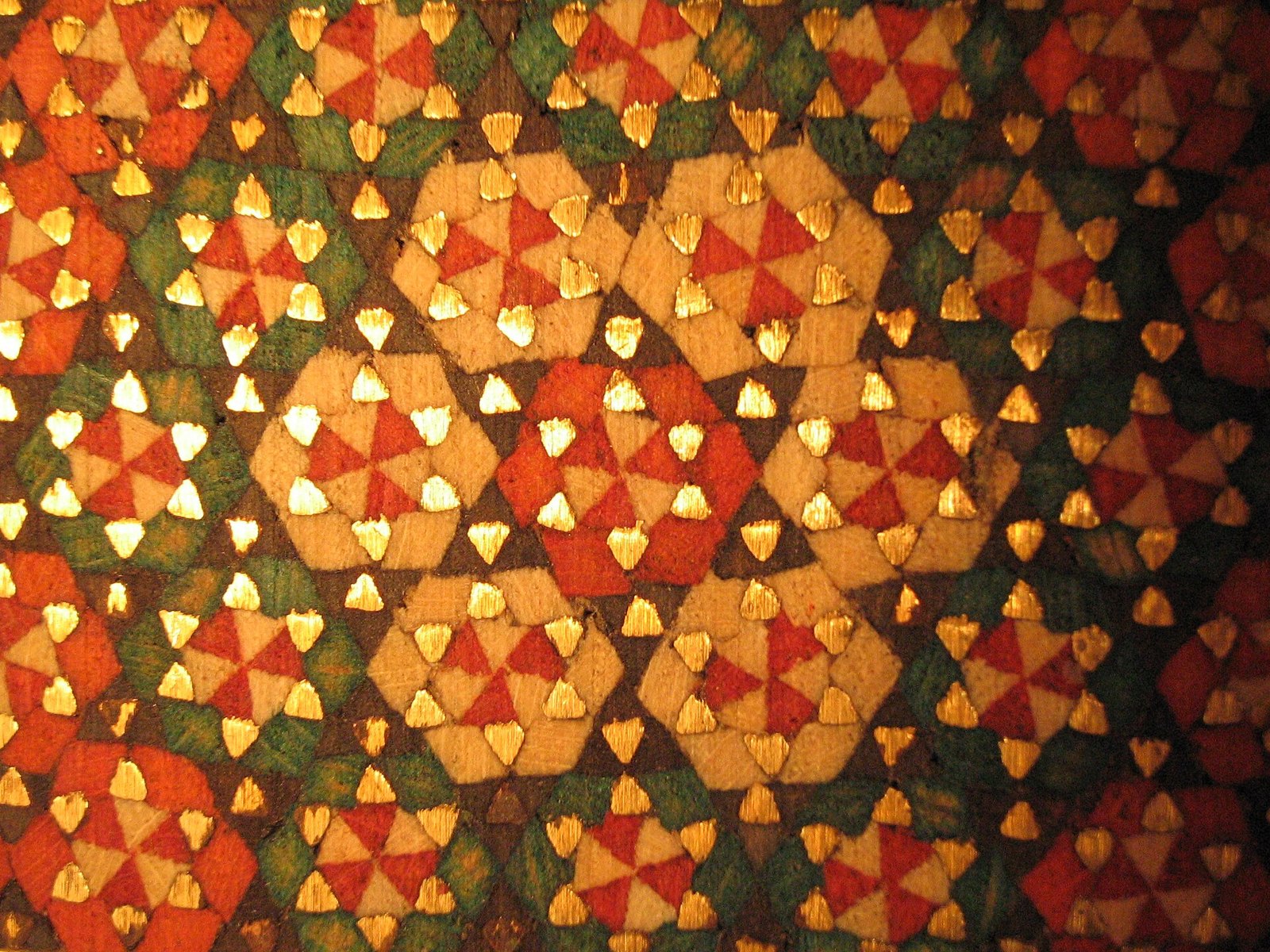
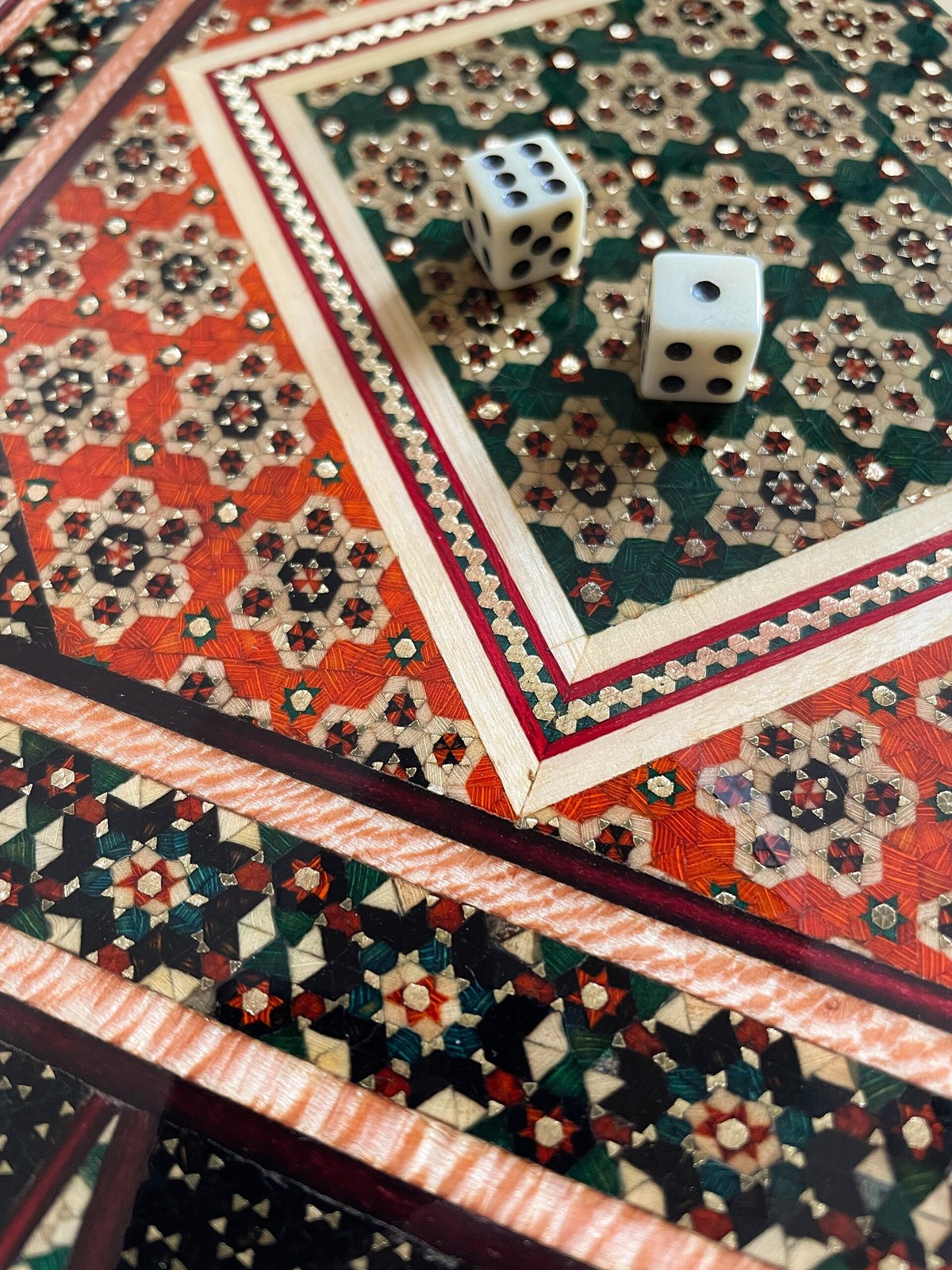
Khatamkari is the assembly of a decorative surface from bundled rods rather than from cut shapes. Rods of contrasting material are filed to a triangular section, bound into a six-pointed star unit, glued into larger blocks, and then sliced across the grain into sheets thin enough to bend around a curved carcase.
Because the pattern is built into the block before slicing, every sheet cut from one block repeats the same figure. Fineness is measured by how many elements fall within a given area: the most demanding work packs several hundred rods into a single star repeat.
History
Inlaid geometric woodwork is documented in Iran from the Safavid period, when Isfahan and Shiraz workshops produced doors, Quran stands, boxes and instrument bodies for court and religious patrons. Earlier related traditions of geometric woodwork existed, but the direct line of descent for the bundled-rod method is not firmly established in the published record.
Production shifted toward smaller export objects in the Qajar period, and again in the twentieth century toward boxes, frames and cases sold to visitors. Several twentieth-century workshops in Isfahan maintained the finer standards; others adopted printed or transferred imitations that reproduce the appearance without the construction.
Materials
The dark elements are usually ebony or stained hardwood, the mid-tones walnut and jujube, and the white elements bone. Thin brass or, in older work, silver wire supplies the metallic lines. The carcase beneath is typically walnut or another stable hardwood.
- Walnut and jujube for warm mid-tones
- Ebony or dyed hardwood for dark lines
- Camel bone for white elements
- Brass wire for metallic accents
- Animal or fish glue in traditional practice
Technique
Rod preparation dominates the work. Each rod must be filed to a consistent triangular section along its full length, since any inconsistency compounds when hundreds are bound together. Bundles are bound with cord and cured under pressure before being combined into blocks.
Slicing is the point of greatest loss: a block that has shifted during curing will produce sheets with broken figures. Applied sheets are pressed, scraped level, and finished with oil or lacquer.
Motifs
The dominant figure is the six-pointed star within a compass-generated polygon grid, shared with tilework and lattice woodwork. Floral arabesque appears in painted or inlaid panels set within a khatam border rather than in the tessellation itself.
Collecting and identification
Examine an edge or an interior corner. Genuine khatam shows the rod ends in section, so the pattern continues through the thickness of the sheet; a printed imitation stops at the surface film. Under magnification, bone elements show fine porosity that plastic substitutes do not.
Lifted or crazed lacquer, shrinkage gaps at panel edges, and replaced hinges are common on older boxes and are not in themselves evidence of poor quality. Claims of a specific workshop or date should be supported by documentation rather than accepted from a description alone.
Preservation
Stable relative humidity matters more than anything else: the carcase and the inlay sheet move at different rates, and repeated swings lift the sheet from the ground. Keep pieces away from direct sun and heat sources, dust with a soft brush, and refer lifted areas to a conservator rather than applying adhesive.
Current status
The finest grades of khatam are made by a small number of documented workshops, concentrated in Isfahan. Published counts of active master practitioners vary and should be treated as approximate; what is consistently reported is a decline in the number of artisans working at the finest rod densities.
Gallery
Images shown are documented examples and objects currently listed. Captions record what is known; where origin or date is an estimate it is labelled as such.
Marketplace
Sources & references
- Book: Wulff, H. E. The Traditional Crafts of Persia. MIT Press, 1966.
- Museum catalogue: Victoria and Albert Museum, Middle East collection records, inlaid woodwork.
- Institution: UNESCO, intangible cultural heritage documentation on Iranian craft practice.
Where origins, dates or symbolism are contested, this entry states the competing readings rather than choosing between them. Editorial analysis is not presented as documented fact.