
What documented Sermeh-duzi looks like
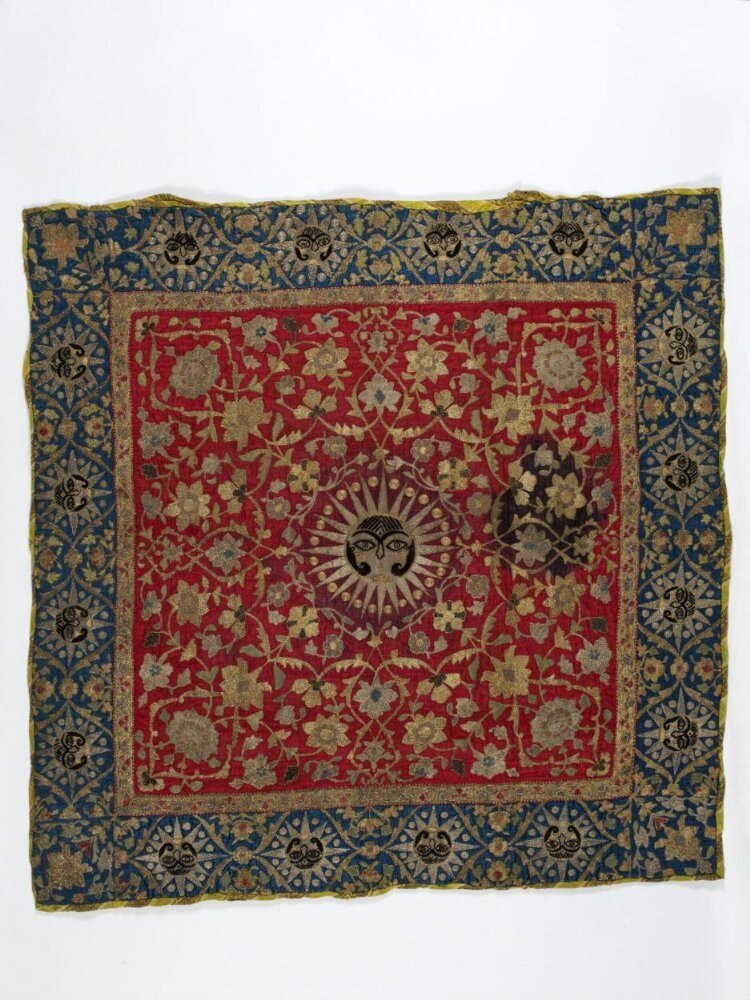
Reference photographs of documented Sermeh-duzi pieces, credited to their sources. Compare construction, surface and wear with any piece you are offered — a resemblance is not proof of origin.
Sermeh-duzi at a glance
| Persian name | سرمهدوزی |
| Category | Textiles · Metal-thread embroidery |
| Main techniques | metal-thread-couching |
| Typical materials | metal-thread, silk, cotton |
| Places of making | isfahan, kerman |
| Current vitality | At risk |
Understanding Sermeh-duzi
What Sermeh-duzi is and how it is made
Definition
Sermeh-duzi is a couched metal-thread embroidery technique, historically worked with fine wire or wire-wound thread laid on the surface of the cloth and stitched down with a separate finer thread rather than passed through the ground fabric itself, since drawn metal wire is too rigid and abrasive to sew directly. The result is a raised, reflective surface pattern suited to heavier fabrics such as velvet.
The technique belongs to a broader family of gold-thread and metal-thread embroidery practised across the historic Persianate and Ottoman world, and Iranian sermeh-duzi shares methods and some motifs with related traditions while developing its own regional conventions in workshops such as those of Isfahan and Rasht.
History
Metal-thread embroidery for court and ceremonial dress is documented in Iran through the Safavid and Qajar periods, used on garments, horse trappings, cushion covers and religious textiles for patrons who could afford the costly gold and silver wire. The craft's prestige was closely tied to the cost of its materials as much as to the skill required.
Demand for elaborate metal-thread embroidered garments declined with changes in dress and court patronage through the twentieth century, and production narrowed toward ceremonial, religious and specialty commissions rather than everyday courtly use, a shift documented in general surveys of Iranian textile crafts.
Materials
Fine wire, traditionally of gold or silver, or more commonly a base-metal wire washed or plated to resemble precious metal, is wound around a silk core to make workable metal thread. The ground cloth is usually velvet or another dense weave capable of supporting the weight and stiffness of couched metal work.
- Wire-wrapped metal thread, historically gold or silver, more often brass-based in later work
- Silk core thread beneath the metal wrapping
- Velvet or heavy woven ground cloth
- Fine couching thread to secure the metal thread to the surface
General background on the craft, not a statement about any individual object; dates and attributions summarise common positions in the literature and remain under review. Read the full Sermeh-duzi entry.
Before you buy: what to inspect
- Sermeh-duzi is couched metal-thread embroidery, usually over card or padding; look for the couching stitches holding the metal threads.
- Real metal thread tarnishes; plastic metallic thread stays evenly bright.
- Machine embroidery has perfectly repeated stitches and often a paper or fabric stabiliser left on the back.
Typical materials: metal-thread, silk, cotton.
Red flags: copies and 'Persian style' imports
- Lurex or metallic polyester sold as gold thread.
- Machine-embroidered metallic motifs on synthetic velvet.
A genuine Sermeh-duzi piece should come with a named place of making in Iran (often isfahan, kerman) and a clear statement that it is handmade.
Questions to ask the seller
- What is the metal thread made of?
- What is the ground fabric?
- Who made it?
What affects the price
| Metal-thread content |
| Density and padding |
| Size |
| Maker |
Care and cleaning
- Do not wash; handle with clean, dry hands.
- Display away from damp and direct sun.
- Consult a textile conservator before any cleaning.
Storage
- Roll with the pile facing inward, never fold.
- Wrap in breathable cotton, not plastic.
- Protect against moths with regular airing and inspection.
Shipping
Rolled textiles travel well; ask for tube or rolled packing and tracked delivery.
Disclaimer
This guide is educational. It cannot confirm that any particular object is genuine, old or valuable. For important purchases, ask an independent specialist. Read the full Sermeh-duzi entry.