
Definition
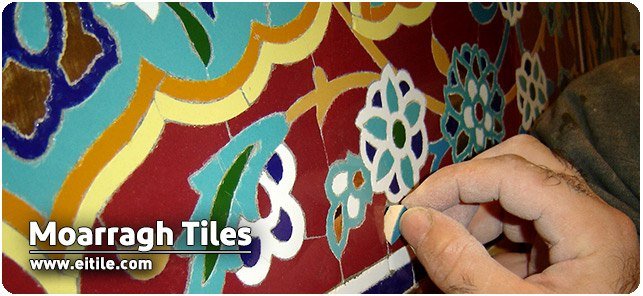
Moarraq, meaning inlaid or veined, refers to tile mosaic assembled from small monochrome pieces rather than from tiles that are individually painted with a multicolour design. Each colour is fired separately as a plain glazed tile, then cut by hand into the precise shapes required by a full-scale drawing.
The cut pieces are laid face down on the drawing, glaze side against the paper, and mortar is poured over the reverse to bind them into a panel, which is then lifted, cleaned and set into the wall or dome as a finished section. The technique allows sharper colour separation and more intricate curvilinear detail than painted tile, at considerably greater labour cost.
History
Cut-tile mosaic revetment is documented on major Iranian monuments from the Ilkhanid and especially the Timurid period, when it was used extensively on shrines, mosques and madrasas in centres such as Yazd, Isfahan and Samarqand-linked workshops. The technique reached a widely recognised peak of refinement under the Safavids, notably on the great domes and portals of Isfahan.
From the later Safavid period onward, the faster and cheaper method of painting a design directly onto a single tile before glazing, known as haft rang or seven-colour tilework, was increasingly used alongside mosaic for large surfaces where cost and speed mattered, while moarraq was retained for the most prestigious commissions and for restoration of earlier monuments.
Materials
The tile body is a fired earthenware or stonepaste (fritware) biscuit, glazed in a single colour and fired before cutting. Cobalt blue, turquoise, white, black, ochre and manganese purple are the traditional palette, chosen for glazes that fire reliably and hold their tone under the mosaic's small unit sizes.
- Stonepaste (fritware) or earthenware tile biscuit
- Single-colour alkaline or lead glazes fired before cutting
- Lime or gypsum-based mortar for setting the assembled panel
- A full-scale cartoon transferred to guide the cutting of each colour
Technique
A master craftsman draws or transfers the full design at working scale, and the design is broken down colour by colour so that cutters know exactly which shapes to cut from each monochrome tile. Cutting is done with a hooked or hammer-edged tool that scores and snaps the glazed tile into the required curve, a skill that takes years to master since each fragment must fit its neighbours precisely along a curved edge.
Pieces are assembled face down on the drawing in sections small enough to lift, mortared on the back, cured, and then set as panels into the wall or dome structure, with the joints between panels concealed within the pattern. Restoration work on historic buildings uses the same process to replace damaged sections, matching the original palette as closely as surviving evidence allows.
Motifs
Complex arabesque scrollwork, geometric strapwork bands and monumental calligraphic inscriptions in thuluth or other scripts are the dominant repertoire, chosen because the cut-piece technique renders sharp, clean letterforms and continuous curving vinework more crisply than painted tile.
Collecting and identification
Moarraq work is overwhelmingly architectural and in situ; portable collectible objects described as moarraq are usually small modern panels or reproductions made for the decorative market rather than salvage from monuments, and any claim of monument provenance should be treated with particular caution.
On modern decorative panels, examine the reverse where visible: hand-cut mosaic shows the irregular outline of each glazed fragment set in mortar, while printed or single-fired tile imitating the look of mosaic will show a continuous flat back.
Preservation
On buildings, the greatest threats are water infiltration behind the mosaic, which loosens the mortar bed and causes pieces to fall, and thermal or seismic movement, which cracks panels along their joints. Conservation practice favours consolidating the original mortar bed and replacing only pieces that are missing or unstable, matching palette and cut style rather than repainting.
For small decorative panels in private hands, keep away from damp and from mounting methods that trap moisture behind the piece, and have any loose fragments reset by a conservator rather than with a generic adhesive.
گالری
تصاویر نمونههایی معرف هستند، نه سندی برای رکوردهای نمونهٔ بازارچه. منبع و وضعیت مجوز آنها در بخش اعتبارهای عکاسی آمده است.
بازارچه
در حال حاضر هیچ شیئی از این صنعت فهرست نشده است.
- Construction
- Cut-tile mosaic
- Object reading
- Structure, materials and condition before attribution
- Evidence status
- Educational summary under editorial review
Cut-tile mosaic
Each colour and curved element is cut from a separate glazed piece before assembly. It is not multi-colour painting on one square tile; the latter is associated with haft-rang. Architectural panels need conservation in place.
Look for separate fragments
Observe boundaries and mortar joins without removing pieces. Portable panels described as architectural salvage require especially careful provenance checks.
- Individually cut monochrome glazed pieces
- Mortar or backing behind assembled fragments
- Curving outlines made by fitted edges
Context, preservation and evidence
Workshops, households, museums and contemporary makers can use the same craft name in different ways. Record who made, sold and documented a piece before assigning a date or location. Condition and technique are observable; origin, attribution and value require further evidence.
These reading notes are educational, not an authenticity certificate or valuation. The associated source list is a starting point; many claims and translations still require specialist review.
Moarraq tile mosaic در تصاویر
این تصاویر جنبهٔ نمایشی دارند و مربوط به شیء خاصی در فهرست نیستند. منابع در صفحهٔ منابع تصاویر آمده است.
| Type | How to distinguish it |
|---|---|
| Moarraq | Mosaic of cut tile fragments |
| Haft-rang | Several colours painted on a single tile |
| Underglaze | Pigment covered by transparent glaze |
اصطلاحات کلیدی
- Moarraq معرق
- Cut-piece mosaic; also used for other inlay crafts.
منابع و مآخذ
- Book: Wilber, D. N. The Architecture of Islamic Iran: The Il Khanid Period. Princeton University Press, 1955.
- Journal article: Encyclopaedia Iranica, entry on tilework (kashi).
- Museum catalogue: Victoria and Albert Museum, Middle East collection records, architectural ceramics.
در جایی که خاستگاه، تاریخ یا نمادشناسی محل مناقشه است، این مدخل روایتهای رقیب را بیان میکند نه اینکه میان آنها یکی را برگزیند. تحلیل سردبیری بهعنوان واقعیتِ مستند ارائه نمیشود.