
What documented Pateh embroidery (Kerman) looks like
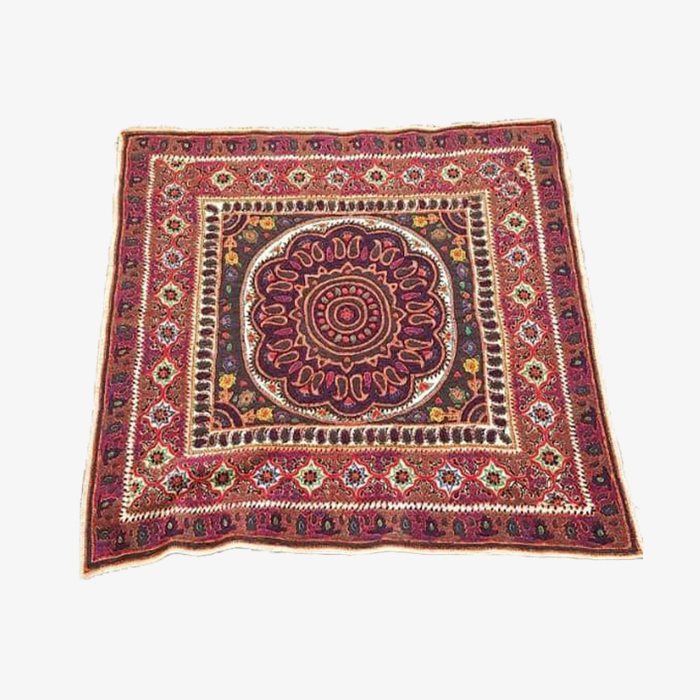
Reference photographs of documented Pateh embroidery (Kerman) pieces, credited to their sources. Compare construction, surface and wear with any piece you are offered — a resemblance is not proof of origin.
Pateh embroidery (Kerman) at a glance
| Persian name | پته |
| Category | Textiles · Embroidery |
| Main techniques | surface-embroidery |
| Typical materials | wool, cotton |
| Places of making | kerman |
| Current vitality | At risk |
Understanding Pateh embroidery (Kerman)
What Pateh embroidery (Kerman) is and how it is made
Definition
Pateh is a needle-embroidered textile particular to Kerman, worked with fine wool or silk thread over a plain woollen ground cloth, usually left in its natural cream or dyed to a solid colour. The embroidery covers the surface densely enough that little of the ground shows through in the finished field, producing a textured, almost pile-like surface distinct from open or sparse embroidery styles.
The craft is closely associated with Kerman's broader wool textile economy, drawing on the region's long-established supply of fine wool and dyeing expertise, and pateh pieces range from small purses and cushion covers to large tablecloths and wall hangings.
History
Kerman has been a centre of wool textile production for a long period, and pateh embroidery is documented as a distinct craft within that broader tradition by the Qajar period, produced largely by women working at home or in small workshops. Precise origin dates for the specific chain-stitch pateh technique as practised today are not firmly established in the published literature.
Twentieth-century demand, both domestic and through craft and tourist markets, sustained pateh production through the Pahlavi period, but heritage documentation in more recent decades has noted a shrinking number of embroiderers working at the finest, most time-intensive grades, as the labour required is not matched by commensurate prices in much of the market.
Materials
A plain-woven wool ground cloth, sometimes dyed, provides the base. Embroidery thread is traditionally wool or silk, worked in a restrained palette historically dominated by warm reds, oranges and golds against the ground colour.
- Woollen ground cloth, natural or dyed
- Wool or silk embroidery thread
- Traditional dyes for both ground and thread, with synthetic dyes common in later work
General background on the craft, not a statement about any individual object; dates and attributions summarise common positions in the literature and remain under review. Read the full Pateh embroidery (Kerman) entry.
Before you buy: what to inspect
- Pateh is wool embroidery on a woollen ground cloth (traditionally hand-woven); the stitches should cover the ground densely.
- Turn the piece over: hand embroidery shows knots, thread joins and slightly uneven stitch lengths on the back.
- Machine embroidery has perfectly repeated stitches and often a paper or fabric stabiliser left on the back.
Typical materials: wool, cotton.
Red flags: copies and 'Persian style' imports
- Machine-embroidered or printed 'Kerman embroidery'.
- Central Asian suzani or other embroideries sold under the pateh name.
A genuine Pateh embroidery (Kerman) piece should come with a named place of making in Iran (often kerman) and a clear statement that it is handmade.
Questions to ask the seller
- Was it embroidered by hand, and where?
- Is the ground cloth hand-woven wool?
- Who made it?
What affects the price
| Stitch density |
| Size |
| Design complexity |
| Maker |
Care and cleaning
- Do not iron directly on the embroidery; press from the back through a cloth if needed.
- Display away from direct sunlight, which fades silk and wool threads.
- Have older or metal-thread pieces cleaned by a textile conservator, not a general dry cleaner.
Storage
- Roll with the pile facing inward, never fold.
- Wrap in breathable cotton, not plastic.
- Protect against moths with regular airing and inspection.
Shipping
Rolled textiles travel well; ask for tube or rolled packing and tracked delivery.
Disclaimer
This guide is educational. It cannot confirm that any particular object is genuine, old or valuable. For important purchases, ask an independent specialist. Read the full Pateh embroidery (Kerman) entry.