
What documented Kashan carpet looks like
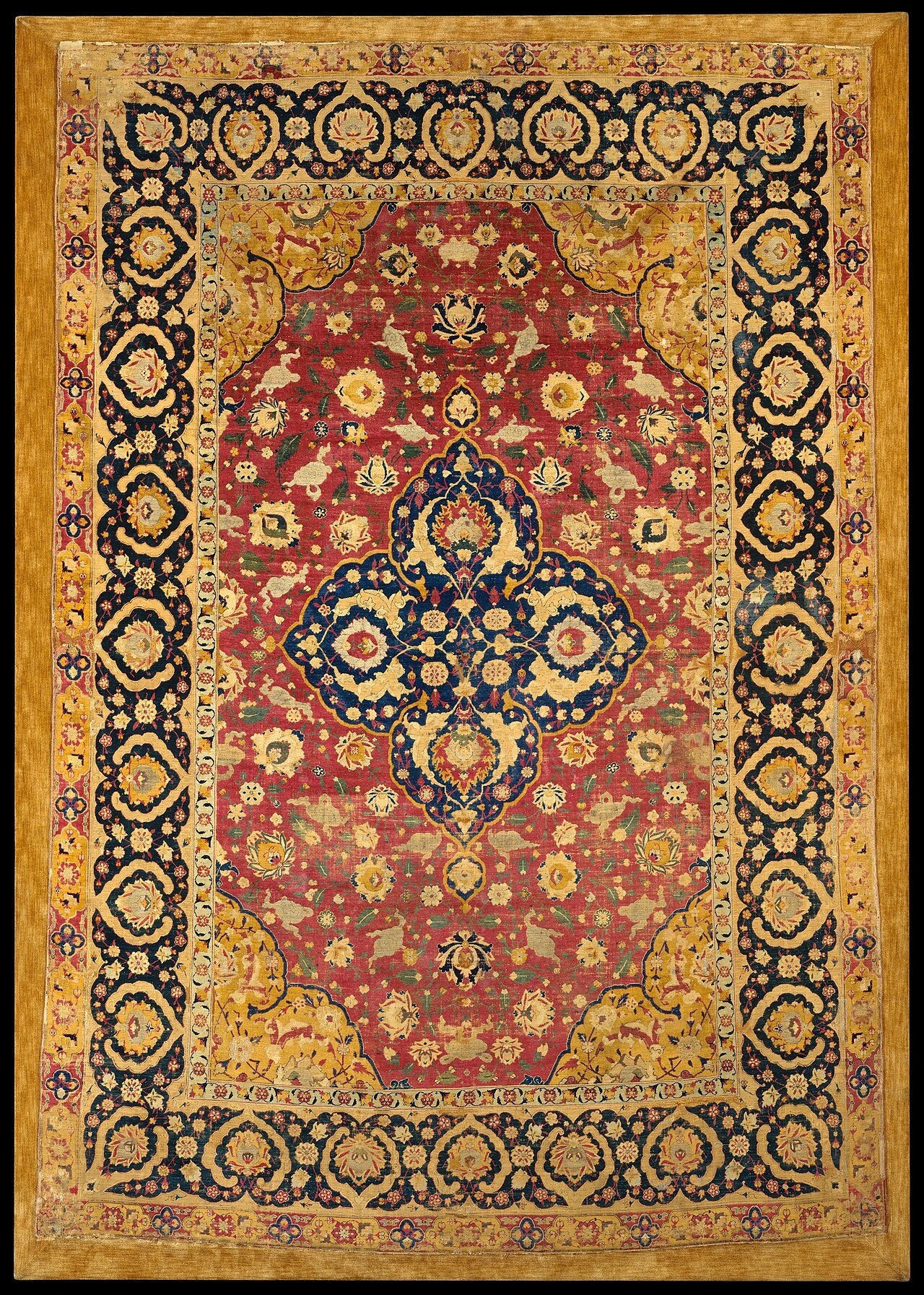
Reference photographs of documented Kashan carpet pieces, credited to their sources. Compare construction, surface and wear with any piece you are offered — a resemblance is not proof of origin.
Kashan carpet at a glance
| Persian name | فرش کاشان |
| Category | Textiles · City carpet |
| Main techniques | knotted-pile-weaving, asymmetric-knot |
| Typical materials | wool, silk, cotton |
| Places of making | kashan |
| Current vitality | Living tradition |
Understanding Kashan carpet
What Kashan carpet is and how it is made
History
Kashan is linked to celebrated Safavid silk carpets and to a strong revival from the late 19th century, when fine wool 'Mohtasham' carpets became famous.
Technique
Usually asymmetrical (Persian) knots on a cotton foundation, with fine wool or silk pile and curvilinear designs drawn on cartoons.
Collecting and identification
Check knot density on the back, fringe as part of the warp, and colour run. Many 'Kashan design' rugs are made elsewhere — ask for a place of making.
This guidance is educational only and is not an authentication or valuation service.
General background on the craft, not a statement about any individual object; dates and attributions summarise common positions in the literature and remain under review. Read the full Kashan carpet entry.
Before you buy: what to inspect
- Turn the piece over: hand-knotted or hand-stitched work shows slight irregularities on the back.
- Look at fringes and edges — on knotted carpets the fringe is usually the warp itself, not a sewn-on strip.
- Check colour consistency; natural dyes often show gentle banding (abrash), which is not a defect.
- Ask whether the colours have been tested for bleeding; never wet-test an old or valuable piece yourself.
Typical materials: wool, silk, cotton.
Red flags: copies and 'Persian style' imports
- Perfectly uniform backs, glued backing cloth or a latex layer (typical of machine or tufted rugs).
- Listings that say 'Persian style', 'Persian design' or 'inspired by' without naming a place of making.
- Printed patterns sold as hand-embroidered or hand-block-printed.
A genuine Kashan carpet piece should come with a named place of making in Iran (often kashan) and a clear statement that it is handmade.
Questions to ask the seller
- Where and by whom was this made, and roughly when?
- What are the fibre and dye (wool, silk, cotton; natural or synthetic)?
- Can you show a close-up photo of the back and the edges?
What affects the price
| Knot or stitch density |
| Fibre (silk is costlier than wool) |
| Size and age |
| Condition and repairs |
| Natural dyes |
Care and cleaning
- Vacuum rugs gently without a beater bar, in the direction of the pile.
- Rotate floor pieces every six to twelve months to even out wear and light exposure.
- Blot spills straight away with cold water; never rub.
- Send valuable or old pieces to a specialist cleaner rather than a general dry cleaner.
Storage
- Roll with the pile facing inward, never fold.
- Wrap in breathable cotton, not plastic.
- Protect against moths with regular airing and inspection.
Shipping
Rolled textiles travel well; ask for tube or rolled packing and tracked delivery.
Disclaimer
This guide is educational. It cannot confirm that any particular object is genuine, old or valuable. For important purchases, ask an independent specialist. Read the full Kashan carpet entry.