
Beginner guide · 5 min
Zari-bafi: Persian gold-thread brocade explained
Editorial team · updated 2026-10-20
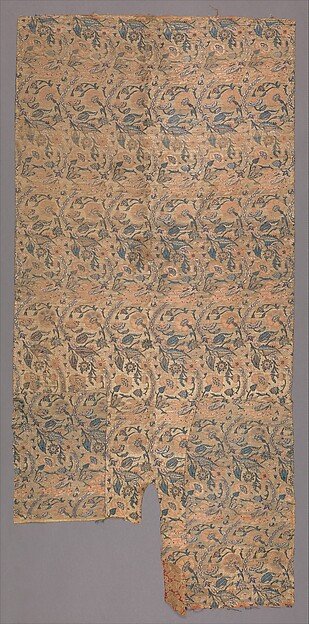
Accessed 15 October 2026. Catalogue: Silk, metal wrapped thread; lampas. Historical museum object illustrating the technique, not a modern product · The Metropolitan Museum of Art · CC0 (Met Open Access; resized and re-encoded) · Photo source ↗
- Type
- Beginner guide
- Reading
- 5 min
- Chapters
- 5
- Photos
- 1
Scope and evidence
This reading separates visible construction, documented materials and origin claims. The photographs retain their own source context; they do not authenticate a purchase or demonstrate every stage described below. Historical examples and contemporary maker statements require different kinds of evidence.
- Construction: Patterned woven cloth with metallic yarns
- Metal: Composition and wrapping require documentation
- Care: Do not polish metallic yarns
- Construction
- Patterned woven cloth with metallic yarns
- Metal
- Composition and wrapping require documentation
- Care
- Do not polish metallic yarns
Brocade is a description, not a single recipe
The word brocade covers patterned fabrics whose ornament is produced during weaving, often with supplementary yarn systems. An Iranian catalogue may specify a more precise construction such as lampas. Preserve that technical term rather than replacing it with a universal claim that all zari-bafi is made by the same drawloom method.
Metallic yarns can include a strip wrapped around a textile core, while modern materials may use other constructions. The visible shine does not identify gold content, silver content or the core fibre. Ask which parts were examined and whether the description is analytical, documentary or simply supplied by the seller.
Follow pattern yarns across the fabric
Examine how the pattern relates to the ground, where metallic yarns appear on the face, and whether floats are visible on an accessible reverse. The organisation of these yarns helps distinguish woven decoration from a surface print, but a reverse view alone may not identify a complex weave.
Do not bend the fabric to force metallic threads to crack, and do not pick apart a loose yarn to inspect its core. Photograph the available detail and leave fibre or metal identification to a textile specialist. Woven metallic ornament can be machine-produced as well as hand-produced.
Separate luxury appearance from evidence
Courtly textile histories describe particular commissions, surviving fragments and collection records. They do not show that a present-day cloth was made for a court or continues an unchanged workshop lineage. Keep historic examples separate from claims about a new maker.
For a commission, request the workshop identity, loom method, fibre specification, dimensions and proposed use. Ask whether metallic yarns are decorative only and whether seams or backing will conceal the reverse. Neither a high price nor a narrow width verifies handloom production.
- Record ground and pattern yarns separately
- Ask what the metallic yarn is made of
- Distinguish a museum fragment from a current commission
- Retain the original technical catalogue wording
Care for a textile-metal composite
A metal-thread textile combines different vulnerabilities: fibres can weaken or fade, while thin metallic strips can tarnish, split or abrade. Rubbing with a silver cloth or applying a metal dip can damage the textile and remove surface layers. Never treat the yarn as a solid metal object.
Support the cloth during movement and avoid sharp folds or snagging. Storage materials, display light and humidity should be selected for the complete object, not just its visible metal. Do not use tarnish as a clock: storage and composition influence it, and absence of tarnish does not establish newness.
| Look at | Record | Do not infer |
|---|---|---|
| Raised woven pattern | Yarn path and reverse if accessible | Handloom manufacture |
| Metallic reflection | Colour and construction as described | Gold purity |
| Tarnish or breaks | Affected areas and loose strips | Date |
| Technical record | Lampas or other specified structure | All zari fabrics share that structure |
References and further reading
- [1] The Met — Brocade, Iran, ca. 1600 ↗The mapped guide photograph is this catalogue example, described as silk and metal-wrapped thread in lampas.
- [2] Canadian Conservation Institute — Caring for textiles and costumes ↗Preventive care; not permission to clean or treat an individual textile.
These sources provide context, not authentication or provenance for an individual object. Editorial interpretations remain under review.