
Collector guide · 11 min
What to look for in khatam inlay
Editorial team · updated 2026-09-29
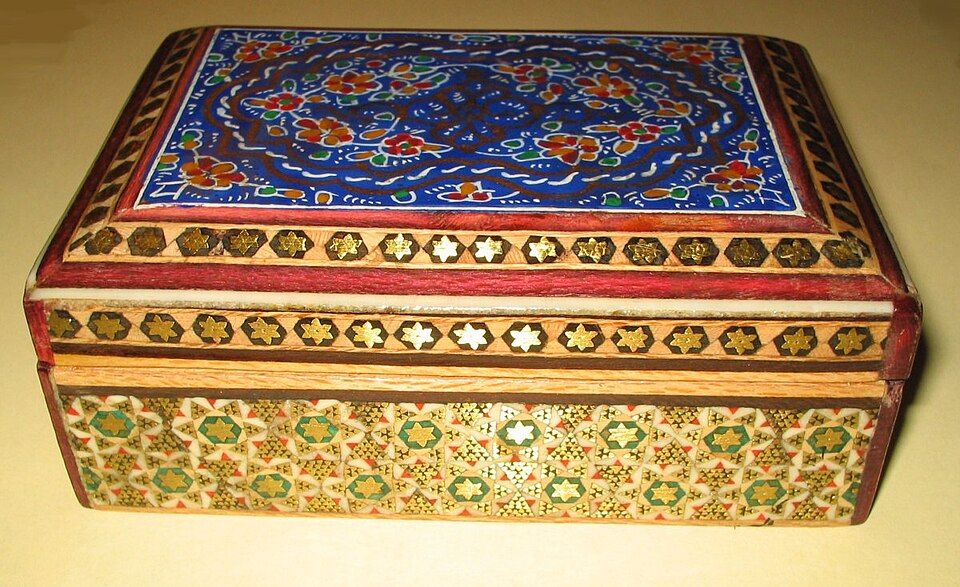
2006-05 · Fabienkhan (Wikimedia Commons) · Public domain (per Wikimedia Commons) · Photo source ↗
- Type
- Collector guide
- Reading
- 11 min
- Chapters
- 9
- Photos
- 1
Fine khatam versus printed or plastic imitations: what to look at on boxes, frames and panels.
Look closely at the pattern
Real khatam is built from tiny triangles of wood, bone and metal assembled into rods and sliced. Under a magnifier you should see separate pieces, with small variations.
Common imitations
Printed paper or plastic laminates look perfect and flat. They often repeat without any piece-to-piece variation.
- Separate tiny pieces: consistent with real khatam
- Printed dots with no joins: imitation
- Plastic sheen and no bone or metal: imitation
Origin
Most khatam comes from Shiraz and Isfahan workshops. A seller's origin claim still needs checking, since similar work is made elsewhere.
Inspection checklist
- Use a magnifier: real khatam shows tiny separate pieces with edges
- Materials: wood, bone (white), brass or copper (metallic), and sometimes stained bone
- The back and inside should be neatly finished
- Printed or resin imitations look flat and repeat perfectly
Where it is made
Isfahan, Shiraz and Tehran are the main centres. Ask the shop whether it makes its own work and how many pieces per square centimetre it uses.
A note on this guide
This is a general introduction written by the CraftPersia editorial team. It has not yet been reviewed by a specialist. Confirm details with makers, conservators or museums, and treat any dates as approximate.
Crafts covered in this guide
Khatamkari (خاتمکاری) — A Persian inlay art in which fine rods of wood, bone and metal are bundled into star units, sliced into thin sheets and applied to a wooden surface to form dense geometric tessellation.
Materials, techniques and centres
Khatamkari is recorded in the archive with walnut wood, camel bone and brass as principal materials, and wood inlay (khatam) as the technique. Associated centres include Isfahan and Shiraz; a place name on its own does not establish where an individual object was made.
Collecting and next steps
When applying this guide to a specific object, work from what can be observed: structure, materials, tool marks, repairs and documentation. Ask the seller or maker for written statements about who made the piece, where, from what materials, and what has been repaired or replaced.
The steps here are educational; identification, conservation and valuation of an individual object require appropriate independent expertise.
References and further reading
- [1] H. E. Wulff, The Traditional Crafts of Persia, MIT Press, 1966.General historical craft reference, not evidence for a particular object.
These sources provide context, not authentication or provenance for an individual object. Editorial interpretations remain under review.