
Beginner guide · 5 min
Rasht-duzi: the felt appliqué and chain-stitch of Gilan
Editorial team · updated 2026-10-20
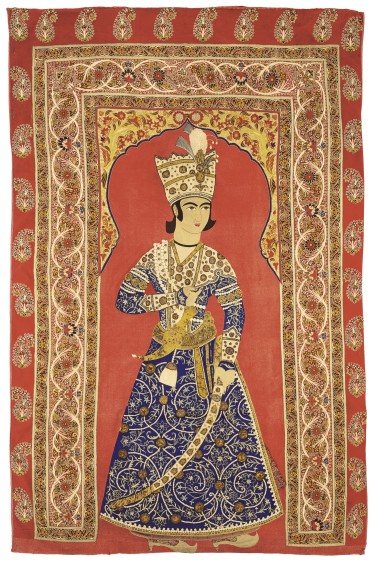
Accessed 15 October 2026.; attribution and origin follow the Commons record and are not independently verified. · Sotheby's · Public domain (per Wikimedia Commons; rights review pending) · Photo source ↗
- Type
- Beginner guide
- Reading
- 5 min
- Chapters
- 5
- Photos
- 2
Scope and evidence
This reading separates visible construction, documented materials and origin claims. The photographs retain their own source context; they do not authenticate a purchase or demonstrate every stage described below. Historical examples and contemporary maker statements require different kinds of evidence.
- Read: Ground cloth, inserted pieces and stitching
- Method: Hook work is still hand embroidery
- Condition: Backing may belong to a later repair
- Read
- Ground cloth, inserted pieces and stitching
- Method
- Hook work is still hand embroidery
- Condition
- Backing may belong to a later repair
Read the layers before naming the technique
Rasht work can bring together coloured wool cloth, shaped pieces and chain-stitch decoration. Begin with the relationship between those layers: is a coloured area a separate piece of cloth, an inserted section, or a field made by embroidery? A floral motif alone does not answer that question.
The archive’s historical panel and craft-context photograph are examples, not a complete typology. Do not assume every Rasht object has the same felt ground, fibre mixture or assembly method. Preserve the source’s terms, including uncertainty about materials and regional attribution.
Trace a chain without pulling it
Chain stitch forms linked loops. A hook may be used to make those loops by hand, so “hand-made or hook-made” is a false opposition. Describe the stitch that is visible and ask how it was worked; a tool name is not a shortcut to authorship or mechanical manufacture.
Look at an accessible edge and reverse with the owner’s permission. Changes of thread, joins between pieces and later backing can clarify construction. Do not pull a loop to test whether it unravels, and do not lift an applied piece to look underneath it.
Distinguish design from later changes
A border, backing or mounting strip may have been added after the embroidered centre. Compare the relationship of seams, wear and stitching, then record possible alterations rather than announcing an original complete ensemble from one view. Repairs can preserve use while changing the present format.
Stitch density is not a universal grade. Design intention, scale, support and condition matter, and broad open areas may be deliberate. A firm modern backing does not necessarily mean a historical panel is structurally sound.
- Note cloth joins and stitch paths
- Separate decoration from mounting stitches
- Ask when backing or lining was added
- Do not identify fibres by touch or weight
Plan a supported display
Textiles with embroidery and applied pieces may have uneven weight. Hanging them from a few points can concentrate stress. Use an assessed support that distributes the load, and keep pins, adhesive strips and clips away from fragile historical material.
Inspect for detached loops, loose pieces and insect debris without brushing or vacuuming unstable decoration. Surface cleaning through a screen is not automatically suitable for every embroidered textile. If threads lift or pieces detach, stop handling and seek a textile conservator’s advice.
Related photographs and screened examples
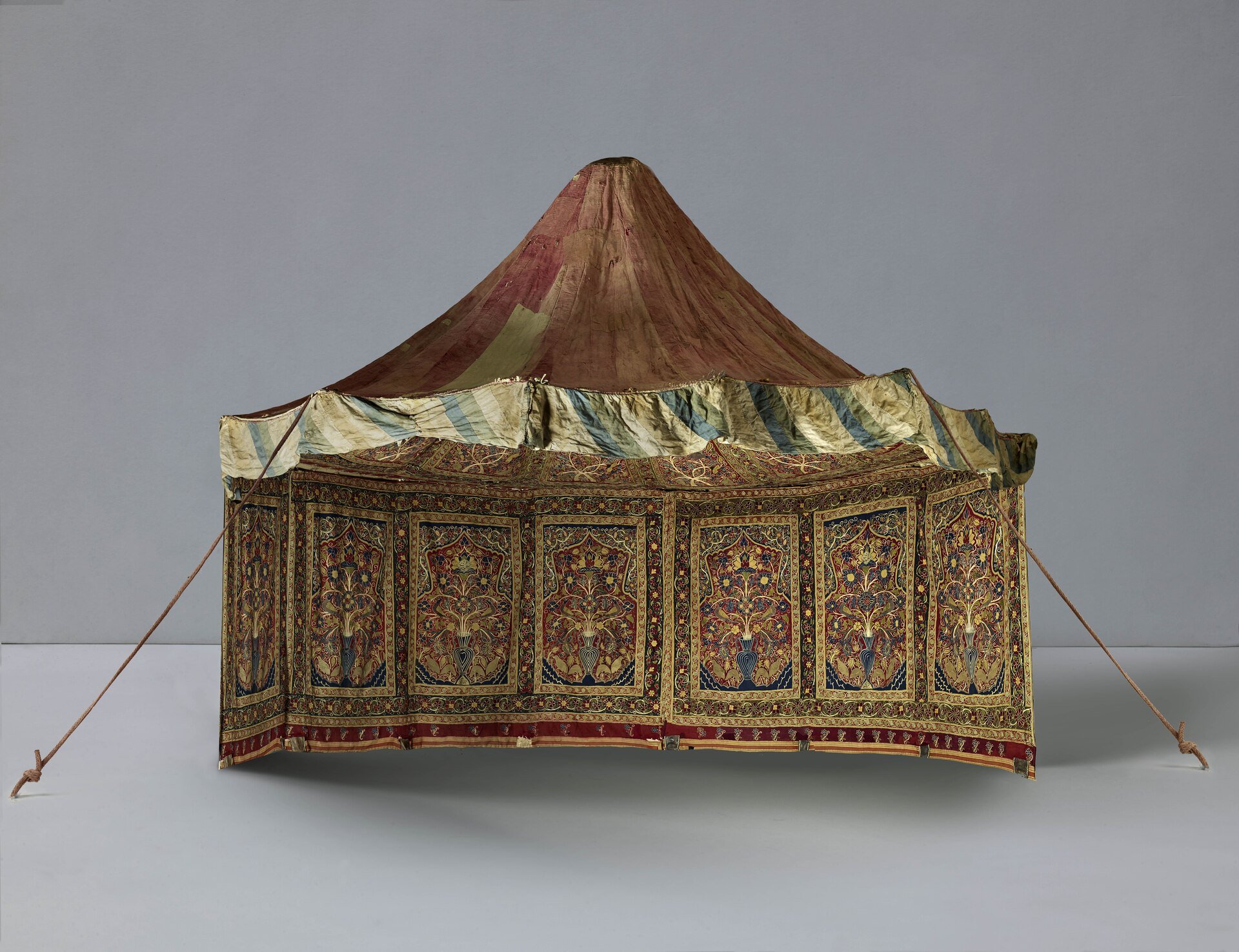
Representative photographs only. Marketplace examples rely on seller descriptions; CraftPersia has not independently authenticated their maker, origin, or rights status. Follow each source link for the listing context.
| Look at | Record | Do not infer |
|---|---|---|
| Coloured area | Separate cloth or stitched field | Every ground is felt |
| Linked loops | Chain stitch, accessible joins | Hook work is not handmade |
| Backing | Material and attachment | Original condition |
| Missing stitching | Location and extent | Overall quality from density |
References and further reading
- [1] Canadian Conservation Institute — Caring for textiles and costumes ↗Preventive care; not permission to clean or treat an individual textile.
- [2] Encyclopaedia Iranica — Isfahan XIII: Crafts ↗Regional history; practices changed over time and are not a timeless national formula.
These sources provide context, not authentication or provenance for an individual object. Editorial interpretations remain under review.