
Beginner guide · 5 min
Persian steelwork (fulad-kari): openwork plaques and standards
Editorial team · updated 2026-10-20
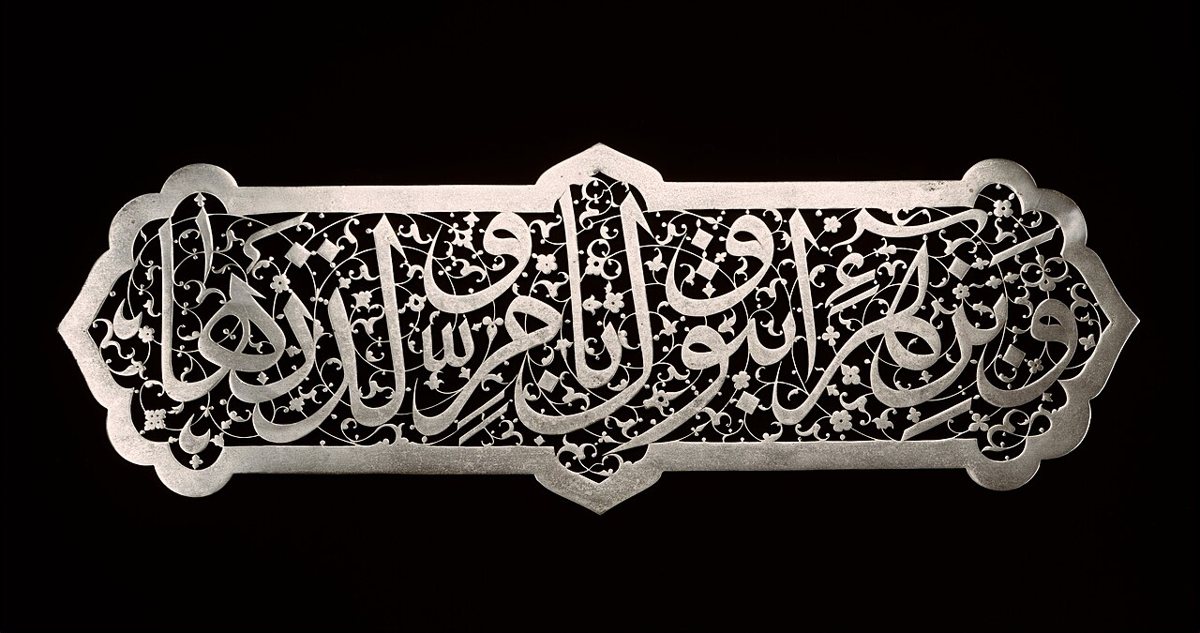
Accessed 15 October 2026.; attribution and origin follow the Commons record and are not independently verified. · in Safavid period (1501–1722) · Public domain (per Wikimedia Commons; rights review pending) · Photo source ↗
- Type
- Beginner guide
- Reading
- 5 min
- Chapters
- 5
- Photos
- 2
Scope and evidence
This reading separates visible construction, documented materials and origin claims. The photographs retain their own source context; they do not authenticate a purchase or demonstrate every stage described below. Historical examples and contemporary maker statements require different kinds of evidence.
- Forms: Pierced plaques, standards and decorated objects
- Reading: Openwork, chasing and inlay are separate
- Risk: Rust colour is not a dating tool
- Forms
- Pierced plaques, standards and decorated objects
- Reading
- Openwork, chasing and inlay are separate
- Risk
- Rust colour is not a dating tool
Read the silhouette and internal drawing
Openwork steel uses removed areas as part of the design. A plaque’s outer profile, internal openings and surviving bridges work together, while inscriptions or surface ornament may add another layer. Do not call all decoration engraving: piercing, relief modelling, chasing and inlay describe different operations.
Begin with the recorded object type and use. A mounted architectural plaque, a processional standard and an armoured object should not be grouped as interchangeable souvenirs. Their mounting, movement and maintenance can explain different forms of wear.
How openwork becomes a finished object
A maker lays out the design, opens internal areas, refines edges and completes surface decoration. Forging, sawing, filing and other operations may be involved according to the object. Ask a current workshop to distinguish hand work, power-tool assistance and prefabricated parts rather than insisting every stage must use the same tool.
A finished photograph cannot prove the cutting method. Rounded corners or repeated forms are prompts for questions, not definitive tests for CNC or laser cutting. Historic objects may also have undergone later repair, so a modern-looking join need not date the whole piece.
Read inscriptions and repairs with restraint
An inscription can name a patron, invoke a prayer or quote poetry. Its content and letter forms need a qualified reading; neither sacred wording nor a recognisable script establishes a Safavid date. Record the source of any attribution and keep question marks from the catalogue.
Inspect accessible edges for breaks, attached repairs or missing bridges without flexing the metal. Brown corrosion, polished high points and dark recesses do not form an age scale. They reflect composition, handling, cleaning and environment as well as time.
- Record function and mounting
- Separate pierced design from surface decoration
- Keep inscriptions legible in photographs
- Do not bend fragile openwork
Support vulnerable projections
Thin bridges and sharp projections can snag packing or concentrate stress. Move the object on an appropriate support instead of gripping an openwork letter or finial. Do not remove old attachments simply to make the object look tidier.
Avoid household rust removers and automatic wiping of fingerprints across unstable decoration. Conservators can assess corrosion, coatings and inlay as a whole. A decorative object’s ability to stand on a shelf does not mean it is safe to carry by its upper ornament or use in a live procession.
Related photographs and screened examples
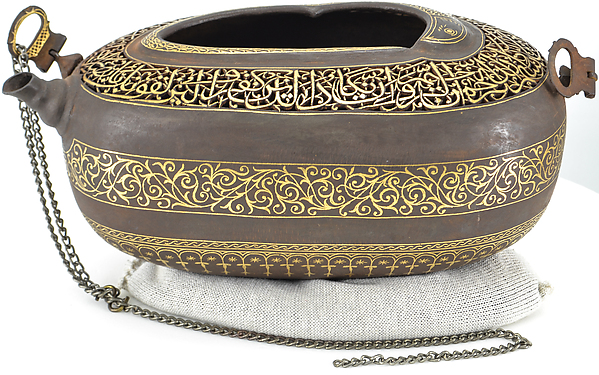
Representative photographs only. Marketplace examples rely on seller descriptions; CraftPersia has not independently authenticated their maker, origin, or rights status. Follow each source link for the listing context.
| Look at | Record | Do not infer |
|---|---|---|
| Openwork | Bridges, openings and breaks | Tool method from repetition |
| Surface ornament | Chased, engraved or inlaid as documented | All decoration is engraving |
| Corrosion | Location, flaking and previous treatment | Antique date |
| Inscription | Photograph and qualified reading | Whole-object attribution |
References and further reading
- [1] Encyclopaedia Iranica — Isfahan XIII: Crafts ↗Regional history; practices changed over time and are not a timeless national formula.
- [2] National Park Service — Curatorial care of metal objects ↗Museum handling and storage guidance; composite surfaces need individual assessment.
These sources provide context, not authentication or provenance for an individual object. Editorial interpretations remain under review.