
Buying guide · 5 min
Handblown Persian glass: what to look for
Editorial team · updated 2026-10-20
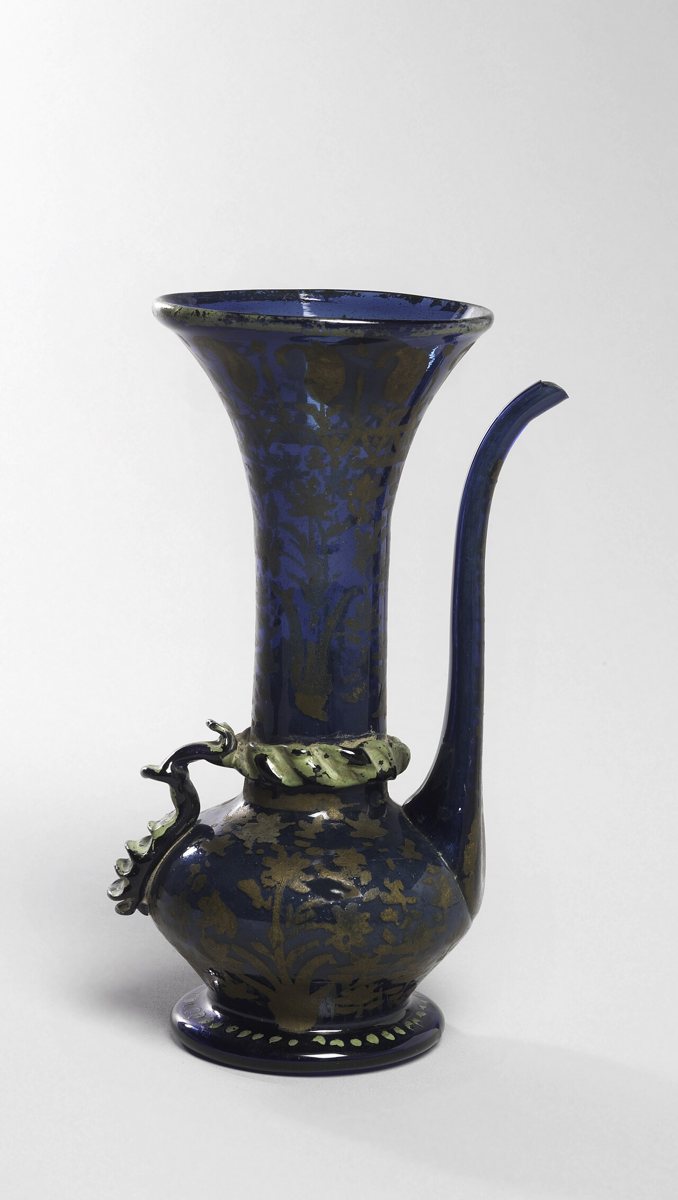
Accessed 15 October 2026.; attribution and origin follow the Commons record and are not independently verified. · Unknown artist · Public domain (per Wikimedia Commons; rights review pending) · Photo source ↗
- Type
- Buying guide
- Reading
- 5 min
- Chapters
- 5
- Photos
- 1
Scope and evidence
This reading separates visible construction, documented materials and origin claims. The photographs retain their own source context; they do not authenticate a purchase or demonstrate every stage described below. Historical examples and contemporary maker statements require different kinds of evidence.
- Evidence: Bubbles and seams are not authenticity tests
- Function: Decorative and drinking vessels differ
- Handling: Support the body, not applied handles
- Evidence
- Bubbles and seams are not authenticity tests
- Function
- Decorative and drinking vessels differ
- Handling
- Support the body, not applied handles
Ask how the vessel was formed
Glass may be free-blown, mould-blown, pressed, cast or shaped with combinations of methods. A maker can use a mould while blowing by hand. Consequently, a mould seam is not proof of machine production, and a pontil scar is not proof of Iranian origin.
Ask for the forming method, glass composition as known, maker and place of production. A historical ewer illustrated here is a catalogue example, not evidence of a current furnace practice. Keep revival style, contemporary manufacture and historical attribution distinct.
Inspect shape without assigning a grade
Compare the rim, wall, foot and applied decoration in consistent light. Bubbles and slight asymmetry can occur in handmade glass but are neither required nor sufficient to identify it. Perfectly regular glass may still involve skilled hand production, while industrial glass may also contain bubbles.
Record cracks, chips, sharp edges, repaired handles and surface haze. Do not tap the vessel to test its sound or flex a handle. A change in reflection may be decorative texture, a surface deposit or deterioration; it needs closer assessment before a cleaning recommendation.
Match the object to its intended use
A decorative bottle is not automatically safe for hot drinks, food or a dishwasher. Ask the maker for its stated use and temperature limitations. Recycled glass is not universally more brittle: composition, annealing, design and condition are relevant and are rarely known from a listing photograph.
Historic or repaired glass should not be filled for use. For new functional work, obtain care instructions and applicable food-contact information from the maker or seller. The archive cannot certify a vessel’s suitability or turn a visual inspection into a product-safety test.
- Ask whether it is decorative or functional
- Record cracks and repaired attachments
- Do not identify production from bubbles alone
- Request maker-specific packing and care
Plan movement and packing
Lift a stable vessel with support under its main body rather than by its neck, handle or applied trails. Use a support and packing that keep fragile projections from carrying the load. Each object needs isolation from neighbouring items; double-boxing alone does not make a poor internal support safe.
Keep uncertain historic surfaces away from wet cleaning. Crizzling, clouding, flaking or old adhesive can require conservation advice. New glass should also be protected from sudden temperature change, but do not generalise a catalogue object’s condition into a rule for all Iranian glass.
| Look at | Record | Do not infer |
|---|---|---|
| Seam or pontil | Observed forming trace | Factory or Iranian origin |
| Bubbles | Location and size | Handmade proof |
| Handle and rim | Cracks, repairs and sharp edges | Safe to lift by handle |
| Functional claim | Written intended use and care | Heat or food safety from appearance |
References and further reading
- [1] National Park Service — Curatorial care of metal objects ↗Museum handling and storage guidance; composite surfaces need individual assessment.
- [2] Guide photograph — historical Iranian ewer ↗Photograph context only; not evidence for contemporary glass manufacture.
These sources provide context, not authentication or provenance for an individual object. Editorial interpretations remain under review.