
Beginner guide · 11 min
Sahhafi: Persian bookbinding traditions
Editorial team · updated 2026-10-03
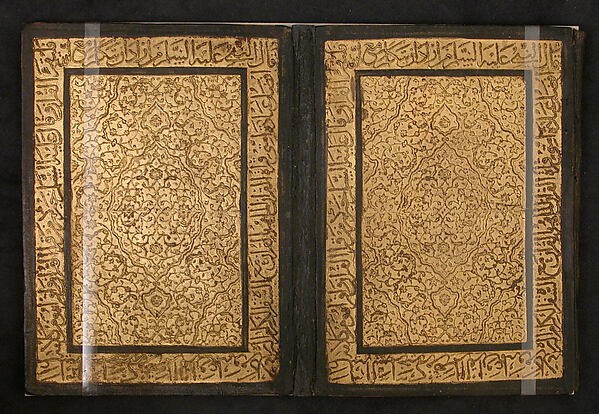
accessed 2026-09-30 · The Metropolitan Museum of Art · CC0 (Met Open Access) · Photo source ↗
- Type
- Beginner guide
- Reading
- 11 min
- Chapters
- 9
- Photos
- 1
Persian bookbinding uses leather or lacquer covers with stamped, gilded or painted decoration and a characteristic envelope flap (lisan).
Structure
Classic Persian bindings have a fore-edge flap that folds over the front cover to protect the text block. Covers are pasteboard faced with leather or lacquer.
Decoration
- Blind- or gold-stamped central medallions and corner pieces
- Filigree cut-leather doublures on fine bindings
- Painted lacquer covers, especially in the Qajar period
Today
Restoration studios in Tehran, Mashhad and Qom keep binding skills alive, and some bind contemporary calligraphy and poetry books by hand.
Binding styles
Persian bindings include tooled and gilded leather, lacquer covers and doublures (decorated inner covers). Envelope flaps (lisan) are a characteristic feature. Contemporary binders in Tehran and Isfahan revive these techniques.
Questions to ask before buying
Ask the seller who made the piece and where, and get the answers in writing on the receipt. CraftPersia lists only work made in Iran or by Iranian makers; ‘Persian style’ is not the same thing as Persian-made. A seller who knows the work will usually be glad to explain the materials and how it was made.
- What leather and boards were used?
- Is the gold tooling real gold leaf?
- Is it a new binding, or a rebinding of an older book?
A note on this guide
This is a general introduction written by the CraftPersia editorial team and has not yet been reviewed by a specialist. Workshop practice varies between towns and families; treat dates and figures as approximate and confirm details with makers, museums or published scholarship before relying on them.
Crafts covered in this guide
Traditional bookbinding (Sahhafi) (صحافی سنتی) — The hand binding of manuscripts and books with leather or lacquer covers, often with a flap (lisan) and stamped, cut or gilded decoration.
Materials, techniques and centres
Traditional bookbinding (Sahhafi) is recorded in the archive with leather, paper and lacquer coating as principal materials. Associated centres include Isfahan, Tabriz and Shiraz; a place name on its own does not establish where an individual object was made.
Collecting and next steps
When applying this guide to a specific object, work from what can be observed: structure, materials, tool marks, repairs and documentation. Ask the seller or maker for written statements about who made the piece, where, from what materials, and what has been repaired or replaced.
The steps here are educational; identification, conservation and valuation of an individual object require appropriate independent expertise.
References and further reading
- [1] H. E. Wulff, The Traditional Crafts of Persia, MIT Press, 1966.General historical craft reference, not evidence for a particular object.
These sources provide context, not authentication or provenance for an individual object. Editorial interpretations remain under review.