
Beginner guide · 11 min
Namad: felt making in Iran
Editorial team · updated 2026-09-29
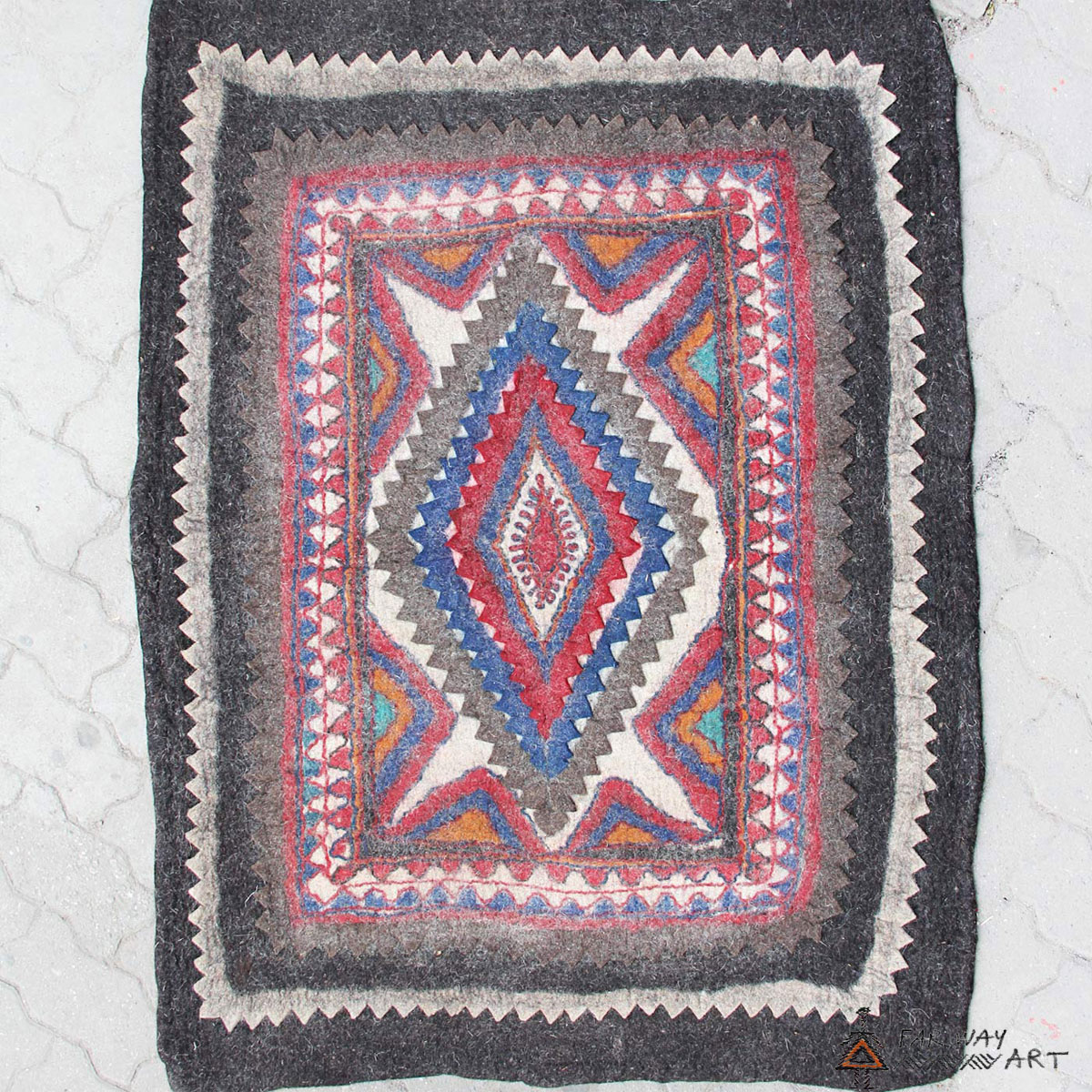
accessed 2026-09-30 · Sr3207 / Farwayart · CC BY-SA 4.0 (Wikimedia Commons) · Photo source ↗
- Type
- Beginner guide
- Reading
- 11 min
- Chapters
- 9
- Photos
- 1
Pressed wool felt rugs made by rolling, wetting and beating wool fibres.
Process
Wool is laid out with colour patterns, wetted with warm water and soap, rolled and pressed for hours until the fibres lock together.
Centres
Namad has been made in many regions, including Mazandaran, Kerman and Khorasan. Workshops are fewer today.
Care
Felt is sensitive to moths. Air regularly and store with care.
Steps
- Wool is washed, carded and sometimes dyed
- Coloured motifs are laid out first, face down
- Base wool is layered on top
- The wool is wetted with warm, soapy water, then rolled and pressed or trampled for hours
- The felt is rinsed, stretched and dried
Regions and uses
Felt-making centres include Kerman, Mazandaran, Kurdistan and Turkmen Sahra. Namad is used as a floor covering, for shepherds' cloaks (kapenak) and for tent linings.
A note on this guide
This is a general introduction written by the CraftPersia editorial team. It has not yet been reviewed by a specialist. Confirm details with makers, conservators or museums, and treat any dates as approximate.
- Material
- Sheep's wool, matted with water, heat and pressure
- Notable areas
- Kerman, Mazandaran, Golestan, Isfahan and pastoral regions
How namad is made
Felt makers lay out a design in coloured wool on a reed mat, cover it with layers of undyed wool, sprinkle hot water and roll the bundle repeatedly — by hand, by foot or with forearms — until fibres lock together. The felt shrinks and densifies as it is worked, so the inlaid design is laid out larger than the finished piece.
- Design laid first, face down
- Base wool layered on top
- Hot water and soap aid felting
- Rolling and pressing for hours
Uses
Namad was a floor covering in homes and teahouses, insulation, and material for shepherds' cloaks (kapenak) and hats. Its thickness makes it warm and sound-absorbing.
Recognising handmade felt
Handmade namad has soft, slightly blurred motif edges where coloured wool merged during felting, and uneven thickness. Machine needle-felt shows uniform thickness and needle holes; printed designs sit on the surface only.
| Feature | Namad | Gelim | Knotted carpet |
|---|---|---|---|
| Structure | Non-woven felt | Woven tapestry | Knotted pile on warp/weft |
| Design edges | Soft, blended | Crisp, slit gaps | Crisp, knot-stepped |
| Weight | Thick, light for size | Thin | Heavy |
References and further reading
These sources provide context, not authentication or provenance for an individual object. Editorial interpretations remain under review.