
Collector guide · 12 min
Recognising Nain carpet features
Editorial team · updated 2026-09-29
accessed 2026-09-30 · NAEINSUN · CC BY-SA 3.0 (Wikimedia Commons; JPG re-encoded) · Photo source ↗
- Type
- Collector guide
- Reading
- 12 min
- Chapters
- 10
- Photos
- 1
Pale ivory and blue palettes, fine wool and silk highlights.
Construction
Fine asymmetric knotting; grades described with ‘la’ counts (such as 4la, 6la, 9la).
Palette
Ivory, beige and blue with silk outlining.
Caution
Grade names describe foundation threads and are not a quality guarantee on their own.
Recognising a Nain rug
No single feature proves where a rug was made, so look at several together: the design, the colours, the knot type, the foundation, and how the edges and ends are finished. Dealers' labels are sometimes used loosely, and ‘Nain design’ rugs are woven in other towns and countries.
- Ivory and blue palette
- Fine wool with silk outlining
- Fineness often stated in la (ply counts)
Judging quality
Nain rugs are generally finely woven; look at the silk highlights. Turn the rug over: hand-knotted rugs show the pattern clearly on the back, with small irregularities. A glued backing cloth or an even grid of stitches suggests a tufted or machine-made rug.
- Even, clear drawing of the motifs
- Wool that springs back when pressed
- Straight sides, and ends that are not pulling in
- No dye run between colours
Care and value
Vacuum regularly without a beater bar, rotate the rug once a year, and keep it out of strong sun. Value depends on condition, fineness, materials, age and design rather than on the city name alone. Get any valuation from an independent appraiser, not from the seller.
A note on this guide
This is a general introduction written by the CraftPersia editorial team. It has not yet been reviewed by a specialist. Practice varies between workshops; confirm details with makers or museums, and treat any dates as approximate.
- Region
- Nain, east of Isfahan
- Character
- Fine weave, light ivory-blue palettes
- Trade term
- 'La' grades describe fineness — ask what is meant
The Nain look
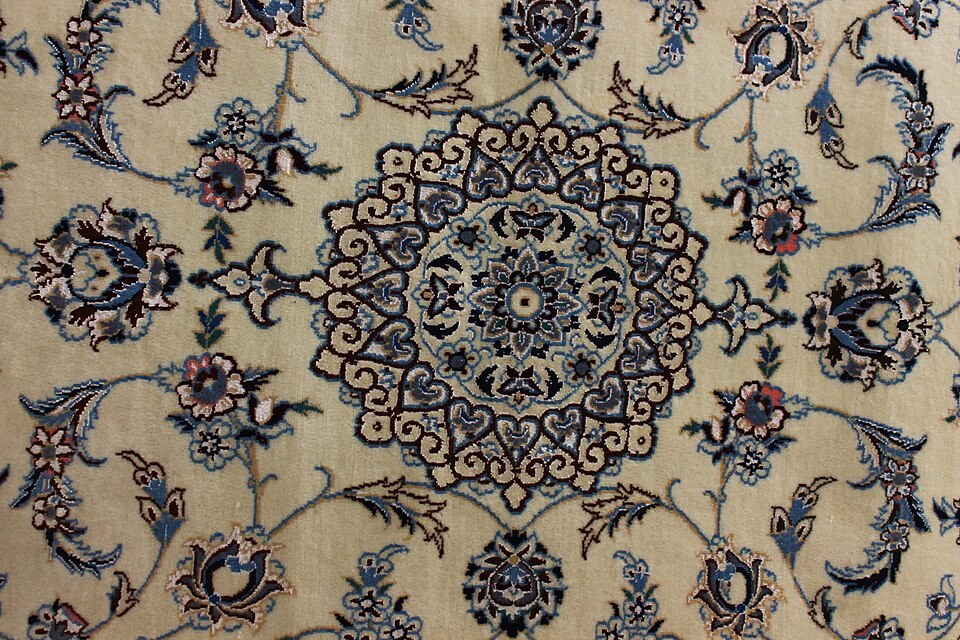
Nain carpets are known for fine curvilinear drawing in restrained palettes — ivory and cream fields with blue outlining, intricate medallion-and-corner or all-over floral designs, often with silk inlay highlighting details. The overall effect is cool and refined, and it has been widely imitated.
Because the look is so distinctive and so copied, appearance is an especially weak guide to origin. Fine 'Nain design' rugs are woven in several Iranian towns and outside Iran, at very different levels of quality and price.
'La' grades and what to ask
The trade describes Nain fineness with 'la' grades — 9-la, 6-la, 4-la — a convention related to the ply of the warp threads, with lower numbers indicating finer rugs. It is a trade shorthand, not a standard: different sellers apply it differently, and it cannot be verified without examining the warps.
Ask the seller to explain what they mean by the grade and to show the warp construction. Compare knot density yourself using the method in the KPSI guide, and treat any single number — la, raj or KPSI — as one fact to be checked, not a verdict.
- Lower la number = finer, in trade usage
- Ask the seller to show the warp construction
- Count density yourself; don't rely on the label
- Silk inlay claims need fibre evidence
Attribution and price
Regional names in the rug trade describe styles and markets as often as weaving places. Treat the pointers here as questions to ask, not proof of origin: only a documented maker, workshop record or reliable provenance establishes where a particular rug was woven.
Fine Nain rugs command high prices, which makes both style-copying and optimistic attribution profitable. A written description naming the claimed origin, the la grade and its basis, the fibres and any silk content is the minimum paperwork for a serious purchase.
| Pointer | What it suggests | What it cannot prove |
|---|---|---|
| Ivory-blue fine floral design | The Nain design tradition | Weaving in Nain |
| La grade quoted | A fineness claim in trade shorthand | Verified warp construction |
| Silk highlights | Possibly genuine inlay | Silk rather than mercerised cotton or viscose |
References and further reading
- [1] A. C. Edwards, The Persian Carpet, Duckworth, 1953.Classic survey; historical context, not a test of an individual carpet.
These sources provide context, not authentication or provenance for an individual object. Editorial interpretations remain under review.