
Beginner guide · 5 min
Monabbat-kari: Persian relief wood carving
Editorial team · updated 2026-10-20
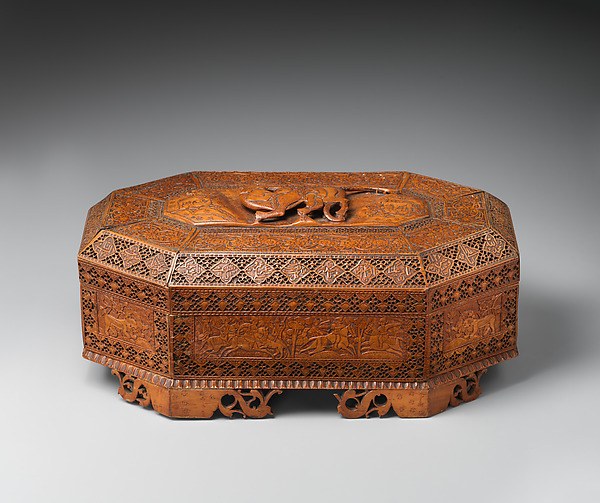
accessed 2026-09-30 · The Metropolitan Museum of Art · CC0 (Met Open Access) · Photo source ↗
- Type
- Beginner guide
- Reading
- 5 min
- Chapters
- 5
- Photos
- 1
Scope and evidence
This reading separates visible construction, documented materials and origin claims. The photographs retain their own source context; they do not authenticate a purchase or demonstrate every stage described below. Historical examples and contemporary maker statements require different kinds of evidence.
- Read: Relief levels, grain and construction
- Method: Machine roughing and hand finishing may coexist
- Care: Finish identification comes before cleaning
- Read
- Relief levels, grain and construction
- Method
- Machine roughing and hand finishing may coexist
- Care
- Finish identification comes before cleaning
Read carving through relief and grain
Monabbat relief carving uses a solid wooden surface to model ornament above a background. Look at the relationship of high points, recessed areas and the wood’s grain. Tool direction and grain can influence edges and fine detail; a crisp motif is not the only valid expression of skill.
A box also has joints, lid fittings and a finish, while an architectural panel has mounting and structural responsibilities. Do not judge the complete object by carving depth alone. A sharply undercut surface may be visually striking yet vulnerable to breakage.
Ask about the full making sequence
A maker selects and prepares the wood, plans the design, removes bulk material, refines the relief and applies or chooses a finish. Hand tools, power tools and machine-assisted roughing can appear in the same workshop. Ask what was done at each stage rather than treating the finished pattern as a yes-or-no machine test.
Repeated forms and rounded recesses do not conclusively identify CNC work. Conversely, small irregularities do not prove exclusive hand carving. A historical carved pearwood box in the archive is a source-specific example, not proof of the species or process used in a new object.
Read cracks and fittings separately from ornament
Record splits, lifting sections, repaired projections, warped lids and loose hinges. Cracks can cross a design or follow the grain; their presence does not alone date the object. Identify whether metal fittings or a lining were added later before describing all parts as original.
Do not force a tight lid or lever a hinge to inspect its underside. Photograph accessible surfaces and ask for repair history. A carving signature is useful documentation but not automatic authentication of the entire box or its claimed date.
- Record relief and structural construction
- Ask about wood species and finish
- Note repairs without opening them
- Separate maker claims from tool observations
Support, dust and conservation decisions
A stable carved object can sometimes be gently dusted, but loose surfaces and projections need assessment first. Do not use a brush to dislodge material from cracks or apply oil to make dry wood look richer. Oil, wax and varnish are not interchangeable treatments.
Avoid abrupt environmental changes and direct sun. Furniture polish or wet cleaning may affect original finishes, adhesives and painted details. For historical material, ask a conservator before any treatment; for a contemporary commission, request instructions for the actual species, finish and fittings.
| Look at | Record | Do not infer |
|---|---|---|
| Relief | Levels and vulnerable projections | Quality from depth |
| Wood | Catalogue or maker’s species claim | Species from colour |
| Tooling | Maker’s account of stages | Handmade from irregularity |
| Box structure | Joints, cracks, hinges and finish | Originality of every part |
References and further reading
- [1] The Met — Carved pearwood box, 2023.265 ↗Specific Iranian box, dated 1714; the craft photograph uses this record, not a modern Abadeh workshop scene.
- [2] Encyclopaedia Iranica — Isfahan XIII: Crafts ↗Regional history; practices changed over time and are not a timeless national formula.
These sources provide context, not authentication or provenance for an individual object. Editorial interpretations remain under review.