
Collector guide · 5 min
Mina'i ware: overglaze-painted ceramics of medieval Iran
Editorial team · updated 2026-10-20
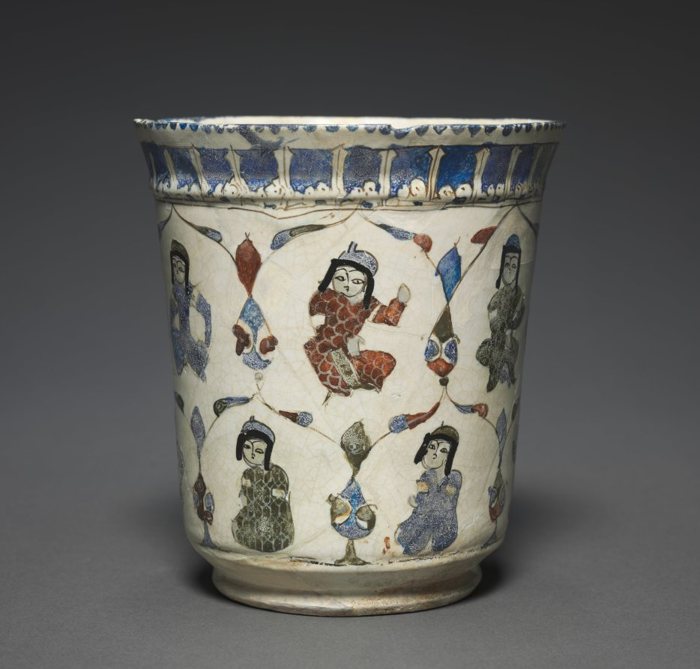
Cleveland Museum of Art · CC0 / public domain (museum open access) · Photo source ↗
- Type
- Collector guide
- Reading
- 5 min
- Chapters
- 5
- Photos
- 1
Scope and evidence
This reading separates visible construction, documented materials and origin claims. The photographs retain their own source context; they do not authenticate a purchase or demonstrate every stage described below. Historical examples and contemporary maker statements require different kinds of evidence.
- Surface: Polychrome decoration with overglaze colours
- Distinguish: Ceramic mina’i is not enamel on copper
- Condition: Restoration may affect large areas
- Surface
- Polychrome decoration with overglaze colours
- Distinguish
- Ceramic mina’i is not enamel on copper
- Condition
- Restoration may affect large areas
A ceramic technique with several layers
Mina’i ware is associated with medieval Iranian ceramics whose polychrome decoration includes overglaze colour. Ceramic body, glaze, painted decoration and gilding where present should be recorded separately. A general firing summary cannot establish the exact sequence or pigment composition of an individual vessel.
Do not confuse mina’i ceramics with modern minakari enamel on metal merely because both involve colour and firing. The supporting material, technical history and conservation risks differ. The mapped museum vessel is an object example, not a workshop demonstration or evidence for every colour recipe.
Read scenes without assigning an identity
Figures, riders and courtly scenes can invite a narrative reading, but a generic enthroned figure is not automatically a named ruler. A Shahnameh identification should come from a source that connects the particular scene and object to that narrative. Preserve uncertain descriptions rather than upgrading them.
Compare how figures, borders and inscriptions work with the vessel’s shape. Missing or repainted passages can change an apparent story. A catalogue image may show a visually complete surface even when significant restoration is present, so image clarity and historical completeness are different things.
Make condition and provenance central
Ask for a report identifying joined fragments, reconstructed sections, fills, overpainting and possible later additions. An old body can carry recent decoration, and an assembled object can combine fragments with different histories. A single date on a listing is not enough to address these possibilities.
Testing should be directed at explicit questions by qualified specialists. Thermoluminescence or pigment analysis has a defined scope and limitations; neither independently supplies a lawful ownership history. Ask whether the report is for this exact object and what part was sampled or examined.
- Request restored-area photographs
- Separate body and decoration claims
- Keep all uncertainty in scene identifications
- Ask what each test actually evaluated
Preserve surfaces rather than improving them
Overglaze paint and gilding can be more exposed than decoration beneath glaze. Do not polish, soak or use solvents to reveal colour or remove dull areas. Old fills and coatings can also be sensitive. Handling should avoid decorated surfaces and vulnerable repairs.
Study historical examples through museums and documented publications where possible. Contemporary original handmade Iranian ceramics need their own maker and material records; replicas and reproductions do not qualify for archive marketplace imports. Neither a modern decorative vessel nor a historical glazed bowl is automatically suitable for food use.
| Look at | Record | Do not infer |
|---|---|---|
| Decoration | Overglaze, underglaze and gilding as documented | One firing recipe |
| Scene | Source’s identification and uncertainty | Named ruler from appearance |
| Condition | Fragments, fills and overpainting | Original surface from completeness |
| Analysis | Method, sample and exact object | Lawful provenance |
References and further reading
- [1] Cleveland Museum of Art — Mina’i ware, 1917.977 ↗The craft-context photograph corresponds to this museum record; catalogue attributions are not independently verified.
- [2] The Met — Takht-i Sulayman and tilework in the Ilkhanid period ↗Architectural and technical context for medieval tiles; not a treatment recipe.
These sources provide context, not authentication or provenance for an individual object. Editorial interpretations remain under review.