
Collector guide · 11 min
Persian lacquer painting (rugani): pen-boxes, mirror cases and covers
Editorial team · updated 2026-10-03
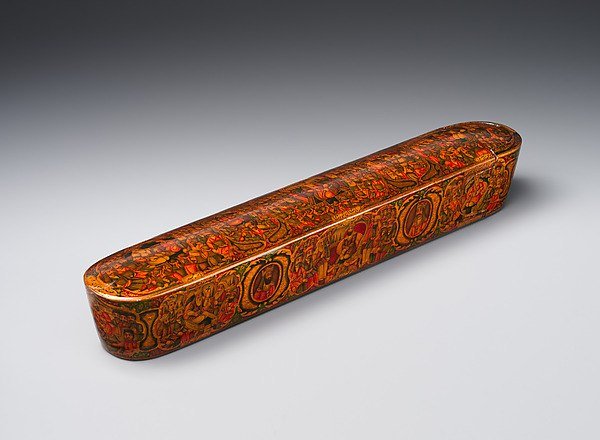
The Met · Public domain (museum open access) · Photo source ↗
- Type
- Collector guide
- Reading
- 11 min
- Chapters
- 9
- Photos
- 1
Persian lacquer painting decorates papier-mâché pen-boxes, mirror cases and book covers with miniature-style scenes under layers of varnish.
Technique
Papier-mâché or wood is primed, painted in watercolour or oil with fine brushes, and sealed with many coats of oil-based varnish. The varnish gives the deep, warm glow.
Key periods
Safavid and especially Qajar artists — including families of court painters — made lacquer pen-boxes (qalamdan) a major art form.
Checking condition
- Fine craquelure in the varnish is normal on old pieces
- Look for overpaint under UV light
- Hinges and edges are where losses start
- Check that the scene matches the period claimed
Materials
Persian lacquer painting (naqqashi-ye laki) applies paint to papier-mâché or wood and seals it with several varnish layers. Pen boxes (qalamdan), mirror cases and book covers are classic forms, especially from the Qajar period.
Questions to ask before buying
Ask the seller who made the piece and where, and get the answers in writing on the receipt. CraftPersia lists only work made in Iran or by Iranian makers; ‘Persian style’ is not the same thing as Persian-made. A seller who knows the work will usually be glad to explain the materials and how it was made.
- Is the base papier-mâché or wood?
- Is it painted by hand or printed?
- Is it old with documents, or contemporary?
A note on this guide
This is a general introduction written by the CraftPersia editorial team and has not yet been reviewed by a specialist. Workshop practice varies between towns and families; treat dates and figures as approximate and confirm details with makers, museums or published scholarship before relying on them.
Crafts covered in this guide
Persian lacquer painting (لاکیکاری) — A decorative technique in which papier-mâché or wooden objects, such as boxes, mirror cases and pen boxes, are painted with fine miniature-style scenes or floral ornament and then sealed under multiple coats of clear lacquer varnish.
Materials, techniques and centres
Persian lacquer painting is recorded in the archive with paper and lacquer coating as principal materials, and painted lacquer finishing as the technique. Associated centres include Isfahan and Shiraz; a place name on its own does not establish where an individual object was made.
Collecting and next steps
When applying this guide to a specific object, work from what can be observed: structure, materials, tool marks, repairs and documentation. Ask the seller or maker for written statements about who made the piece, where, from what materials, and what has been repaired or replaced.
The steps here are educational; identification, conservation and valuation of an individual object require appropriate independent expertise.
References and further reading
- [1] H. E. Wulff, The Traditional Crafts of Persia, MIT Press, 1966.General historical craft reference, not evidence for a particular object.
These sources provide context, not authentication or provenance for an individual object. Editorial interpretations remain under review.