
Beginner guide · 11 min
Kilims of Iran: a beginner’s guide
Editorial team · updated 2026-09-29
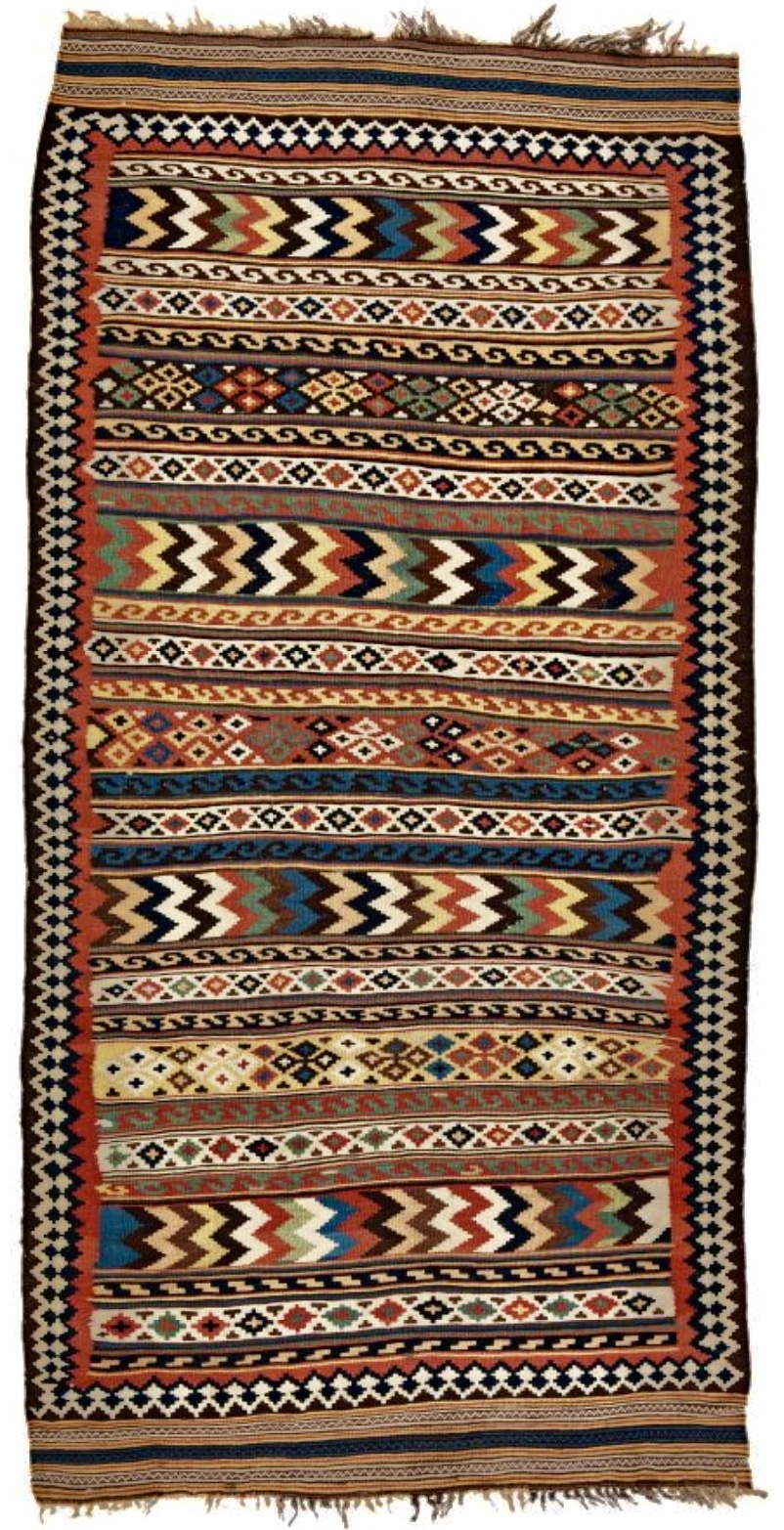
Unknown tribal weaver; photograph by auction house (per Commons) · Public domain (per Wikimedia Commons) · Photo source ↗
- Type
- Beginner guide
- Reading
- 11 min
- Chapters
- 9
- Photos
- 1
Flat-woven rugs without pile, made by tribal and village weavers across Iran.
Flat weave
A kilim has no pile. Colour comes from weft threads that turn back at the edge of each colour area, sometimes leaving small slits.
Regions
Kilims are woven by Qashqai, Bakhtiari, Kurdish, Shahsavan and other groups. Attribution to a group needs specialist study.
Use and care
Kilims are light and reversible. Use a rug pad on hard floors and rotate often.
Kilim weaving techniques
- Slit tapestry: colours change with small vertical slits at the boundaries
- Interlocking: wefts share warps where colours meet, with no slits
- Weft wrapping (soumak): a raised, embroidered-looking surface
- Weft-faced plain weave: simple stripes
Buying and using kilims
Hand-woven kilims are usually reversible, and their colour boundaries show the weaving technique. Kilims are thinner than pile rugs, so use a non-slip underlay. Ask where the kilim was woven: Fars, Kurdistan, Khorasan and Azerbaijan all have traditions.
A note on this guide
This is a general introduction written by the CraftPersia editorial team. It has not yet been reviewed by a specialist. Confirm details with makers, conservators or museums, and treat any dates as approximate.
- Structure
- Slit-tapestry flatweave
- Fibre
- Mostly wool
- Weaving groups
- Qashqai, Bakhtiari, Kurds, Shahsavan, Lurs and others
How a kilim is woven
Coloured wefts are passed back and forth only within their own colour area, then turn back. Where two colours meet vertically, small slits form — the characteristic slit-tapestry structure. There is no pile, so both faces are often usable.
Design
Slits favour diagonal and stepped edges, so kilim designs are strongly geometric: lozenges, hooks, stepped medallions and bands.
- Look for small vertical slits
- Geometric, stepped motifs
- Often reversible
Buying and care
Check for even tension (no wavy edges) and intact ends. Use an underlay to stop slipping. Kilims are lighter than pile rugs and easier to clean, but slits can open with heavy wear.
| Type | Structure | Look |
|---|---|---|
| Gelim / kilim | Slit tapestry | Geometric, crisp |
| Soumak (verni) | Weft wrapping | Fine, slightly raised |
| Jajim | Warp-faced strips | Striped bands |
| Zilu | Cotton weft-faced | Two-colour repeats |
References and further reading
These sources provide context, not authentication or provenance for an individual object. Editorial interpretations remain under review.