
Beginner guide · 11 min
Khatam kari: how Persian micro-mosaic inlay is made
Editorial team · updated 2026-09-29
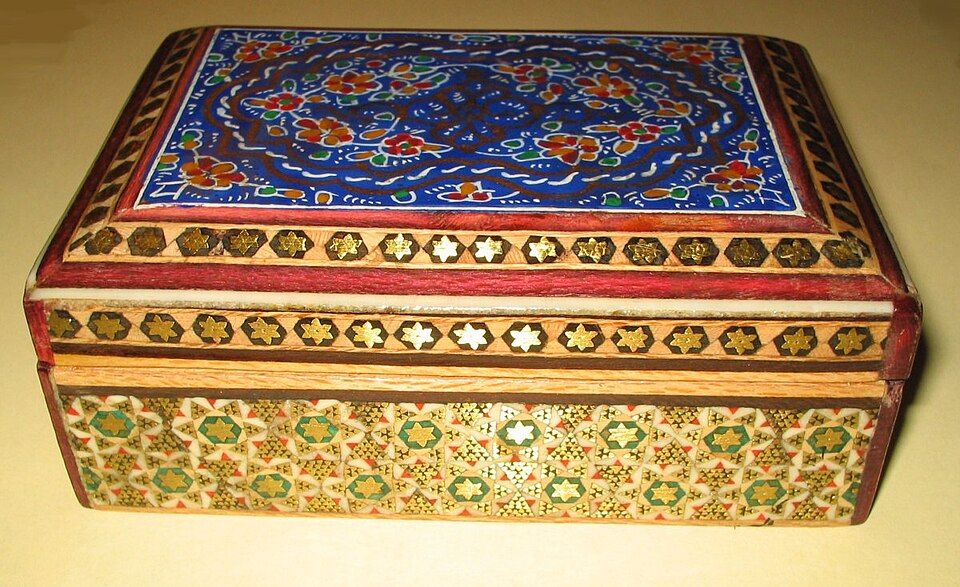
2006-05 · Fabienkhan (Wikimedia Commons) · Public domain (per Wikimedia Commons) · Photo source ↗
- Type
- Beginner guide
- Reading
- 11 min
- Chapters
- 9
- Photos
- 1
Khatam kari is Persian micro-mosaic inlay: tiny triangles of wood, bone and metal arranged into star patterns and glued onto objects.
What is khatam kari?
Khatam kari (khatam-kari) is a woodworking technique where thin rods of wood, bone and brass are bundled into triangular patterns, glued, sliced and applied to surfaces. The word khatam also means 'seal' or 'ring' in Persian. Shiraz and Isfahan are the main centres.
How it is made
- Rods of wood, bone and brass wire are filed into triangles
- Rods are bundled into a pattern block, usually a six-pointed star
- Blocks are glued and pressed, then sliced into thin sheets
- Sheets are glued onto a wooden object and polished
- The surface is sealed with varnish
Materials
Common materials include walnut, orange wood, ebony, camel bone and brass. A single square centimetre can hold dozens of pieces.
Real vs. imitation
Printed paper and plastic imitations exist. Real khatam shows the pattern at edges and cut sides and has a slightly uneven, tactile surface. See our guide to identifying khatam from imitation.
Care
Keep away from moisture, heat and direct sun; dust with a soft cloth.
Patterns and terms
Khatam patterns are built from star units, most commonly a six-pointed star. Workshops describe fineness by how many pieces fit into a unit, and finer work uses thinner rods. Typical objects include boxes, frames, chess boards, pen boxes and furniture inlays.
- Craft
- Geometric marquetry of wood, bone and metal from Shiraz and Isfahan
- Unit
- Star patterns built from triangular rods bundled and sliced
What khatam is
Khatam-kari is the inlaying of tiny geometric mosaics — stars and polygons — built from rods of coloured woods, camel bone and brass. A single box lid may contain tens of thousands of individual pieces. It is among the most precise of all Iranian crafts.
Judging quality
Fine khatam has small, regular stars with tight joins and a smooth, glassy finish. Coarser work shows larger cells, gaps between pieces and cloudy lacquer. Genuine khatam is always constructed from real rod bundles; printed or transfer 'khatam' patterns on souvenirs show no cell structure under magnification.
- Small, even star cells
- No gaps at joins
- Real bone and metal visible under magnification
Care
Keep khatam away from direct sun, radiators and damp; the many glued joints react to humidity swings. Dust with a soft dry cloth and never use water or polish on the surface.
| Check | Genuine khatam | Printed imitation |
|---|---|---|
| Magnified surface | Individual cells with joins | Flat printed dots |
| Edge detail | Pattern continues on bevels | Pattern stops or misaligns |
| Weight and feel | Solid, crisp | Light, uniform |
References and further reading
These sources provide context, not authentication or provenance for an individual object. Editorial interpretations remain under review.