
Beginner guide · 11 min
Crafts of Kashan: carpets, velvet, rosewater and tiles
Editorial team · updated 2026-10-03
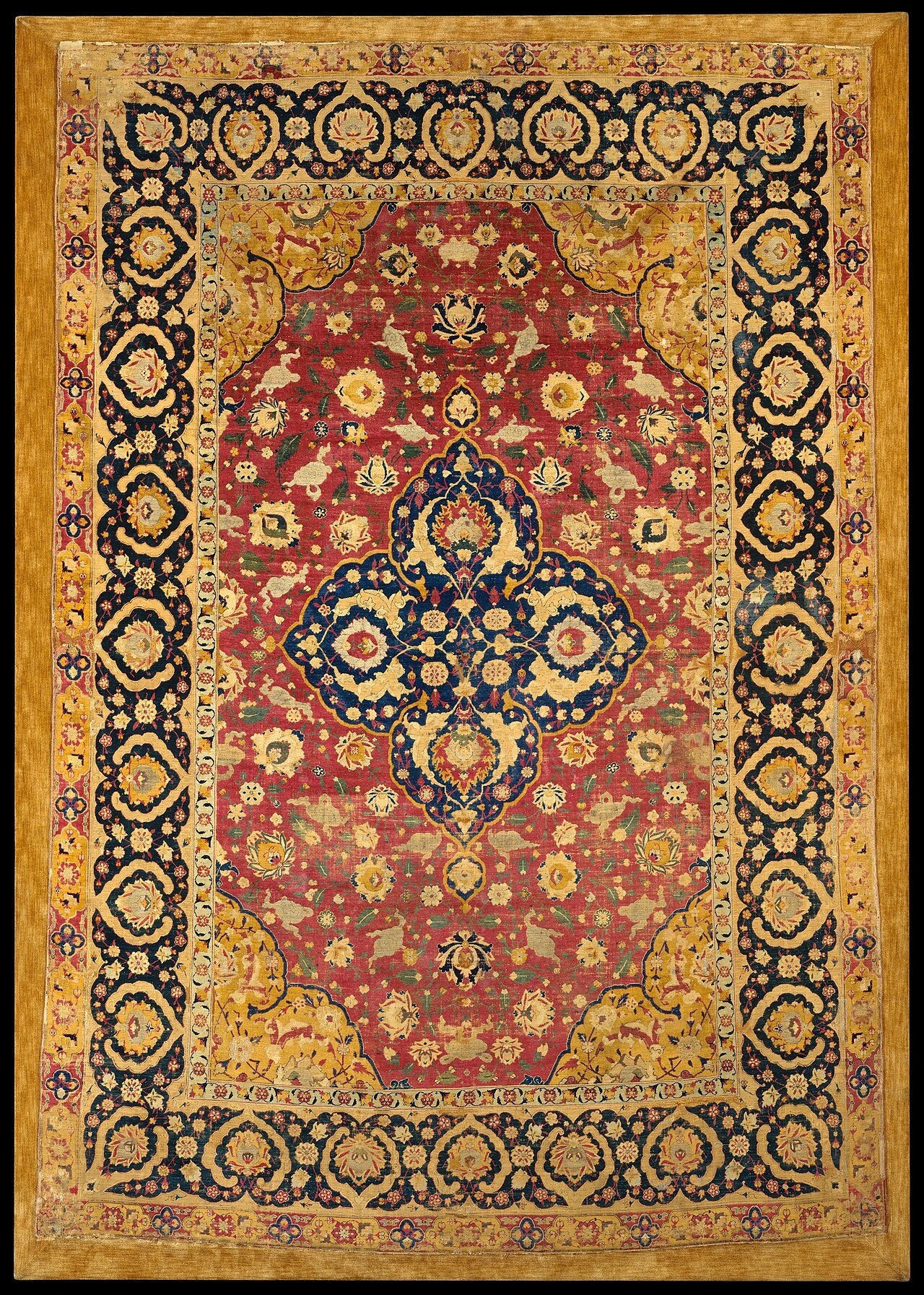
accessed 2026-09-30 · The Metropolitan Museum of Art · CC0 (Met Open Access / Wikimedia Commons) · Photo source ↗
- Type
- Beginner guide
- Reading
- 11 min
- Chapters
- 9
- Photos
- 1
Kashan is famous for fine carpets, historic velvet and lustre tiles; its restored houses show stucco and lattice windows.
Highlights
- Kashan carpets with dense medallion designs
- Historic silk velvet and brocade
- Medieval lustre tile heritage
- Gach-bori and gereh-chini in historic houses
When to go
The spring rosewater season (around May) draws visitors to Qamsar and Niasar nearby.
Kashan carpets in brief
Kashan carpets are typically woven on cotton foundations with wool or silk pile and an asymmetrical knot. Classic designs use a central medallion with corner pieces on a deep red or navy field, though all-over designs exist. Quality ranges widely, so judge each rug on knot density, clarity of drawing and wool quality rather than the city name alone.
Velvet and lustre: history rather than shopping
Kashan was a major centre of silk velvet and brocade weaving in the Safavid period and of lustre-glazed ceramics in the medieval period. Examples are mainly found in museums today; contemporary revivals exist, but be cautious of anything described as old or antique without documentation.
- Historic velvet: see museum collections rather than expecting it in shops
- Lustreware: modern lustre tiles are made, but old pieces need provenance
- Architecture: Tabatabaei, Borujerdi and Ameri houses show stucco, mirror and lattice work
Planning a craft visit to Kashan
Workshops and bazaar shops usually keep morning and late-afternoon hours, and many close on Friday and for a midday break. Bring cash or a local payment card, as international cards generally do not work in Iran. When you find a maker you like, ask for a business card or a phone number used for messaging apps so you can order later; many workshops also ship within Iran. Photograph labels and written descriptions rather than relying on verbal claims.
- Ask whether the piece was made in the shop or bought in
- Request materials in writing (wool or silk, natural or synthetic dye, wood species, metal)
- Check export rules for carpets, antiques and old manuscripts before paying
- Wrap fragile enamel and ceramics yourself if you doubt the shop's packing
A note on this guide
This guide is general information from the CraftPersia editorial team and has not been reviewed by a specialist. Prices, workshop locations and practices change; check current details before travelling or buying.
Crafts covered in this guide
Kashan carpet (فرش کاشان) — Hand-knotted city carpets from Kashan, often in wool or silk, known for medallion designs and deep reds and blues.
Velvet weaving (Makhmal-bafi) (مخملبافی) — A silk weaving technique producing a cut or voided pile on a foundation weave, used in Iran for garments, cushion covers and furnishing panels, with figured Safavid velvets among the most studied survivals.
Lustreware (Zarrin-fam) (زرینفام) — A ceramic decoration in which metallic oxides are painted onto a glazed surface and fired in a reducing kiln to produce a metallic sheen, associated especially with Kashan.
Materials, techniques and centres
Kashan carpet, Velvet weaving (Makhmal-bafi) and Lustreware (Zarrin-fam) are recorded in the archive with wool, silk, cotton, metal thread and stonepaste (frit) as principal materials, and knotted pile weaving and asymmetric (Persian) knot as techniques. Associated centres include Kashan and Isfahan; a place name on its own does not establish where an individual object was made.
Collecting and next steps
When applying this guide to a specific object, work from what can be observed: structure, materials, tool marks, repairs and documentation. Ask the seller or maker for written statements about who made the piece, where, from what materials, and what has been repaired or replaced.
The steps here are educational; identification, conservation and valuation of an individual object require appropriate independent expertise.
| Craft | Associated centres | Key materials |
|---|---|---|
| Kashan carpet | Kashan | Wool, Silk, Cotton |
| Velvet weaving (Makhmal-bafi) | Kashan, Isfahan | Silk, Metal thread |
| Lustreware (Zarrin-fam) | Kashan | Stonepaste (frit) |
References and further reading
- [1] H. E. Wulff, The Traditional Crafts of Persia, MIT Press, 1966.General historical craft reference, not evidence for a particular object.
These sources provide context, not authentication or provenance for an individual object. Editorial interpretations remain under review.