
Collector guide · 12 min
Recognising Kashan carpet features
Editorial team · updated 2026-09-29
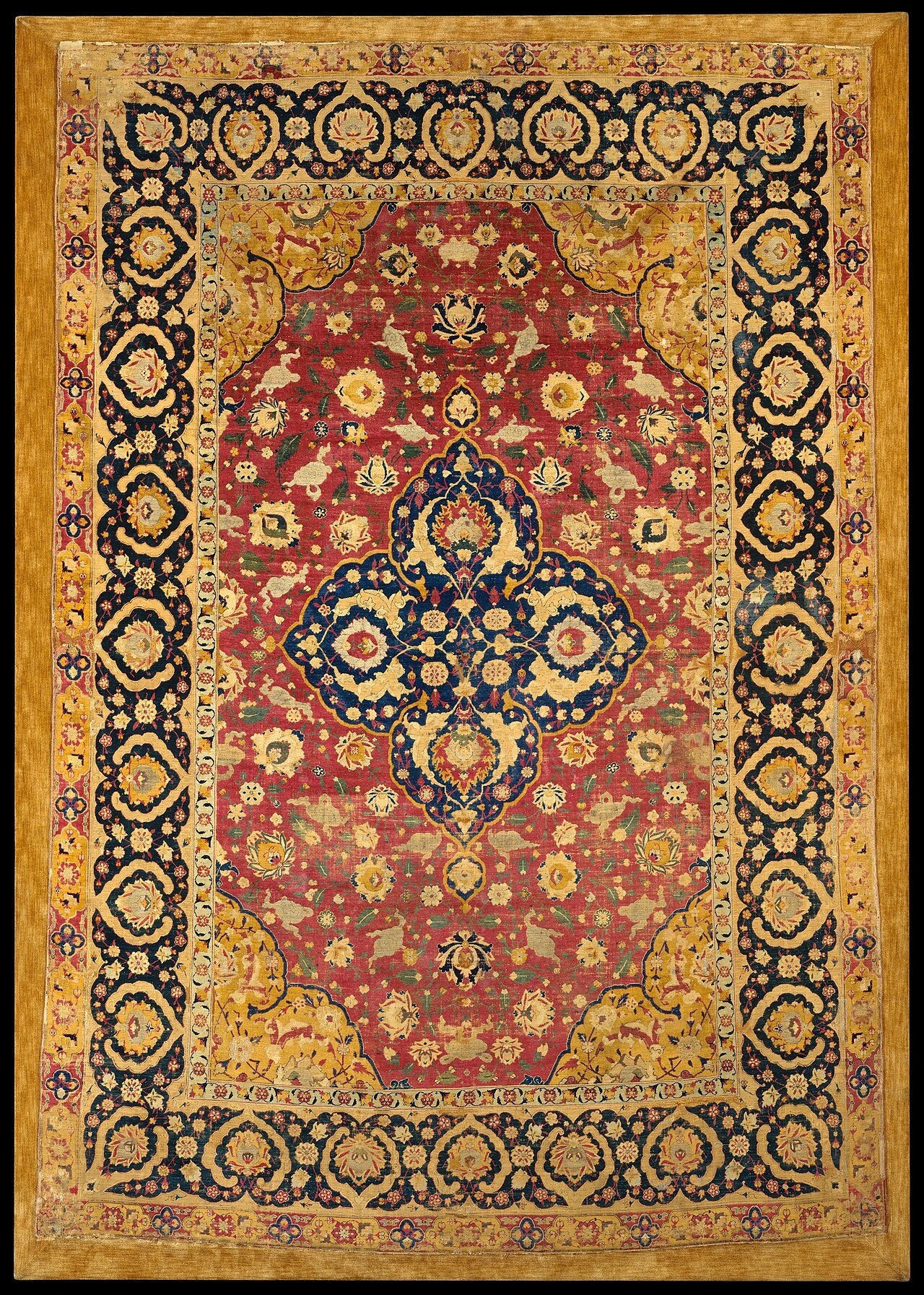
accessed 2026-09-30 · The Metropolitan Museum of Art · CC0 (Met Open Access / Wikimedia Commons) · Photo source ↗
- Type
- Collector guide
- Reading
- 12 min
- Chapters
- 10
- Photos
- 1
Features often described in Kashan carpets, from wool to silk pieces.
Construction
Often asymmetric knots with cotton or silk foundations.
Designs
Deep red fields with medallions are a well-known look, among many others.
Caution
Kashan-style carpets are woven in many places; ask for origin evidence.
Recognising a Kashan rug
No single feature proves where a rug was made, so look at several together: the design, the colours, the knot type, the foundation, and how the edges and ends are finished. Dealers' labels are sometimes used loosely, and ‘Kashan design’ rugs are woven in other towns and countries.
- Central medallion with corner pieces
- Deep red or navy field
- Cotton foundation, asymmetric knot
Judging quality
Kashan rugs vary in quality, so compare the fineness and the wool. Turn the rug over: hand-knotted rugs show the pattern clearly on the back, with small irregularities. A glued backing cloth or an even grid of stitches suggests a tufted or machine-made rug.
- Even, clear drawing of the motifs
- Wool that springs back when pressed
- Straight sides, and ends that are not pulling in
- No dye run between colours
Care and value
Vacuum regularly without a beater bar, rotate the rug once a year, and keep it out of strong sun. Value depends on condition, fineness, materials, age and design rather than on the city name alone. Get any valuation from an independent appraiser, not from the seller.
A note on this guide
This is a general introduction written by the CraftPersia editorial team. It has not yet been reviewed by a specialist. Practice varies between workshops; confirm details with makers or museums, and treat any dates as approximate.
- Region
- Kashan, central Iran
- Character
- Curvilinear medallion-and-corner city designs
- Heritage
- Kashan weaving skills are UNESCO-listed (2010)
The classic Kashan layout
Kashan carpets are associated with a formal city repertoire: a central lobed medallion with pendants, quartered corner designs, and curvilinear floral vines, usually on a red or dark blue field with an ivory border system. The drawing is flowing and precise, quite unlike the angular geometry of village weaving.
This repertoire was so successful that it has been copied for over a century — by other Iranian towns, and by factories in several countries. A 'Kashan design' rug may have no connection with Kashan, so the design tells you about the pattern tradition, not the place of weaving.
Construction, materials and the UNESCO context
Traditional Kashan weaving uses asymmetrical knots on a cotton foundation with wool pile, often in the finer commercial grades. Silk highlights and all-silk pieces exist but are a minority; any silk claim deserves the scrutiny described in the fibre guides.
In 2010 UNESCO inscribed the traditional skills of carpet weaving in Kashan on its intangible heritage list. That recognition concerns the living practice — the skills of Kashan weavers — and says nothing about any individual rug. A seller invoking UNESCO to authenticate a specific carpet is misusing the listing.
- Asymmetric knots, cotton foundation typical
- Silk claims need evidence, not sheen
- UNESCO listing covers skills, not objects
- Ask what documents the attribution
Evidence before price
Regional names in the rug trade describe styles and markets as often as weaving places. Treat the pointers here as questions to ask, not proof of origin: only a documented maker, workshop record or reliable provenance establishes where a particular rug was woven.
For older Kashan carpets — including the celebrated 'Motasham' workshop attributions — the market is full of hopeful labels. Independent specialist opinion and written provenance matter more than any woven signature or dealer's story.
| Pointer | What it suggests | What it cannot prove |
|---|---|---|
| Medallion-and-corner floral design | City design tradition of central Iran | Weaving in Kashan itself |
| Fine asymmetric knotting | Commercial workshop production | Age, maker or workshop |
| 'Motasham' attribution | A famous workshop name | Anything, without documentation |
References and further reading
- [1] UNESCO, Traditional skills of carpet weaving in Kashan (2010). ↗Documents a living practice; does not authenticate a listed rug.
These sources provide context, not authentication or provenance for an individual object. Editorial interpretations remain under review.