
Beginner guide · 5 min
Firuzeh-kubi: turquoise inlay on copper and brass
Editorial team · updated 2026-10-20
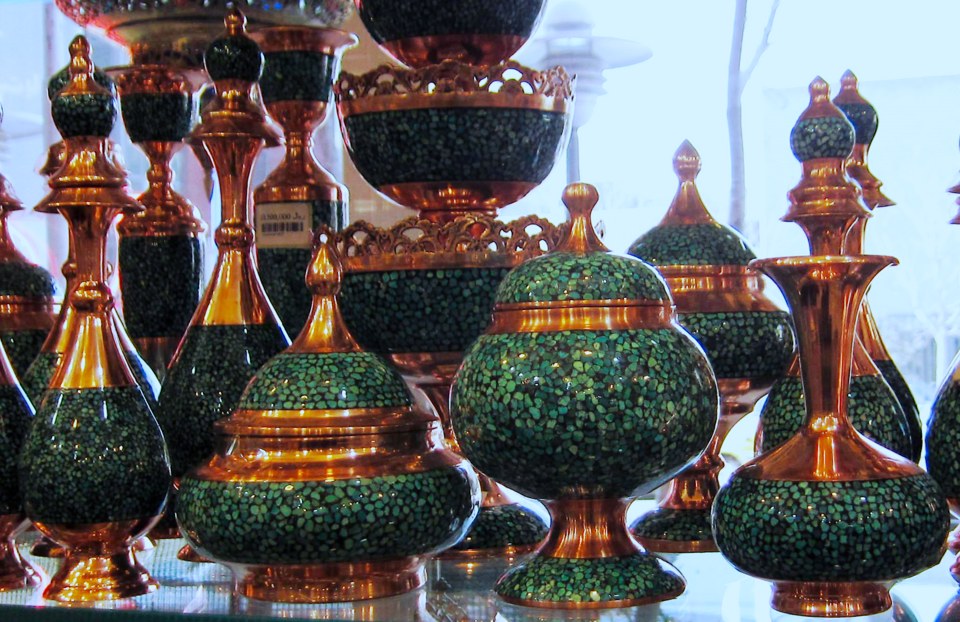
accessed 2026-09-30 · MRG90 · CC BY-SA 4.0 (Wikimedia Commons; JPG conversion) · Photo source ↗
- Type
- Beginner guide
- Reading
- 5 min
- Chapters
- 5
- Photos
- 1
Scope and evidence
This reading separates visible construction, documented materials and origin claims. The photographs retain their own source context; they do not authenticate a purchase or demonstrate every stage described below. Historical examples and contemporary maker statements require different kinds of evidence.
- Composite: Stone chips, adhesive and metal support
- Origin: Mine and manufacture are separate claims
- Care: No alcohol, heat or colour-transfer tests
- Composite
- Stone chips, adhesive and metal support
- Origin
- Mine and manufacture are separate claims
- Care
- No alcohol, heat or colour-transfer tests
Describe the assembly rather than only the colour
Firuzeh-kubi combines small turquoise pieces with an adhesive system over a prepared support, commonly metal. The boundaries of the decorated fields, bare metal areas and joins are part of the object’s construction. A bright blue surface alone does not establish stone identity or Iranian manufacture.
Adhesive formulations and finishing methods vary. Do not label every binder as a single traditional mastic recipe without a maker or technical source. The archive photograph shows a finished decorated object, not an authenticated record of the material preparation or workshop sequence.
Stone identity and treatment need disclosure
Ask whether the pieces are natural turquoise, treated natural stone, reconstituted material or a substitute. Stabilisation and reconstitution are different descriptions and should not be collapsed. Colour variation, dark matrix and small chip size cannot independently identify a mine, a treatment or purity.
Do not wipe a chip with alcohol to see whether colour transfers, and do not heat or scratch it. Such tests can damage stone, adhesive and protective finish. If material identity matters to a purchase, ask for appropriate examination or a clear statement of what is and is not known.
Inspect the joins and support
Look for missing pieces, visible gaps, lifting at an edge and repairs where stone meets metal. Closely packed chips can be a design choice, but the smallest gap is not a universal quality grade. Structure, durability, intended use and finish must be considered separately.
Ask whether the base was shaped by the maker, sourced as a prefabricated component or altered after decoration. Hand work and supplied components can coexist. Keep the stone’s alleged mine, the decoration workshop and the final assembly location as distinct documentary questions.
- Record base metal and stone description
- Ask what binder and finish were used
- Note missing and moving chips without touching
- Separate stone origin from place of manufacture
Care for the weakest component
Do not apply metal polish across a stone-covered field. Abrasives or solvents can affect turquoise, binder and coatings even if the bare metal could tolerate them. Avoid heat and contact with perfume or household cleaners; do not assume a shiny finish makes the object waterproof.
Treat historic or unassessed pieces as decorative rather than food vessels. For new functional claims, request the maker’s stated use and care instructions. A loose chip or lifting field needs assessment; pressing it back or adding household glue may create a more difficult conservation problem.
| Look at | Record | Do not infer |
|---|---|---|
| Stone claim | Identity and disclosed treatment | Mine from colour |
| Binder | Maker’s description or assessment | Universal mastic recipe |
| Edge and joins | Missing, loose or repaired chips | Durability from packing density |
| Origins | Stone source, decoration and assembly | One claim proves all stages |
References and further reading
- [1] Encyclopaedia Iranica — Isfahan XIII: Crafts ↗Regional history; practices changed over time and are not a timeless national formula.
- [2] National Park Service — Curatorial care of metal objects ↗Museum handling and storage guidance; composite surfaces need individual assessment.
These sources provide context, not authentication or provenance for an individual object. Editorial interpretations remain under review.