
Collector guide · 12 min
Recognising Bakhtiari carpet features
Editorial team · updated 2026-09-29
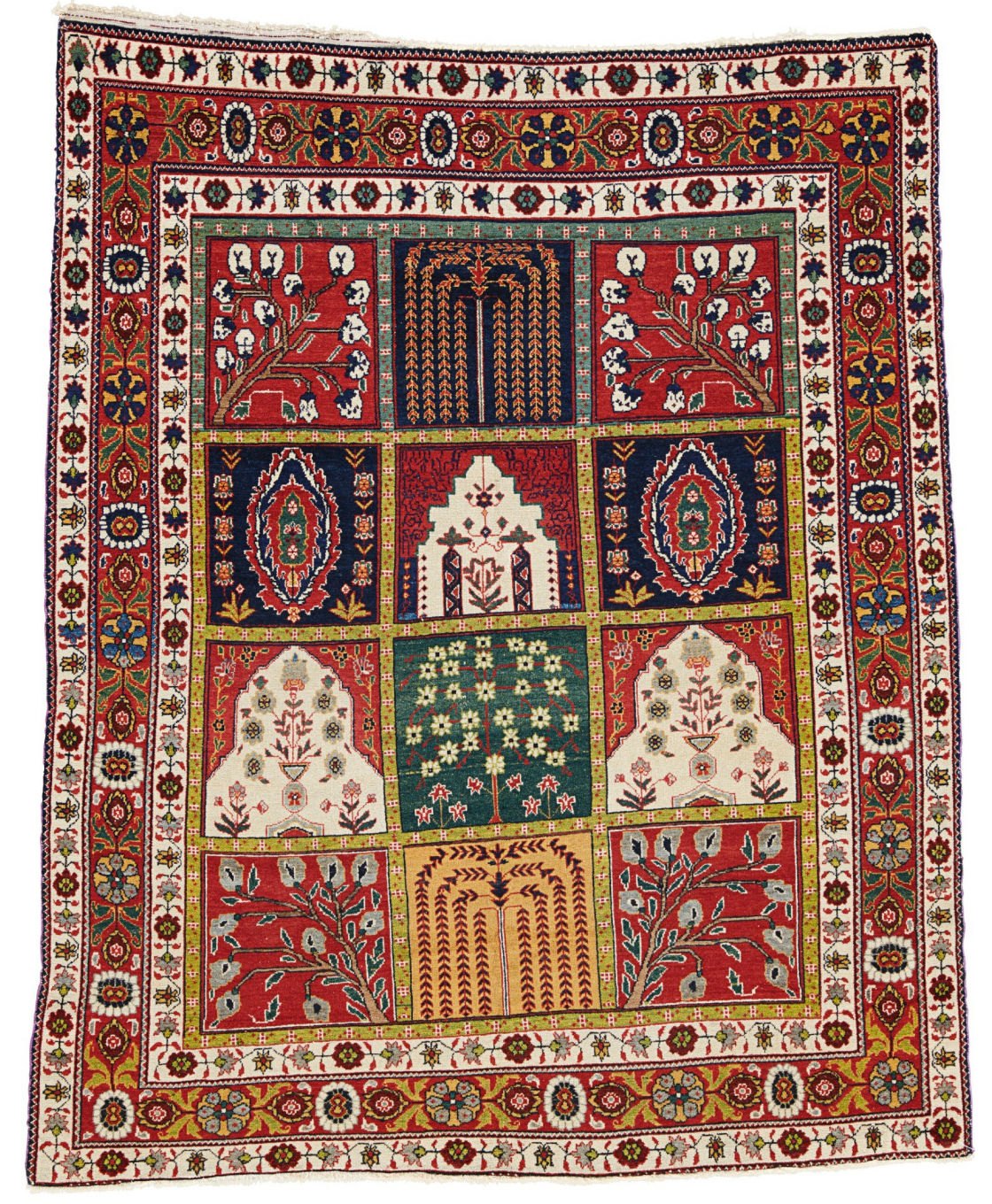
accessed 2026-09-30 · Unknown weaver; Wikimedia Commons photograph · Public domain (per Wikimedia Commons) · Photo source ↗
- Type
- Collector guide
- Reading
- 12 min
- Chapters
- 10
- Photos
- 1
Garden-panel designs from the Chaharmahal region.
Design
The ‘garden’ layout divides the field into panels, each with a tree, flower or vase.
Construction
Village weaving, often symmetric knots, sturdy wool.
Caution
Garden designs are copied widely; look at construction and ask for origin.
Recognising a Bakhtiari rug
No single feature proves where a rug was made, so look at several together: the design, the colours, the knot type, the foundation, and how the edges and ends are finished. Dealers' labels are sometimes used loosely, and ‘Bakhtiari design’ rugs are woven in other towns and countries.
- Garden compartment (khesti) layout
- Bold, durable wool
- Village character
Judging quality
Bakhtiari rugs are known for robust wool and the garden-panel design. Turn the rug over: hand-knotted rugs show the pattern clearly on the back, with small irregularities. A glued backing cloth or an even grid of stitches suggests a tufted or machine-made rug.
- Even, clear drawing of the motifs
- Wool that springs back when pressed
- Straight sides, and ends that are not pulling in
- No dye run between colours
Care and value
Vacuum regularly without a beater bar, rotate the rug once a year, and keep it out of strong sun. Value depends on condition, fineness, materials, age and design rather than on the city name alone. Get any valuation from an independent appraiser, not from the seller.
A note on this guide
This is a general introduction written by the CraftPersia editorial team. It has not yet been reviewed by a specialist. Practice varies between workshops; confirm details with makers or museums, and treat any dates as approximate.
- Region
- Chaharmahal and Bakhtiari, west-central Iran
- Character
- Garden panels (khesti), bold medallions, sturdy weave
- Caution
- Village, workshop and style-copy production all exist
Garden panels and medallions
The signature Bakhtiari design is the khesti or garden-panel layout: the field divided into a lattice of compartments, each holding a tree, flower or animal motif — a woven echo of the Persian garden. Bold medallion designs with strong colours are also woven in the region.
The same region produces both nomadic-influenced village weaving and settled workshop production, and the khesti layout is woven elsewhere too. As always, design identifies a tradition, not an address.
Construction and condition
Bakhtiari-area rugs are generally sturdy, with a firm weave suited to floor use. Wool quality is often noted as a strength of the region's production, but 'good wool' is a claim to feel and question, not a specification: ask what the pile and foundation are, and judge handle yourself.
These are working rugs, so apply the working-rug condition checks: even wear, honest ends and edges, disclosed repairs. Dye quality matters with strong colours — the damp-cloth colour-run test belongs on a hidden corner, and only with the seller's permission.
- Khesti panel or bold medallion layouts
- Firm, durable weave for floor use
- Check wear, ends, edges and repairs
- Test colour-fastness only with permission
Attribution and price
Regional names in the rug trade describe styles and markets as often as weaving places. Treat the pointers here as questions to ask, not proof of origin: only a documented maker, workshop record or reliable provenance establishes where a particular rug was woven.
Older Bakhtiari weaving — including pieces attributed to specific villages or to 'bibi baf' (woman-woven) production — attracts collector prices. Those attributions need documentation or specialist support; a seller's family story is a lead to verify, not evidence.
| Pointer | What it suggests | What it cannot prove |
|---|---|---|
| Khesti garden-panel design | The Bakhtiari design tradition | Region of weaving |
| Sturdy heavy weave | Utility production | Village versus workshop origin |
| Strong natural-looking colours | Possible natural dyes | Dye chemistry — needs evidence |
References and further reading
- [1] A. C. Edwards, The Persian Carpet, Duckworth, 1953.Classic survey; historical context, not a test of an individual carpet.
These sources provide context, not authentication or provenance for an individual object. Editorial interpretations remain under review.