
Definition
Mina'i ware is a stonepaste (fritware) pottery decorated with a combination of underglaze and overglaze enamel colours, the overglaze pigments applied on top of the fired glaze and fixed by a second, lower-temperature firing in a muffle kiln. This two-stage process allowed a wider palette, including reds, greens and gilding, than underglaze painting alone could achieve at the time.
The term mina'i, meaning enamelled, is a later art-historical label rather than a name documented in period sources for this ware; some scholars also use haft rang (seven colour) for related overglaze-painted wares, and the terminology in the literature is not fully standardised.
History
Mina'i ware is documented from Iran, principally associated with Kashan, in the second half of the twelfth century and into the early thirteenth century, alongside the broader flourishing of Kashan stonepaste production and lustreware in the same period. Production appears to have ended, along with much of the Kashan luxury ceramic industry, following the Mongol invasions of the early thirteenth century, and the technique was not revived in the same form afterward.
Surviving pieces, mostly bowls and small vessels, are prized for their painted scenes of courtly and narrative life, including horsemen, seated figures, and episodes that some scholars connect to epic literature such as the Shahnameh, though specific narrative identifications for individual pieces are often debated rather than certain.
Materials
The body is stonepaste, a mixture of ground quartz, a small proportion of clay and a glass frit, fired to a hard, pale body that takes a clear alkaline glaze well. Overglaze pigments, applied after the glaze firing, included iron-red, black, white, and sometimes gilding, fixed by a second firing at a temperature low enough not to disturb the glaze beneath.
- Stonepaste (fritware) body of quartz, clay and frit
- Clear alkaline glaze, often tinted pale turquoise or colourless
- Overglaze enamel colours including red, black and white
- Gilding on some pieces, fixed with the enamel firing
Technique
Vessels were thrown or moulded in stonepaste, given an initial underglaze decoration in some cases, glazed and fired. Figural and decorative scenes were then painted over the fired glaze in enamel pigments and fixed in a second, cooler firing, a sequence that risked loss of the overglaze layer if the second firing was mishandled, which likely limited output to skilled specialist workshops.
The painting style is notably pictorial for its period, with attention to facial detail, costume and setting that goes beyond the more schematic figural work found on some contemporary underglaze wares.
Motifs
Seated and enthroned figures, mounted riders, birds and vegetal scrollwork populate the painted scenes, often arranged in registers around the interior of a bowl. Some pieces carry inscriptions in addition to the figural scenes.
Collecting and identification
Authentic mina'i ware is rare, museum-concentrated, and has long attracted forgery and heavy restoration; any piece offered outside an institutional or well-documented provenance chain should be treated with strong caution and verified by specialist scientific and connoisseurial examination rather than by appearance alone.
Because the overglaze enamel layer is fragile, genuine excavated or long-handled pieces frequently show wear, flaking or old restoration to the enamel, which is not itself proof of authenticity but is consistent with the ware's known fragility.
Preservation
The overglaze enamel is the most vulnerable layer, more easily abraded and lost than the underlying glaze; handling should avoid any contact with the painted surface, and cleaning should be left to a conservator familiar with historic ceramics rather than attempted with household methods.
Museum practice for mina'i pieces typically avoids washing painted surfaces with water or solvents and stores or displays them away from direct handling and vibration, given the risk of enamel loss.
گالری
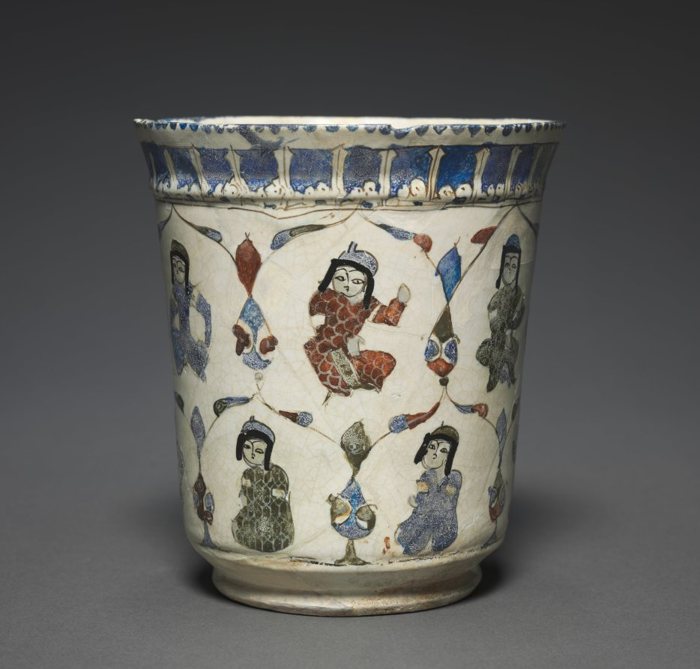
تصاویر نمونههایی معرف هستند، نه سندی برای رکوردهای نمونهٔ بازارچه. منبع و وضعیت مجوز آنها در بخش اعتبارهای عکاسی آمده است.
بازارچه
در حال حاضر هیچ شیئی از این صنعت فهرست نشده است.
- Construction
- Historical overglaze ceramic
- Object reading
- Structure, materials and condition before attribution
- Evidence status
- Educational summary under editorial review
Historical overglaze ceramic
Mina’i ware uses overglaze enamel colours, sometimes alongside underglaze elements, on a previously glazed ceramic body. The surviving medieval corpus is studied through museum records; not every figural glazed bowl belongs to this class.
Avoid decorative attribution
Compare glaze layering, painted details and documented museum parallels. Without testing and provenance, a visual resemblance cannot establish chronology or authenticity.
- Ceramic body beneath glaze
- Painted colours above a fired glaze layer
- Possible flaking of overglaze decoration
Context, preservation and evidence
Workshops, households, museums and contemporary makers can use the same craft name in different ways. Record who made, sold and documented a piece before assigning a date or location. Condition and technique are observable; origin, attribution and value require further evidence.
These reading notes are educational, not an authenticity certificate or valuation. The associated source list is a starting point; many claims and translations still require specialist review.
Mina'i ware در تصاویر
این تصاویر جنبهٔ نمایشی دارند و مربوط به شیء خاصی در فهرست نیستند. منابع در صفحهٔ منابع تصاویر آمده است.
| Type | How to distinguish it |
|---|---|
| Mina’i ware | Ceramic with overglaze painted decoration |
| Minakari | Fired enamel on a metal form |
| Underglaze pottery | Pigments beneath transparent glaze |
اصطلاحات کلیدی
- Mina’i مینایی
- Historical ceramic decoration category, distinct from metal enamel.
منابع و مآخذ
- Book: Watson, O. Persian Lustre Ware. Faber and Faber, 1985.
- Journal article: Encyclopaedia Iranica, entry on ceramics (sofal), Seljuk period wares.
- Museum catalogue: The Metropolitan Museum of Art, Islamic art collection records, mina'i ware.
در جایی که خاستگاه، تاریخ یا نمادشناسی محل مناقشه است، این مدخل روایتهای رقیب را بیان میکند نه اینکه میان آنها یکی را برگزیند. تحلیل سردبیری بهعنوان واقعیتِ مستند ارائه نمیشود.