
Collector guide · 3 min read
Reading a Luristan horse bit: winged ibexes, casting and object assembly
CraftPersia editorial draft · specialist review pending · updated 2026-10-14
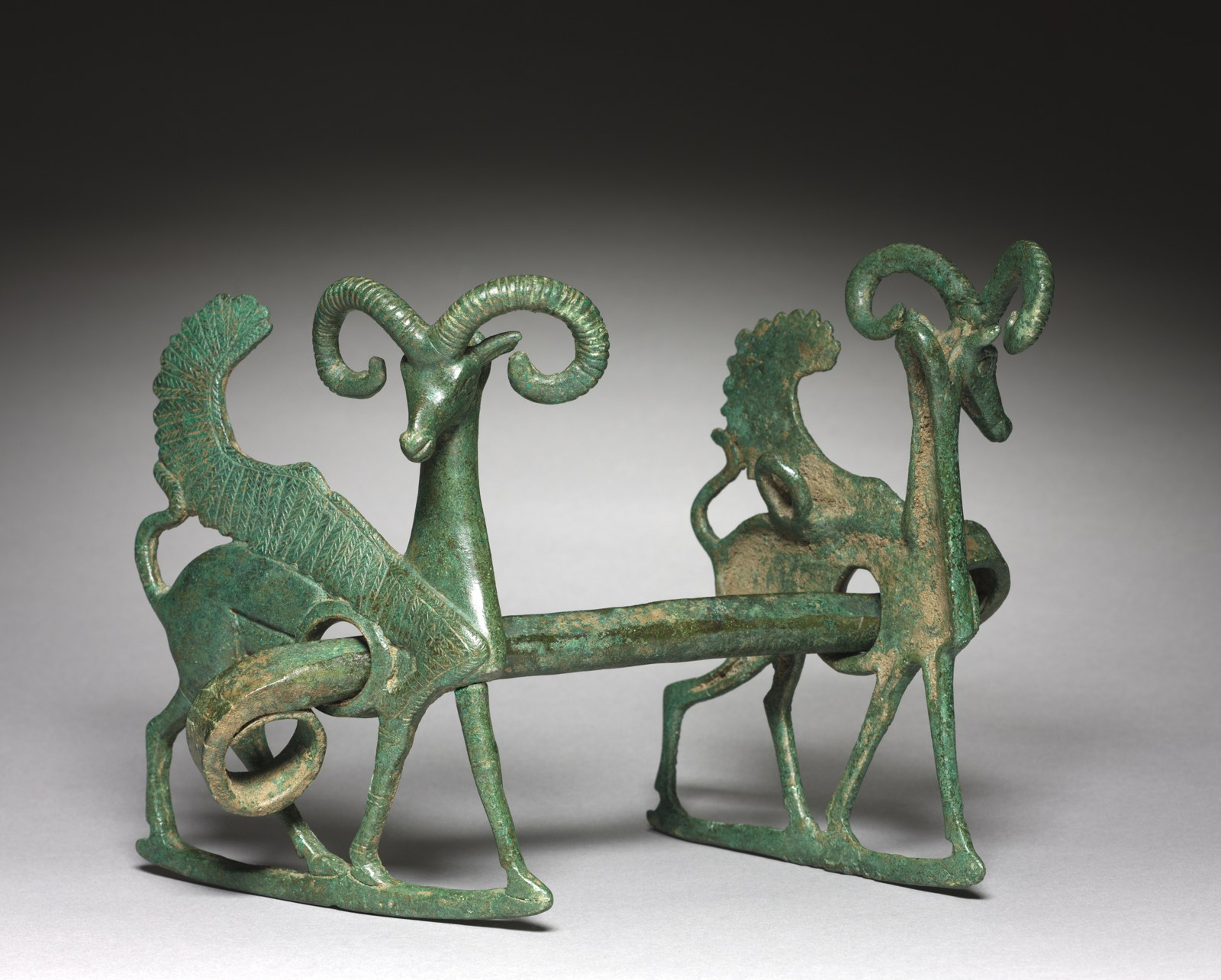
800–600 BCE · CP-LIB-CMA-1980-102 · consulted 2026-10-14 · Cleveland Museum of Art · CC0 (museum open access; resized JPEG) · Photo source ↗
Luristan is a sourced attribution, not an animal-style test
The Cleveland catalogue records Horse Bit with Winged Ibex Cheekpieces as Iran, Luristan, 800–600 BCE, in bronze, cast and incised. Each field belongs to accession 1980.102. Luristan is a broad historical and geographical attribution here; it does not identify a named maker or excavated workshop. Keep the attribution attached to the source rather than converting a shared animal vocabulary into an origin test.
Ancient metalwork can circulate without complete findspot or ownership information. A museum record and a dated provenance account answer different questions. Before developing an archaeological narrative, consult the institution’s supporting publications and acquisition details. The object’s modern entry into a collection is not its manufacture date, and a catalogue classification is not a reconstruction of its entire journey.
Read cheekpieces and bar as an assembly
The photograph shows two ornamented lateral elements linked by a bar. The title identifies the lateral elements as cheekpieces and the composite object as a horse bit. Describe these components before treating the silhouette as a freestanding sculpture. Wings, horns and open spaces organise the visible animal forms; their exact symbolism is not settled by the descriptive name.
A photographed assembly cannot independently prove that every component was originally made together or remained together throughout its history. Ask whether conservation or catalogue documentation discusses joins, replacements or reconstruction. The arrangement seen on screen records the museum presentation. It should not be used to demonstrate actual fitting on a living horse or to infer the identity of an ancient rider.
- Record paired lateral elements and connecting bar.
- Distinguish construction gaps from losses.
- Keep modern presentation separate from original-use reconstruction.
Cast body and incised surface
Casting produces a form by solidifying molten metal in a prepared mould; incision adds cut lines to a surface. The museum lists both operations for this object. They describe different scales of making, and a complex cast shape may still carry later tool work. The catalogue does not require the entire object to have been carved from solid metal.
A lost-wax process is often discussed in ancient bronze literature, but this medium field alone does not establish the exact mould system. Likewise, open areas do not automatically prove that metal was sawn away after casting. Keep construction hypotheses distinct from the sourced wording. Tool marks, mould evidence and technical analysis are needed for more detailed conclusions.
Green surfaces are not clocks
The photograph shows green and darker surface areas. Bronze corrosion and patination can affect colour, but appearance cannot date an object or prove that a surface developed in antiquity. Lighting, coatings and previous treatment also change what is visible. Record colour distribution and texture without calling every patch stable patina or every dark line an original incision.
Do not scrape green material, oil a surface or use acid to reveal metal. Such actions can remove evidence and destabilise an object. A conservator should assess friable or changing surfaces and advise on handling and display. Projections and narrow links need support; the object should not be lifted by its animal tips or connecting bar without a suitable handling plan.
Collecting questions for ancient bronze
A collecting dossier should include ownership history, lawful export information, full photographs, dimensions and a dated condition assessment. The statement “Luristan type” may describe stylistic comparison rather than documented origin. Ask exactly which evidence supports the attribution. A similar green surface or winged animal shape cannot inherit this museum object’s date or provenance.
Contemporary handmade Iranian bronze work belongs to a separate category with maker and manufacture records. Copies of ancient horse fittings are not accepted here as original historic or contemporary traditional objects simply because they resemble the illustration. Use this image to learn vocabulary and close looking, not to justify an undocumented market purchase.
- Collection
- Cleveland Museum of Art
- Accession
- 1980.102
- Catalogue date
- 800–600 BCE
- Origin as catalogued
- Iran
Keep the evidence layers separate
A useful research record distinguishes direct observation, the institution’s catalogue statements and your own interpretation. None of these should silently replace the others. Record the source and access date before comparing a historical object with a current listing.
- Observe: shape, layout and visible features.
- Attribute: retain the catalogue’s exact qualifications.
- Investigate: seek additional views, condition information and lawful provenance.
| Evidence | Documented statement | What it does not establish |
|---|---|---|
| Identity | Horse Bit with Winged Ibex Cheekpieces · 1980.102 | Identity or authenticity of another object |
| Date | 800–600 BCE | An independent date for a similar listing |
| Material | Bronze, cast and incised | A complete technical analysis from the photograph |
| Origin | Iran | Provenance of contemporary goods with similar ornament |
| Photo licence | CC0 (museum open access; resized JPEG) | Rights to unrelated auction or shop photographs |
References and further reading
- [1] Cleveland Museum of Art: Horse Bit with Winged Ibex Cheekpieces, 1980.102 ↗Primary catalogue source; consulted 2026-10-14. Qualifiers and collection updates take precedence over this editorial reading.
- [2] Canadian Conservation Institute: Caring for cultural heritage ↗Preventive conservation context, not a treatment prescription.
These sources provide context, not authentication or provenance for an individual object. Editorial interpretations remain under review.