
Collector guide · 3 min read
Reading a Seljuq bird-shaped vessel: casting, chasing and an inlaid eye
CraftPersia editorial draft · specialist review pending · updated 2026-10-14
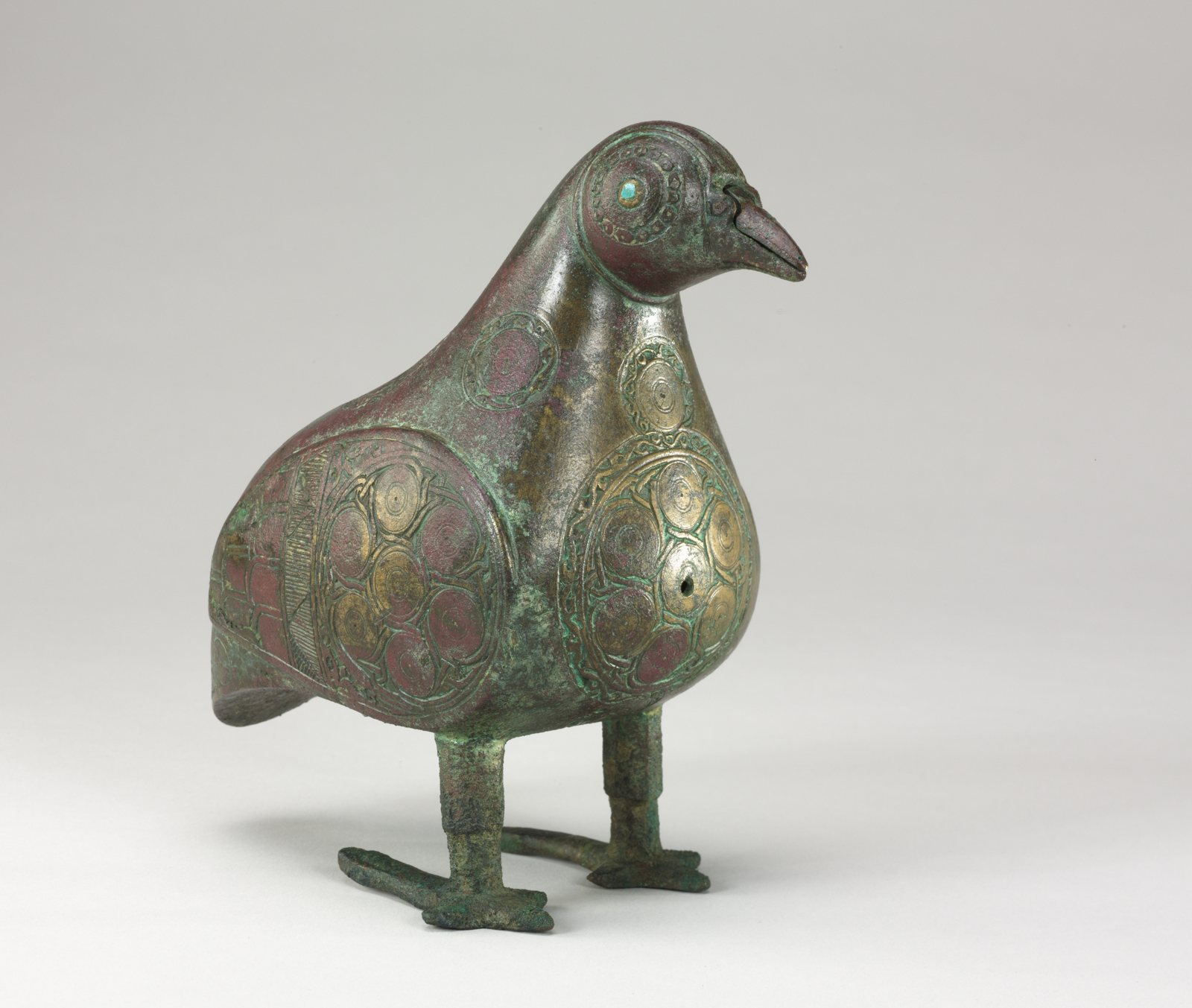
1100s · CP-LIB-CMA-1948-458 · consulted 2026-10-14 · Cleveland Museum of Art · CC0 (museum open access; resized JPEG) · Photo source ↗
What the catalogue states
Cleveland Museum of Art records this vessel as Iran, Seljuq period, dated to the 1100s, in bronze, cast, with chased and chiseled decoration and eyes inlaid with blue glass. It measures 17.5 × 9.5 cm. Those fields should travel together: the period label is a broad dynastic attribution, not a specific workshop or city, and the museum does not name a maker.
The museum suggests it may have served as a water vessel for pouring, filled through an opening in the chest. Note the word “may”: the function is a proposal grounded in form, not a recorded use. A responsible description keeps that qualification rather than presenting the object as a documented ritual implement.
Casting first, then surface work
Casting produced the body, legs and tail as a hollow form; chasing and chiselling then refined feathers and the roundel-like wing ornament. These are distinct operations that leave different evidence. In the photograph, raised wing panels and engraved lines can be described, but the order of tools, the number of moulds and any later repairs cannot be reconstructed from one view.
The blue glass eyes are a separate material set into the metal. Inlay of this kind can loosen or be replaced over centuries, so their presence is an observation, not proof that every element is original. A conservator’s report would distinguish original inlay from later fills.
- Describe the cast form and the surface decoration separately.
- Record glass inlay as a distinct material.
- Do not infer repairs or originality from a photograph.
Patina, colour and condition
Green and reddish tones reflect corrosion products and lighting as well as alloy. They cannot independently establish composition or age; scientific analysis would be required. Avoid cleaning a historical bronze to make decoration more legible: removing corrosion can remove the original surface and the evidence it carries.
The legs and feet are slender structural points. If such an object is handled, it should be supported under the body, never lifted by the tail or neck. The vessel is a museum object; its historical form gives no assurance of present safety for water or food.
Collecting research and the limits of a comparison
Accession 1948.458 is a comparative reference, not a certificate that can be borrowed by another object. For any candidate offered for sale, request its own dimensions, all-round photographs including the base or reverse, a dated condition report and a traceable ownership and export history. Visual similarity to a museum piece establishes neither date nor origin, and attractive objects are the most frequently copied.
Keep lawful provenance separate from stylistic attribution; an auction estimate or a confident description resolves neither. For contemporary handmade Iranian work, look instead for a named maker and real production information rather than a historical comparison. The museum photograph is released CC0 through the Cleveland open-access programme; that status does not extend to photographs of other objects or to a seller’s images.
- Ask for the object’s own measurements and views.
- Request documented ownership and export history.
- Treat the museum record as comparison only.
- Collection
- Cleveland Museum of Art
- Accession
- 1948.458
- Catalogue date
- 1100s
- Origin as catalogued
- Iran
Keep the evidence layers separate
A useful research record distinguishes direct observation, the institution’s catalogue statements and your own interpretation. None of these should silently replace the others. Record the source and access date before comparing a historical object with a current listing.
- Observe: shape, layout and visible features.
- Attribute: retain the catalogue’s exact qualifications.
- Investigate: seek additional views, condition information and lawful provenance.
| Evidence | Documented statement | What it does not establish |
|---|---|---|
| Identity | Bird-shaped Vessel · 1948.458 | Identity or authenticity of another object |
| Date | 1100s | An independent date for a similar listing |
| Material | Bronze, cast, with chased and chiseled decoration; eyes inlaid with blue glass | A complete technical analysis from the photograph |
| Origin | Iran | Provenance of contemporary goods with similar ornament |
| Photo licence | CC0 (museum open access; resized JPEG) | Rights to unrelated auction or shop photographs |
References and further reading
- [1] Cleveland Museum of Art: Bird-shaped Vessel, 1948.458 ↗Primary catalogue source; consulted 2026-10-14. Qualifiers and collection updates take precedence over this editorial reading.
- [2] Canadian Conservation Institute: Caring for cultural heritage ↗Preventive conservation context, not a treatment prescription.
These sources provide context, not authentication or provenance for an individual object. Editorial interpretations remain under review.