
راهنمای مجموعهداران · 3 min read
Reading a Sasanian horse-shaped vessel: sculptural form and partial gilding
CraftPersia editorial draft · specialist review pending · بهروزرسانی 2026-10-14
این راهنما هنوز به فارسی ترجمه نشده است و فعلاً به انگلیسی نمایش داده میشود.
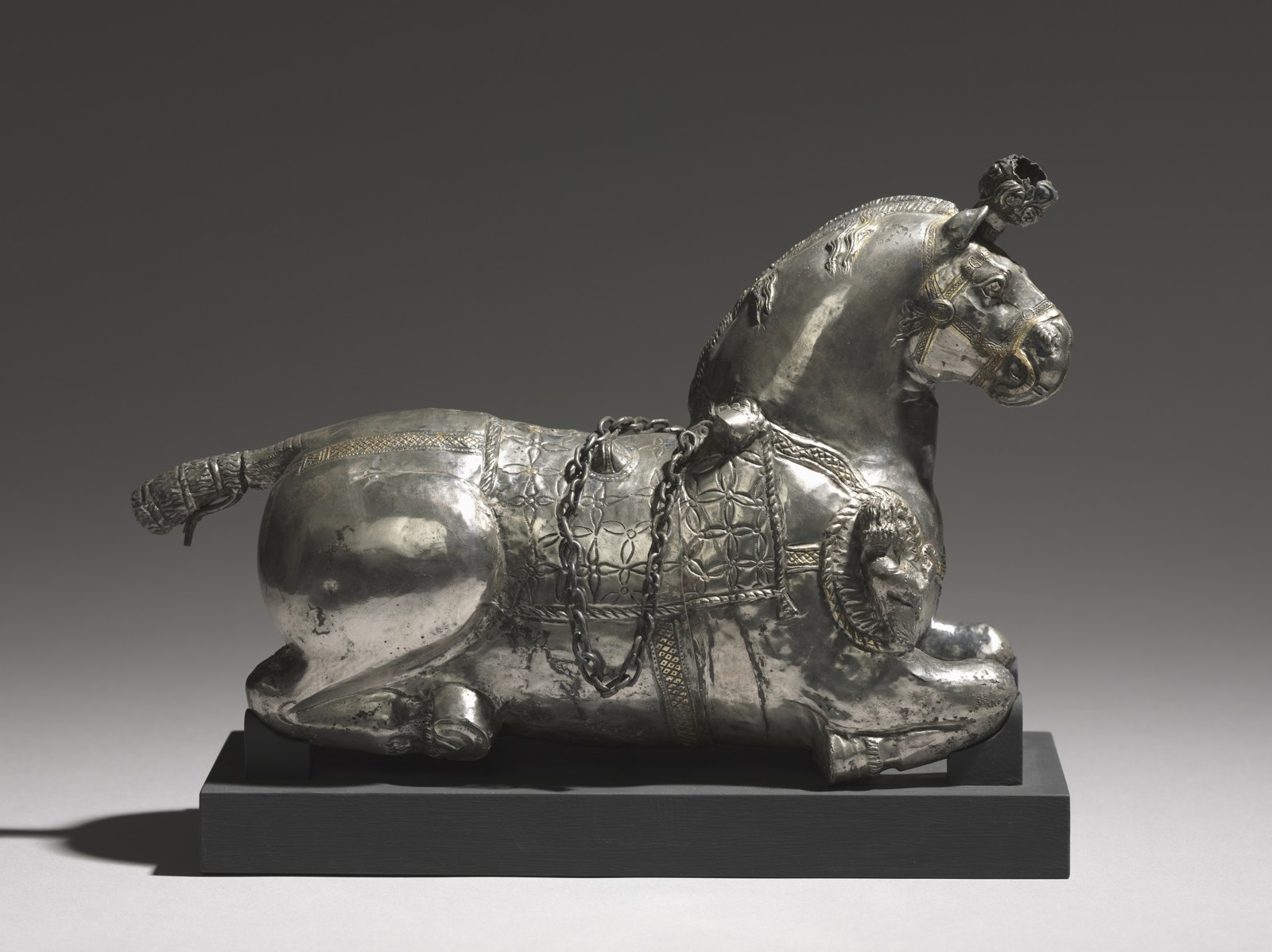
200–325 CE · CP-LIB-CMA-1964-41 · consulted 2026-10-14 · Cleveland Museum of Art · CC0 (museum open access; resized JPEG) · منبع عکس ↗
Keep the museum date and Sasanian label together
Cleveland records this horse-shaped drinking vessel as Iran, Sasanian Empire, with a date of 200–325 CE and medium of silver, partially gilt. The date range and cultural label should be retained as separate fields. A catalogue can use a broad historical classification alongside a range that spans a political transition; silently narrowing the date to match a dynasty would change the source.
Accession 1964.41 identifies the object and its collection record. The form invites questions about drinking, display and courtly objects, but it does not name the individual who used it. The image alone cannot certify ceremonial use, ritual practice or royal ownership. Any stronger historical account should be attributed to object-specific scholarship rather than inferred from richness or animal form.
A vessel is more than an animal silhouette
The photographed horse has a long horizontal body, modelled head and detailed surface ornament. The dark block beneath it is a modern display support visible in the museum photograph, not part of the ancient vessel. Retaining the whole photograph keeps that presentation legible; a tight crop can obscure both support and the object’s overall proportions.
Read sculptural contour, body openings and applied or worked details separately. One side view cannot locate every opening or explain exactly how liquid moved through the vessel. Use the catalogue and additional views before drawing a functional diagram. The term rhyton is used for particular drinking-vessel forms, but naming a form is not sufficient evidence for a reconstructed ceremony.
- Separate modern support from the catalogued object.
- Record which openings are actually visible.
- Treat functional reconstruction as interpretation, not observation.
Partial gilding is a material description, not a recipe
Partially gilt means that gold has been applied to some areas of an otherwise different substrate. The museum identifies silver as the main material. This differs from a solid-gold vessel and from assuming that every yellowish region is gold. Photographic lighting can exaggerate or suppress tonal differences, making material analysis a separate question.
Several historical gilding methods exist. The brief catalogue medium does not by itself specify mercury gilding, leaf application or a detailed process sequence. Avoid choosing one because the object appears old. The distribution of gold may be studied as a design relationship, but claims about thickness, purity, repairs or technique need a technical publication or examination.
Assembly and conservation questions
Animal-shaped hollow vessels can pose complicated construction questions: body forming, joins, attached elements and local surface work may require different operations. Those are questions to ask of this object, not a licence to declare a particular casting or soldering method from the photograph. Visible boundaries may reflect manufacture, damage, repair or lighting.
Do not flex an attached element, probe an opening or clean a join to investigate it. A condition assessment should map vulnerable projections, old repairs and any active corrosion before movement or display. Handling should follow qualified advice and appropriate support. Historical silver and gilded surfaces should not receive improvised polishing or liquid tests.
Comparing animal vessels without borrowed provenance
Compare silhouette, dimensions, metal statement, construction evidence and documented date before matching animal details. A horse-shaped object offered online may be contemporary, a reproduction or an undocumented antiquity. This library accepts the museum object as a historical reference; it does not make similar commercial objects eligible under the genuine Iranian handmade rule.
Request the actual seller’s maker or ownership documentation and identify how each assertion was obtained. Photographs of another collection object must not stand in for views of the item being sold. Estimates and catalogue comparisons are not certificates. Rights attached to this CC0 museum photograph also do not extend to photographs from an auction house or dealer.
- Collection
- Cleveland Museum of Art
- Accession
- 1964.41
- Catalogue date
- 200–325 CE
- Origin as catalogued
- Iran
Keep the evidence layers separate
A useful research record distinguishes direct observation, the institution’s catalogue statements and your own interpretation. None of these should silently replace the others. Record the source and access date before comparing a historical object with a current listing.
- Observe: shape, layout and visible features.
- Attribute: retain the catalogue’s exact qualifications.
- Investigate: seek additional views, condition information and lawful provenance.
| Evidence | Documented statement | What it does not establish |
|---|---|---|
| Identity | Horse-Shaped Drinking Vessel · 1964.41 | Identity or authenticity of another object |
| Date | 200–325 CE | An independent date for a similar listing |
| Material | Silver, partially gilt | A complete technical analysis from the photograph |
| Origin | Iran | Provenance of contemporary goods with similar ornament |
| Photo licence | CC0 (museum open access; resized JPEG) | Rights to unrelated auction or shop photographs |
منابع و مطالعات بیشتر
- [1] Cleveland Museum of Art: Horse-Shaped Drinking Vessel, 1964.41 ↗Primary catalogue source; consulted 2026-10-14. Qualifiers and collection updates take precedence over this editorial reading.
- [2] Canadian Conservation Institute: Caring for cultural heritage ↗Preventive conservation context, not a treatment prescription.
این منابع زمینهٔ پژوهشی فراهم میکنند، نه تأیید اصالت یا پیشینهٔ یک شیء خاص. تفسیرهای سردبیری همچنان در دست بررسیاند.