
Collector guide · 3 min read
Reading an Iranian barber’s apron: woven ornament and assembled clothing
CraftPersia editorial draft · specialist review pending · updated 2026-10-12
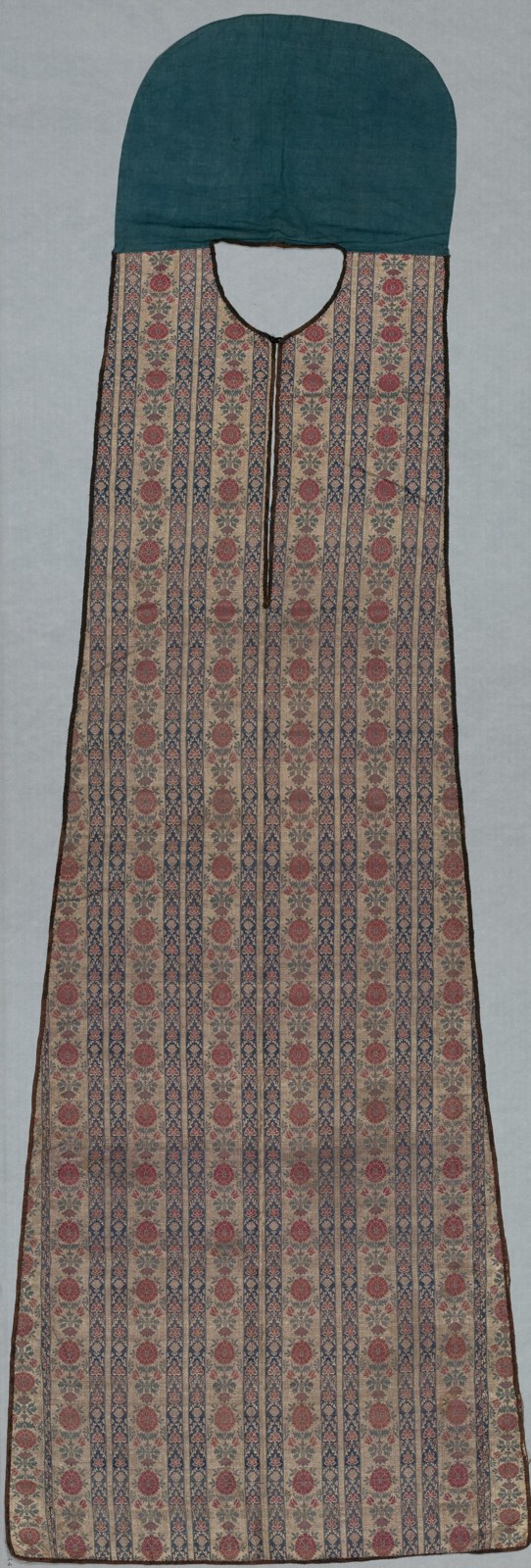
late 18th century · CP-LIB-MET-458906 · consulted 2026-10-12 · The Metropolitan Museum of Art · CC0 (museum open access; resized JPEG) · Photo source ↗
An occupational object with a specific catalogue identity
The Met identifies accession 2013.1144 as a barber’s apron from Iran, dating to the late eighteenth century. Its medium is silk and metal-thread in a weft-faced compound plain weave. Keep both the function and the technical wording tied to the catalogue. It is not a termeh tablecloth or an embroidery sampler simply because its patterned panel looks decorative.
Occupational textiles can combine practical format and elaborate ornament. That observation does not establish who wore this particular apron, where the barber worked or which ceremony it served. Such social details need object-specific documentation. The catalogue title gives a starting point for investigation, not permission to invent a biography for an anonymous owner.
Read the silhouette as well as the patterned panel
The photographed apron has a long patterned lower section and a rounded upper area with an opening. These features distinguish the complete object from an isolated repeat of its textile design. Record the silhouette, opening, transitions and edges before discussing flower patterns. A close crop of the woven panel would lose evidence of assembly and function.
Floral units repeat in vertical bands. Describe their spacing and relationship to the long format without assigning a workshop from the arrangement. A clothing object may combine separately made cloth and later finishing. The whole-object photograph cannot resolve all seams or prove that every section is contemporary with the patterned panel.
- Retain a whole-object view that includes the upper section.
- Describe pattern direction in relation to the apron’s long format.
- Separate garment assembly from the making of its cloth.
What the weave description actually supports
“Weft-faced compound plain weave” is a structural description: the visible pattern and cloth are organised through a compound weaving system in which wefts dominate the face. It is more precise than calling the textile simply brocade. Reproduce the museum wording before introducing broader trade terms, whose meanings can vary.
Metal-thread is not equivalent to solid gold thread. The catalogue’s material wording does not identify the composition of every metallic component or its core. Nor can shine in a photograph provide that analysis. Embroidery, applied braid and woven metal-thread require different process descriptions even when all produce a reflective surface.
Documenting material vulnerability
Silk, metallic components, joins and any lining can respond differently to handling and environmental change. Record snagging, loose ends, wear and discoloration by location without calling every dark area corrosion or every pale area fading. An online image is not sufficient to plan a treatment.
Do not wash, polish metallic yarns or press an old apron with a household iron. Pressure can flatten relief, moisture can affect materials and cleaning can remove evidence. A supported storage arrangement that avoids sharp folds is generally a better starting point, with object-specific advice from a textile conservator. Historical use as clothing is not a reason to wear a fragile surviving object.
Comparing ceremonial and occupational textiles
A useful comparison sets format, fibre, weave, assembly and documented function side by side. A barber’s apron, a ceremonial cover and a bolt of cloth may share floral ornament while remaining different objects. Avoid letting a present-day retail label overwrite the museum’s specific title.
When buying contemporary handmade Iranian work, ask who wove the cloth and who assembled the object; they may be different people. Record those answers without implying that a divided workflow is less authentic. A named Iranian maker, explicit hand process and actual manufacture location matter more than a resemblance to this historical apron.
- Collection
- The Metropolitan Museum of Art
- Accession
- 2013.1144
- Catalogue date
- late 18th century
- Origin as catalogued
- Iran
Keep the evidence layers separate
A useful research record distinguishes direct observation, the institution’s catalogue statements and your own interpretation. None of these should silently replace the others. Record the source and access date before comparing a historical object with a current listing.
- Observe: shape, layout and visible features.
- Attribute: retain the catalogue’s exact qualifications.
- Investigate: seek additional views, condition information and lawful provenance.
| Evidence | Documented statement | What it does not establish |
|---|---|---|
| Identity | Barber's Apron · 2013.1144 | Identity or authenticity of another object |
| Date | late 18th century | An independent date for a similar listing |
| Material | Silk, metal-thread; weft-faced compound plain weave | A complete technical analysis from the photograph |
| Origin | Iran | Provenance of contemporary goods with similar ornament |
| Photo licence | CC0 (museum open access; resized JPEG) | Rights to unrelated auction or shop photographs |
References and further reading
- [1] The Metropolitan Museum of Art: Barber's Apron, 2013.1144 ↗Primary catalogue source; consulted 12 October 2026. Qualifiers and collection updates take precedence over this editorial reading.
- [2] Canadian Conservation Institute: Caring for cultural heritage ↗Preventive conservation context, not a treatment prescription.
These sources provide context, not authentication or provenance for an individual object. Editorial interpretations remain under review.