
Collector guide · 3 min read
Reading Sari ware: a bird bowl, polychrome slip and Amul attribution
CraftPersia editorial draft · specialist review pending · updated 2026-10-14
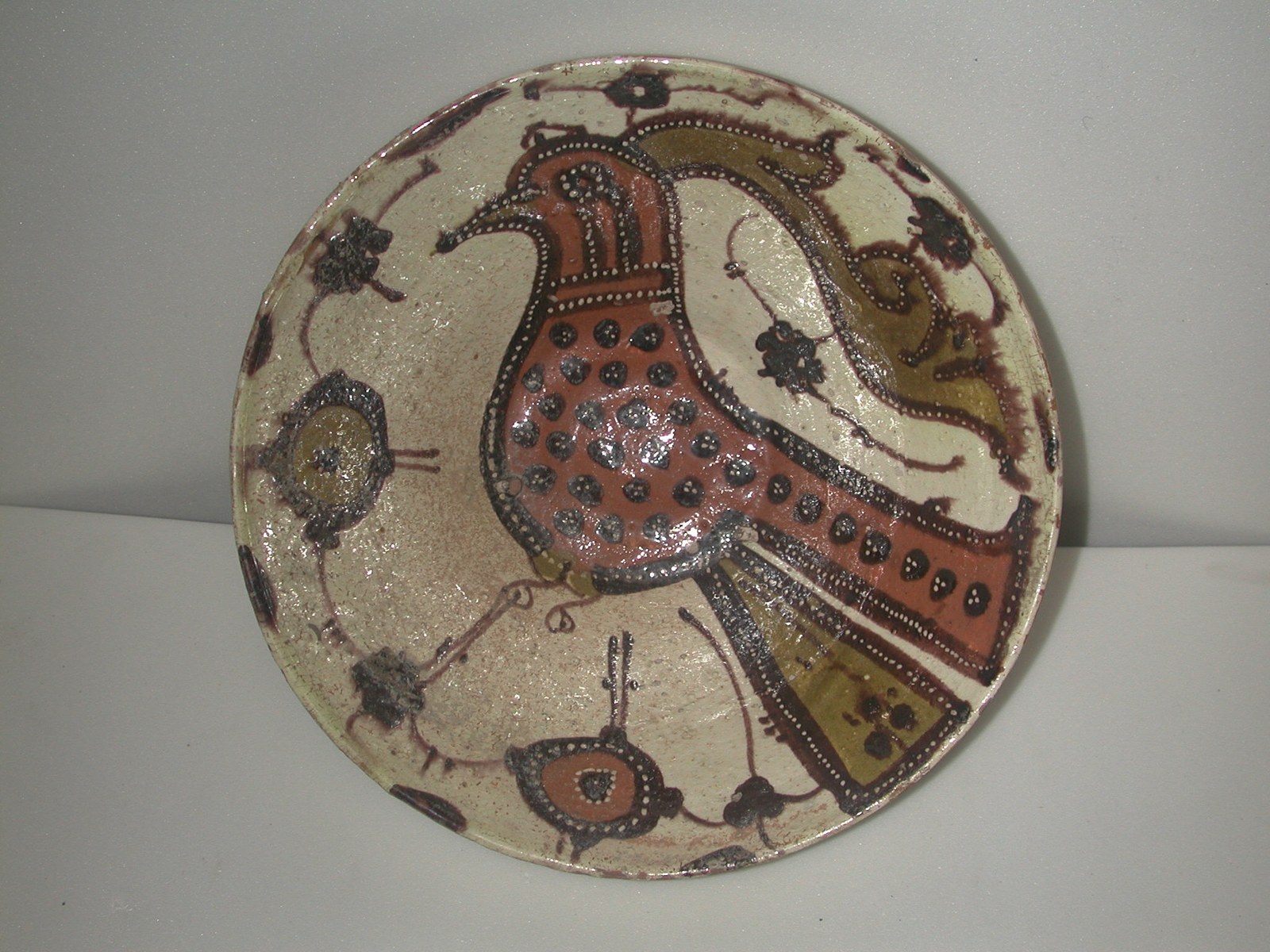
10th century · CP-LIB-MET-451477 · consulted 2026-10-14 · The Metropolitan Museum of Art · CC0 (museum open access; resized JPEG) · Photo source ↗
Sari ware does not erase the Amul field
The Met records Bowl with Bird and Flowers, accession 58.91, as Iranian and tenth-century. Its city field says Amul, while the medium identifies the ceramic category as Sari ware. Preserve these distinct labels. A ware name can organise a comparative group without functioning as the exact manufacture location of every example; silently replacing Amul with Sari confuses classification and locality.
The source medium describes earthenware, white slip and polychrome slip decoration under transparent glaze. These are more useful distinctions than simply calling the object Persian pottery. Keep the date and place statements tied to the museum record, and use specific scholarship before expanding them into a history of a particular workshop or regional community.
A large bird within a circular field
The image shows a large stylised bird surrounded by smaller floral forms. Read contour, direction, proportions and the spacing of surrounding ornament before identifying a species or symbolic message. The title provides the broad categories bird and flowers; it does not establish a nightingale, peacock or a specific literary narrative.
The curved bowl wall affects the apparent size and spacing of motifs. An interior view gives strong evidence of layout but weak evidence of exterior decoration, foot profile and depth. Compare additional views where available. Avoid assigning an artist’s identity or level of training from freely drawn forms; visual character is not an account of the anonymous maker’s biography.
- Record the main bird and surrounding fill separately.
- Treat species and symbolism as questions requiring sources.
- Compare interior layout with a documented profile view.
White slip, coloured slips and transparent glaze
A slip is a clay suspension, while glaze forms a vitreous coating in firing. Here the catalogue states that polychrome slip decoration appears over a white slip ground and beneath transparent glaze. That wording helps distinguish the bowl from ceramics painted on an opaque white glaze. Similar pale grounds can arise from different materials.
The photograph cannot establish the mineral ingredients of the slips or the exact firing programme. A colour name is not a chemical formula. Keep body, ground, decoration and coating as separate layers in a research record, while acknowledging that detailed process evidence requires analysis or a technical publication. Do not infer a modern recipe from a medieval palette.
Surface interruptions and restoration
Lines and colour changes visible in a published photograph are observations, not complete diagnoses. Some may relate to fractures, joins, wear, restoration or reflected light. Without a treatment report it is not possible to quantify original surface, identify every fill or establish how much of the image was reconstructed.
Ask for a dated condition assessment and full-view photographs rather than relying on a decorative crop. Existing chips should not be scraped to investigate layers, and a historical ceramic should not be washed or used for food without appropriate advice. Conservators can document instability, joins and coatings with methods that are unsuitable for casual home testing.
A disciplined comparison with other bird bowls
Compare this object with accession 51.183 in the library: both show birds, but their dates, locality statements and medium wording differ. This is a useful evidence table, not a competition between styles. A shared subject does not mean a shared workshop, glaze system or historical function. Preserve uncertainty such as “possibly Gurgan” in the other record.
For a commercial bowl, require its own provenance, condition, production method and actual-item photographs. A Sari-ware comparison does not prove that a current listing is Iranian, handmade or medieval. Contemporary work should have a named Iranian maker or documented Iranian production. Historical pieces additionally require lawful collecting documentation; neither resemblance nor price substitutes for it.
- Collection
- The Metropolitan Museum of Art
- Accession
- 58.91
- Catalogue date
- 10th century
- Origin as catalogued
- Iran
Keep the evidence layers separate
A useful research record distinguishes direct observation, the institution’s catalogue statements and your own interpretation. None of these should silently replace the others. Record the source and access date before comparing a historical object with a current listing.
- Observe: shape, layout and visible features.
- Attribute: retain the catalogue’s exact qualifications.
- Investigate: seek additional views, condition information and lawful provenance.
| Evidence | Documented statement | What it does not establish |
|---|---|---|
| Identity | Bowl with Bird and Flowers · 58.91 | Identity or authenticity of another object |
| Date | 10th century | An independent date for a similar listing |
| Material | Earthenware; white slip with polychrome slip decoration under transparent glaze (Sari ware) | A complete technical analysis from the photograph |
| Origin | Iran | Provenance of contemporary goods with similar ornament |
| Photo licence | CC0 (museum open access; resized JPEG) | Rights to unrelated auction or shop photographs |
References and further reading
- [1] The Metropolitan Museum of Art: Bowl with Bird and Flowers, 58.91 ↗Primary catalogue source; consulted 2026-10-14. Qualifiers and collection updates take precedence over this editorial reading.
- [2] Canadian Conservation Institute: Caring for cultural heritage ↗Preventive conservation context, not a treatment prescription.
These sources provide context, not authentication or provenance for an individual object. Editorial interpretations remain under review.