
Collector guide · 3 min read
Reading an Iranian bird bowl: glaze layers and qualified Gurgan attribution
CraftPersia editorial draft · specialist review pending · updated 2026-10-12
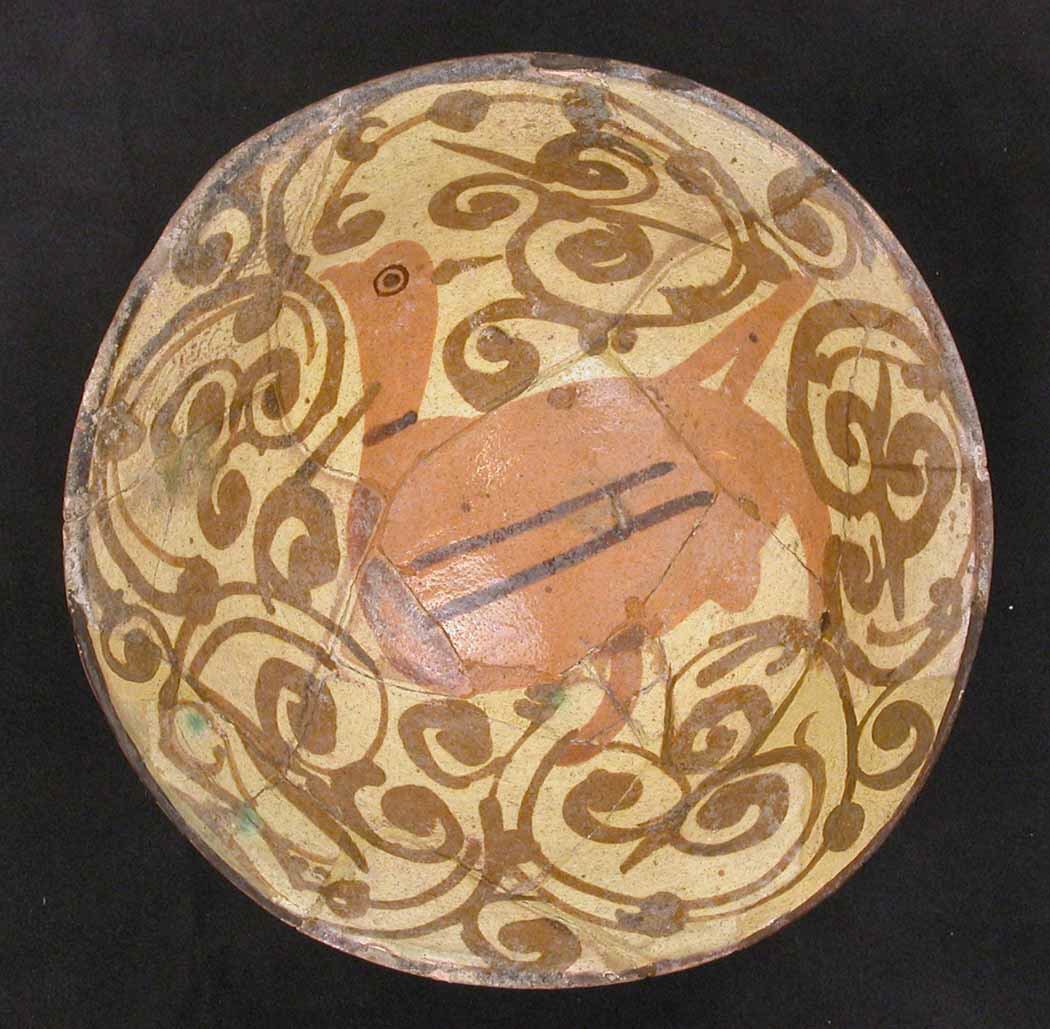
10th–11th century · CP-LIB-MET-451061 · consulted 2026-10-12 · The Metropolitan Museum of Art · CC0 (museum open access; resized JPEG) · Photo source ↗
Why “possibly Gurgan” must remain qualified
The Met records this bowl as Iranian, dating to the tenth–eleventh century, with “possibly Gurgan” in its locality field. That qualification is part of the evidence. A short caption that drops “possibly” turns a museum attribution into an unsupported certainty. Accession 51.183 identifies the particular object; neither the bird nor the palette independently assigns a workshop.
Geographical names in ceramic catalogues can refer to production hypotheses, findspots or broad comparative groups. Read the exact field and accompanying scholarship before equating them. Gurgan is not a universal label for any bird bowl with brown scrolls. A documented place attribution needs to remain connected to the source that makes it and the date at which that source was consulted.
Bird, scrolls and the circular field
A large bird occupies the centre of the photographed interior while surrounding scrolls fill the circular field. Describe the relative scale of the bird, its direction, the shape of its body and the spacing of the surrounding ornament. This produces a useful visual record without asserting that the bird is a particular species, dynasty or symbolic message.
The curved wall alters the apparent spacing of motifs. A straight-on image privileges the interior and hides profile, exterior and foot. A convincing object description therefore combines front and side views rather than treating the photograph as the entire vessel. Colour balance and reflected light also affect how the pinkish central body and darker lines appear.
- Read the central figure before the surrounding fill.
- Keep species identification separate from a general bird description.
- Ask for exterior and foot views before discussing construction.
Opaque white glaze and a transparent covering
The catalogue describes earthenware painted on opaque white glaze under transparent colourless glaze. This wording should be reproduced accurately when comparing surface systems. It differs from decoration applied over a yellow slip. Both can provide a light ground, but a similar visual effect does not mean identical materials or processing.
A photograph cannot independently reconstruct the firing sequence or determine whether a colourant penetrated a particular layer. Such conclusions need technical investigation, not a confident narrative based on colour alone. Keep the museum’s medium statement as a sourced description and any workshop explanation as a separately cited account. This prevents a historical object from being misused as evidence for an unrelated contemporary kiln practice.
Restoration can change what a pattern seems to say
Visible lines cross the photographed field. Record where they occur without guessing whether they are fractures, old joins or treatment boundaries. Restored passages can reconnect ornament and make a composition easier to read, while also creating uncertainty about which details are original. The published image is not sufficient to measure the amount of restoration.
A prospective buyer should request a condition report that identifies fills, repainting, consolidants and repaired breaks where known. An absence of such information is an evidence gap, not proof of pristine condition. Ultraviolet photographs may assist a conservator but are not a universal authentication test. Never subject a borrowed or owned bowl to improvised chemical or mechanical tests.
Comparing auction descriptions responsibly
When an auction description uses “Gurgan type,” compare the wording to this qualified museum record rather than upgrading it to a secure origin. Note whether the sale gives an accession-like inventory number, dimensions, ownership history and bibliographic comparison. A decorative resemblance to accession 51.183 is only one observation among these different kinds of evidence.
Keep estimate, hammer price and total purchase cost separate; a museum object has no current retail price here. Auction availability and rights can change. Saving a source link and the consultation date protects the research record, but it does not grant reuse permission for an auction photograph. Contemporary handmade Iranian bowls need their own maker documentation, not an inherited medieval attribution.
- Collection
- The Metropolitan Museum of Art
- Accession
- 51.183
- Catalogue date
- 10th–11th century
- Origin as catalogued
- Iran
Keep the evidence layers separate
A useful research record distinguishes direct observation, the institution’s catalogue statements and your own interpretation. None of these should silently replace the others. Record the source and access date before comparing a historical object with a current listing.
- Observe: shape, layout and visible features.
- Attribute: retain the catalogue’s exact qualifications.
- Investigate: seek additional views, condition information and lawful provenance.
| Evidence | Documented statement | What it does not establish |
|---|---|---|
| Identity | Bowl · 51.183 | Identity or authenticity of another object |
| Date | 10th–11th century | An independent date for a similar listing |
| Material | Earthenware; painted on opaque white glaze under transparent colorless glaze | A complete technical analysis from the photograph |
| Origin | Iran | Provenance of contemporary goods with similar ornament |
| Photo licence | CC0 (museum open access; resized JPEG) | Rights to unrelated auction or shop photographs |
References and further reading
- [1] The Metropolitan Museum of Art: Bowl, 51.183 ↗Primary catalogue source; consulted 12 October 2026. Qualifiers and collection updates take precedence over this editorial reading.
- [2] Canadian Conservation Institute: Caring for cultural heritage ↗Preventive conservation context, not a treatment prescription.
These sources provide context, not authentication or provenance for an individual object. Editorial interpretations remain under review.