
Collector guide · 2 min read
Reading an Ilkhanid Sultanabad dish: deer, phoenixes and borrowed motifs
CraftPersia editorial draft · specialist review pending · updated 2026-10-14
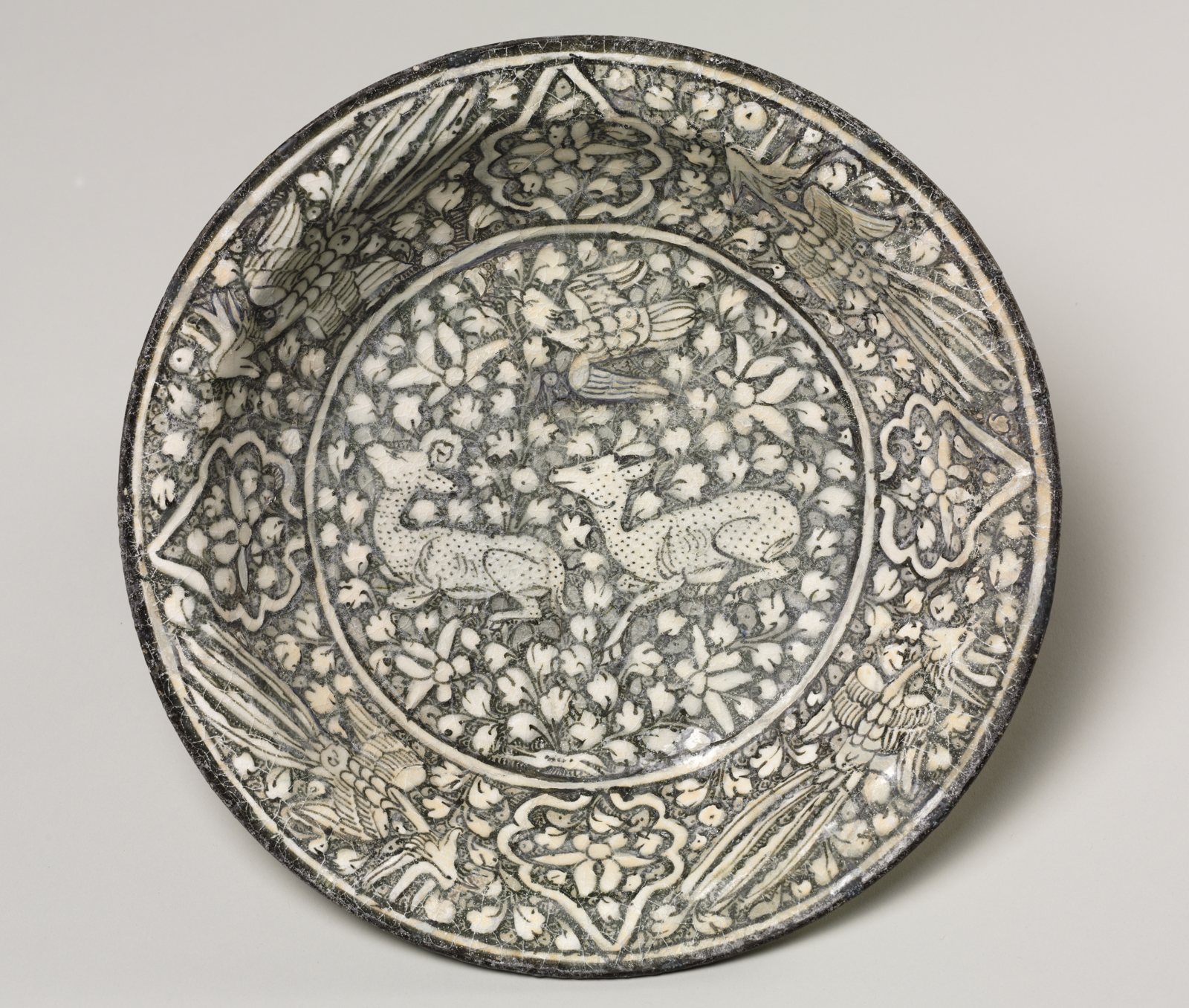
1300–1350 · CP-LIB-CMA-1924-742 · consulted 2026-10-14 · Cleveland Museum of Art · CC0 (museum open access; resized JPEG) · Photo source ↗
Deer, phoenix and lotus in a dated range
Cleveland records this dish as Iran, probably Sultanabad, Ilkhanid period, 1300–1350, fritware with underglaze-painted design, Sultanabad ware, 32.6 cm in diameter. The museum notes that the flying phoenix on the rim derived from China, most likely transmitted on prestigious silk textiles. “Most likely” is the museum’s qualification and should be preserved.
Compare this record with the Bowl with Flying Birds (1915.589): both are Sultanabad ware, but one is “probably Kashan” and the other “probably Sultanabad”. Attributions in the same ware group can differ, so do not harmonise them.
Reading the composition
Two recumbent deer occupy the central medallion, with a bird above, set among dense floral ground. The cavetto carries phoenixes and floral fields, and a dark rim frames the whole. Read centre, wall and rim as separate zones and note whether motifs repeat around the circumference.
Only the interior is visible. The exterior, base and foot ring hold evidence about manufacture and condition and should be examined in additional views before any comparative claim is made.
- Centre: paired deer.
- Wall: phoenixes and flowers.
- Rim: dark band — check for chips.
A large dish and its risks
Large fritware dishes are prone to stress cracks and to repairs that may be extensively overpainted. Specks, spots and glaze dulling in a photograph can be wear, firing or restoration. Ask for an ultraviolet condition report when comparing a market example.
Display on a padded stand that supports the rim evenly; avoid wire hangers that grip the edge.
Collecting research and the limits of a comparison
Accession 1924.742 is a comparative reference, not a certificate that can be borrowed by another object. For any candidate offered for sale, request its own dimensions, all-round photographs including the base or reverse, a dated condition report and a traceable ownership and export history. Visual similarity to a museum piece establishes neither date nor origin, and attractive objects are the most frequently copied.
Keep lawful provenance separate from stylistic attribution; an auction estimate or a confident description resolves neither. For contemporary handmade Iranian work, look instead for a named maker and real production information rather than a historical comparison. The museum photograph is released CC0 through the Cleveland open-access programme; that status does not extend to photographs of other objects or to a seller’s images.
- Ask for the object’s own measurements and views.
- Request documented ownership and export history.
- Treat the museum record as comparison only.
- Collection
- Cleveland Museum of Art
- Accession
- 1924.742
- Catalogue date
- 1300–1350
- Origin as catalogued
- Iran
Keep the evidence layers separate
A useful research record distinguishes direct observation, the institution’s catalogue statements and your own interpretation. None of these should silently replace the others. Record the source and access date before comparing a historical object with a current listing.
- Observe: shape, layout and visible features.
- Attribute: retain the catalogue’s exact qualifications.
- Investigate: seek additional views, condition information and lawful provenance.
| Evidence | Documented statement | What it does not establish |
|---|---|---|
| Identity | Ceramic dish with deer, phoenix, and lotus blossoms · 1924.742 | Identity or authenticity of another object |
| Date | 1300–1350 | An independent date for a similar listing |
| Material | Fritware with underglaze-painted design, Sultanabad ware | A complete technical analysis from the photograph |
| Origin | Iran | Provenance of contemporary goods with similar ornament |
| Photo licence | CC0 (museum open access; resized JPEG) | Rights to unrelated auction or shop photographs |
References and further reading
- [1] Cleveland Museum of Art: Ceramic dish with deer, phoenix, and lotus blossoms, 1924.742 ↗Primary catalogue source; consulted 2026-10-14. Qualifiers and collection updates take precedence over this editorial reading.
- [2] Canadian Conservation Institute: Caring for cultural heritage ↗Preventive conservation context, not a treatment prescription.
These sources provide context, not authentication or provenance for an individual object. Editorial interpretations remain under review.