
راهنمای مجموعهداران · 3 min read
Reading a fragmentary Nishapur bowl: radial ornament and missing evidence
CraftPersia editorial draft · specialist review pending · بهروزرسانی 2026-10-14
این راهنما هنوز به فارسی ترجمه نشده است و فعلاً به انگلیسی نمایش داده میشود.
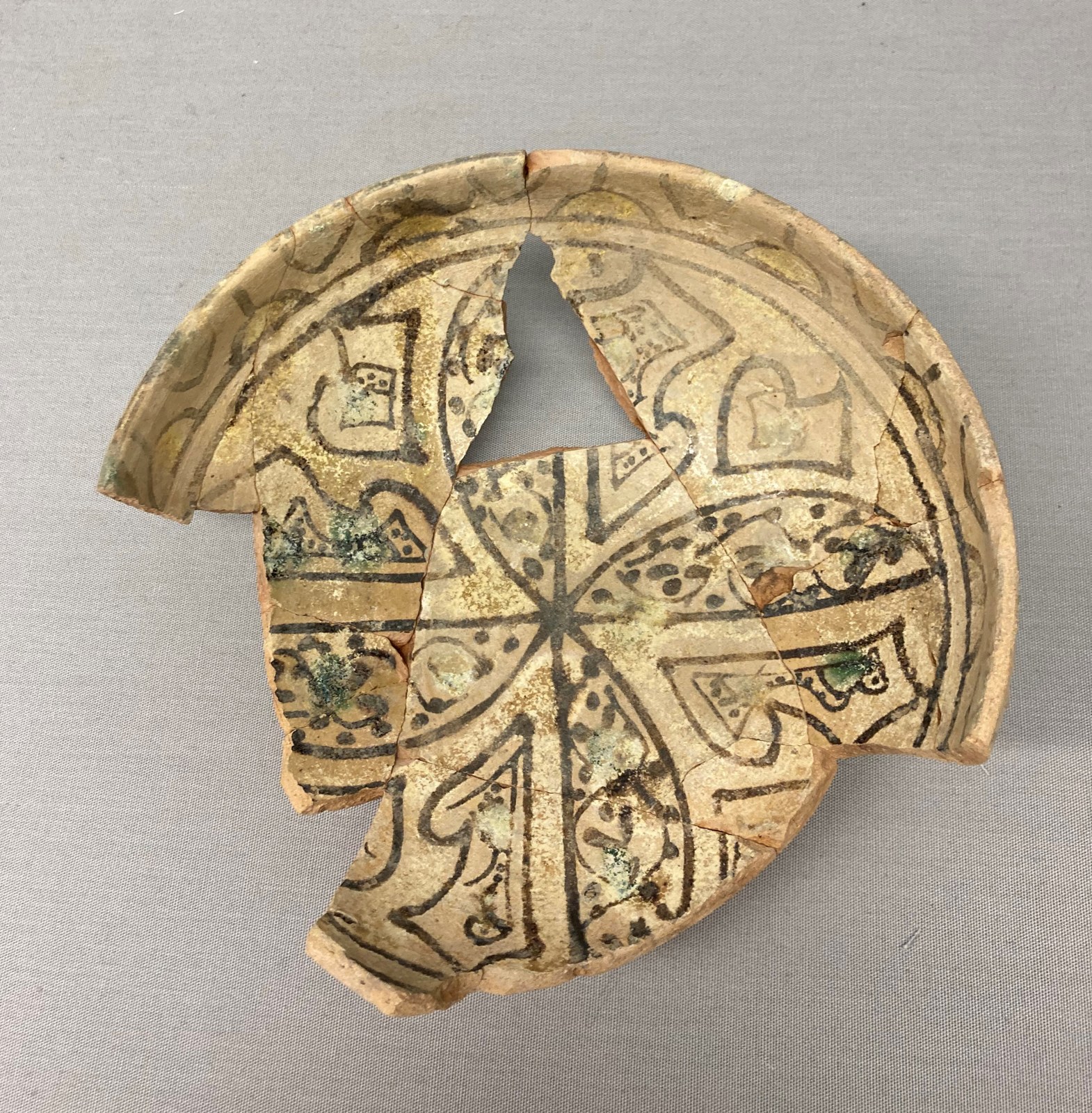
9th–10th century · CP-LIB-MET-449718 · consulted 2026-10-14 · The Metropolitan Museum of Art · CC0 (museum open access; resized JPEG) · منبع عکس ↗
A fragmentary bowl with a precise source record
The Metropolitan Museum of Art records accession 40.170.22 as a bowl from Iran, Nishapur, dating to the ninth–tenth century. The medium states earthenware with decoration in black and touches of yellow and green. The neutral museum title matters: adding a precise inscription or ware classification without supporting scholarship would alter the record.
The downloaded overhead view visibly preserves only part of the circular form. This is a useful study of fragmentary evidence rather than a defective substitute for a complete bowl. Keep the missing areas visible. A drawing that reconstructs a full rim or completed design must mark proposed portions separately from surviving material; a photographic gap cannot be filled by confidently written description.
Radial layout and letter-like forms
Dark lines divide the interior into radiating areas around a central arrangement. Describe the number and orientation of surviving divisions and where ornament meets a fracture or missing sector. Curved walls and an overhead camera view compress the three-dimensional form into a surface image. The shape of a full profile and the depth of the bowl remain separate questions.
Some ornament can appear letter-like. A securely readable inscription would require a qualified transcription tied to the actual surviving strokes. Do not adopt a generic blessing from another Nishapur bowl or label every angular form Kufic. The distinction between observation, a proposed reading and a sourced transcription is especially important when fragments interrupt the sequence.
- Describe surviving lines before naming script.
- Mark missing sectors in any reconstruction.
- Do not transfer an inscription from a similar bowl.
Preserve the catalogue medium without expanding it
The medium field identifies earthenware and coloured decoration but does not provide a complete body recipe or a detailed firing sequence. Black, yellow and green are appearance descriptions, not independent chemical identifications. A technical study may explain ingredients or layers; that evidence needs its own citation rather than being presumed from a familiar palette.
Compare this record with the library’s bowl explicitly described as yellow slip under transparent glaze. Similar colours do not justify giving both the same layer sequence. A photograph of worn or restored areas can mislead material reading, and exposed edges should never be enlarged to inspect a body. Existing high-resolution views and conservation documentation are safer sources of information.
Fragments, joins and condition coverage
Visible breaks delimit surviving evidence. They do not tell a viewer when or why the bowl broke. A fragment can have later joins, fills or coatings, and an overhead view may conceal support or restoration on the reverse. Record visible losses by location and consult a treatment record before describing the object as unrestored.
For a private ceramic, ask for exterior, base and oblique views alongside annotated condition photographs. Fracture lines, glaze losses and repainting need separate descriptions. Do not tap, wet or scratch an object as a test. An old bowl’s original practical function does not establish modern food safety, especially when glaze composition and repairs are unknown.
Learning from incomplete objects
Fragments are valuable because they make the limits of evidence explicit. A full catalogue can compare shape, material and ornament while retaining uncertainty about lost passages. The aim is not to manufacture completeness, but to ask which features survive and which claims require additional documentation. This approach is useful for museum study and for reading incomplete auction descriptions.
A seller’s reference to “Nishapur” must be assessed against its own stated evidence and lawful provenance. Museum parallels do not establish ownership history or export legality. New Iranian hand-painted ceramics need maker documentation and should be dated as contemporary. The CC0 source image is a comparative illustration, not a photograph of stock offered for sale.
- Collection
- The Metropolitan Museum of Art
- Accession
- 40.170.22
- Catalogue date
- 9th–10th century
- Origin as catalogued
- Iran
Keep the evidence layers separate
A useful research record distinguishes direct observation, the institution’s catalogue statements and your own interpretation. None of these should silently replace the others. Record the source and access date before comparing a historical object with a current listing.
- Observe: shape, layout and visible features.
- Attribute: retain the catalogue’s exact qualifications.
- Investigate: seek additional views, condition information and lawful provenance.
| Evidence | Documented statement | What it does not establish |
|---|---|---|
| Identity | Bowl · 40.170.22 | Identity or authenticity of another object |
| Date | 9th–10th century | An independent date for a similar listing |
| Material | Earthenware; decoration in black with touches of yellow and green | A complete technical analysis from the photograph |
| Origin | Iran | Provenance of contemporary goods with similar ornament |
| Photo licence | CC0 (museum open access; resized JPEG) | Rights to unrelated auction or shop photographs |
منابع و مطالعات بیشتر
- [1] The Metropolitan Museum of Art: Bowl, 40.170.22 ↗Primary catalogue source; consulted 2026-10-14. Qualifiers and collection updates take precedence over this editorial reading.
- [2] Canadian Conservation Institute: Caring for cultural heritage ↗Preventive conservation context, not a treatment prescription.
این منابع زمینهٔ پژوهشی فراهم میکنند، نه تأیید اصالت یا پیشینهٔ یک شیء خاص. تفسیرهای سردبیری همچنان در دست بررسیاند.